25 Other Ways to Say “I Have a Question” (With Examples)
Knowing other ways to say I have a question can make your messages sound more polite, confident, and professional. The phrase itself is not rude, but it can feel abrupt, especially in emails, meetings, and classrooms.
This guide gives you polite openers for work, formal email options, and casual alternatives for friends and chats. You will also learn how to ask for clarification politely and how to choose the right opener for each situation.
What Does “I Have a Question” Mean?
“I have a question” is a simple way to signal that you need information, clarification, or help. It prepares the listener for what comes next and shows that you are about to ask something specific.
A question can be a request for information, an expression of doubt, or a way to check understanding. The Cambridge Dictionary defines it as a sentence or phrase used to find out information, and you can read the full entry for question.
In professional settings, the phrase is often softened. Instead of announcing a question, many people open with a polite request, such as “Could you help me understand…?” or “May I ask…?”
Is “I Have a Question” Professional or Polite?
Yes, “I have a question” is professional and polite in most situations. It is direct, clear, and easy to understand. It is not demanding or rude on its own.
However, context matters. In a formal email, it can sound a little blunt if it opens the message with no greeting or softening language. In a meeting, it can interrupt the flow if you do not signal timing, for example by saying “When you have a moment…”
The best approach is to match your opener to the setting. A short, polite phrase works well in chats, while a more formal opener works better in emails to senior colleagues or clients.
Quick Top Picks: All 39 Alternatives at a Glance
Here are all 39 alternatives in this guide, in the same order as the detailed sections below:
- Can I ask you something?
- May I ask a question?
- Do you mind if I ask something?
- Could you help me understand something?
- I was wondering something.
- I would like to ask something.
- Would it be OK to ask a question?
- Is now a good time for a quick question?
- Could you clarify something for me?
- Can you explain something to me?
- What do you mean by that?
- Could you walk me through this?
- I am not sure I follow — could you explain?
- Could you expand on that a little?
- Can you confirm something for me?
- Just to clarify, could you tell me more?
- What is your take on this?
- What would you recommend here?
- Could I get your opinion on something?
- Do you think this approach would work?
- What do you suggest I do next?
- How would you approach this?
- Would you advise doing it this way?
- What is the best way to handle this?
- Quick question — do you have a minute?
- Can I pick your brain for a second?
- Got a second for a question?
- I have been meaning to ask you something.
- Can I run something by you?
- Mind if I ask you something quick?
- I have a question about something.
- Just curious — could you tell me something?
- I wanted to ask about something.
- I am writing to ask about something.
- I would appreciate your guidance on something.
- I would be grateful if you could confirm something.
- I am reaching out because I have a question.
- Would you mind clarifying something for me?
- I have a question about the next steps.
Polite Openers for Meetings and Class
These openers are ideal when you want to ask something without interrupting or sounding demanding. They work well in meetings, lectures, and group discussions.
1. Can I ask you something?
Tone: Polite and everyday. Example: “Can I ask you something about the deadline for this project?”
2. May I ask a question?
Tone: Polite and slightly formal. Example: “May I ask a question about the new process?”
3. Do you mind if I ask something?
Tone: Considerate and soft. Example: “Do you mind if I ask something about the budget?”
4. Could you help me understand something?
Tone: Collaborative and respectful. Example: “Could you help me understand something about the report?”
5. I was wondering something.
Tone: Gentle and conversational. Example: “I was wondering something about the meeting time.”
6. I would like to ask something.
Tone: Polite and clear. Example: “I would like to ask something about the next steps.”
7. Would it be OK to ask a question?
Tone: Careful and respectful. Example: “Would it be OK to ask a question before we move on?”
8. Is now a good time for a quick question?
Tone: Considerate and time-aware. Example: “Is now a good time for a quick question about the presentation?”
Ways to Ask for Clarification
These alternatives are useful when you already heard the information but need it explained more clearly. They are some of the most useful ways to ask for clarification politely.
9. Could you clarify something for me?
Tone: Polite and direct. Example: “Could you clarify something for me about the delivery date?”
10. Can you explain something to me?
Tone: Simple and friendly. Example: “Can you explain something to me about how this system works?”
11. What do you mean by that?
Tone: Direct and curious. Example: “What do you mean by that when you say the project is on hold?”
12. Could you walk me through this?
Tone: Collaborative and practical. Example: “Could you walk me through this part of the process?”
13. I am not sure I follow — could you explain?
Tone: Honest and humble. Example: “I am not sure I follow — could you explain the last step again?”
14. Could you expand on that a little?
Tone: Interested and polite. Example: “Could you expand on that a little before we decide?”
15. Can you confirm something for me?
Tone: Clear and professional. Example: “Can you confirm something for me about the meeting location?”
16. Just to clarify, could you tell me more?
Tone: Careful and precise. Example: “Just to clarify, could you tell me more about the deadline?”
Ways to Ask for Advice or Opinions
Sometimes your question is not about facts, but about judgement. These openers invite advice without sounding uncertain or pushy.
17. What is your take on this?
Tone: Casual and collaborative. Example: “What is your take on this new marketing idea?”
18. What would you recommend here?
Tone: Respectful and open. Example: “What would you recommend here for the launch plan?”
19. Could I get your opinion on something?
Tone: Polite and thoughtful. Example: “Could I get your opinion on something before I send this email?”
20. Do you think this approach would work?
Tone: Practical and curious. Example: “Do you think this approach would work for our team?”
21. What do you suggest I do next?
Tone: Direct and action-focused. Example: “What do you suggest I do next after the client replies?”
22. How would you approach this?
Tone: Open and respectful. Example: “How would you approach this problem if you were in my position?”
23. Would you advise doing it this way?
Tone: Formal and careful. Example: “Would you advise doing it this way, or is there a better option?”
24. What is the best way to handle this?
Tone: Practical and solution-focused. Example: “What is the best way to handle this delay with the client?”
Casual and Friendly Ways to Ask a Question
For chats, friends, and informal colleagues, a lighter opener often works better. These options sound natural without sounding rude.
25. Quick question — do you have a minute?
Tone: Friendly and brief. Example: “Quick question — do you have a minute to check this file?”
26. Can I pick your brain for a second?
Tone: Casual and warm. Example: “Can I pick your brain for a second about this idea?”
27. Got a second for a question?
Tone: Very informal and chatty. Example: “Got a second for a question about tomorrow’s meeting?”
28. I have been meaning to ask you something.
Tone: Friendly and personal. Example: “I have been meaning to ask you something about your trip.”
29. Can I run something by you?
Tone: Collaborative and informal. Example: “Can I run something by you before I share it with the team?”
30. Mind if I ask you something quick?
Tone: Relaxed and polite. Example: “Mind if I ask you something quick about the schedule?”
31. I have a question about something.
Tone: Simple and informal. Example: “I have a question about something in the report.”
32. Just curious — could you tell me something?
Tone: Light and curious. Example: “Just curious — could you tell me something about how this works?”
Formal Email Openers for Questions
When you need a formal way to say I have a question, these openers work well in professional emails. They sound respectful and give the reader context before the question itself.
33. I wanted to ask about something.
Tone: Formal and measured. Example: “I wanted to ask about something regarding the contract terms.”
34. I am writing to ask about something.
Tone: Formal and direct. Example: “I am writing to ask about something in the project brief.”
35. I would appreciate your guidance on something.
Tone: Respectful and formal. Example: “I would appreciate your guidance on something before the deadline.”
36. I would be grateful if you could confirm something.
Tone: Very polite and formal. Example: “I would be grateful if you could confirm something about the start date.”
37. I am reaching out because I have a question.
Tone: Professional and clear. Example: “I am reaching out because I have a question about the onboarding process.”
38. Would you mind clarifying something for me?
Tone: Polite and formal. Example: “Would you mind clarifying something for me about the requirements?”
39. I have a question about the next steps.
Tone: Clear and professional. Example: “I have a question about the next steps after the review.”
When writing professional emails, you may also need softer phrasing for requests. For example, these other ways to say I would like to can help you open a message without sounding demanding.
Example: One Question, Three Email Openers
Here is the same question — about a changed deadline — opened three different ways.
Soft opener: “Hi Sarah, I hope you are well. I was wondering if you could help me understand something about the new deadline. Has it moved to Friday, or is the original date still correct?”
Direct opener: “Hi Sarah, quick question about the deadline. Has it moved to Friday, or are we still working to the original date?”
Formal opener: “Dear Ms. Carter, I am writing to ask about the revised deadline for the project. Could you please confirm whether the new date is Friday? Thank you for your guidance.”
Each version asks the same thing, but the tone changes the impression. The soft version is warm, the direct version is efficient, and the formal version is respectful and structured.
Which One Should You Use? A Quick Guide
Choose your opener based on where and how you are asking.
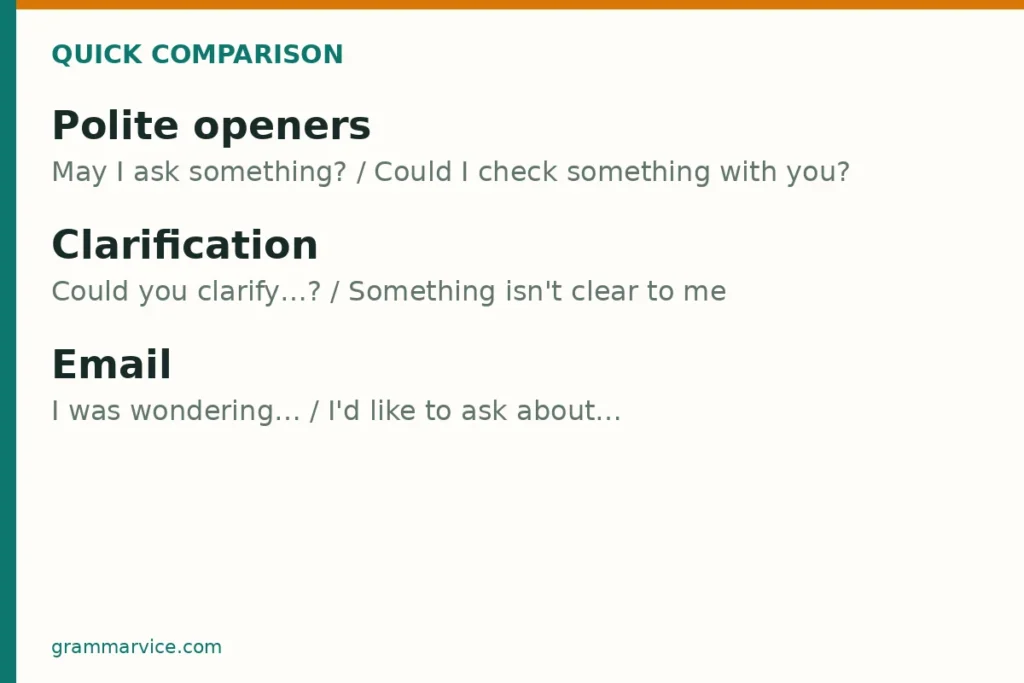
- Meeting: Use “May I ask a question?” or “Would it be OK to ask a question?” They respect the speaker and the agenda.
- Email: Use “I am writing to ask about something” or “I would appreciate your guidance on something.” They sound professional and give context.
- Classroom: Use “Could you help me understand something?” or “I am not sure I follow — could you explain?” They show engagement, not confusion.
- Chat: Use “Quick question — do you have a minute?” or “Can I run something by you?” They are short, friendly, and easy to answer.
Mistakes to Avoid
Even polite openers can fail if they sound demanding or vague.
- Starting with a demand: “Tell me…” or “Explain this now” can sound rude. Add a polite opener first.
- Being too vague: “I have a question” with no topic leaves the reader guessing. Add a short clue, such as “about the deadline.”
- Apologising too much: “Sorry, sorry, I know this is silly, but…” can undermine your confidence. One polite opener is enough.
- Asking at the wrong time: In a meeting, wait for a pause. In an email, put the question near the start so it is easy to find.
If you are learning how to say I have a question professionally, the openers above give you professional ways to say I have a question for every setting. Most of them are simply polite ways to ask a question: they show how to ask a question politely by adding a softener, a topic, or a time check instead of blurting out the question itself.
Timing matters too. An I have a quick question alternative such as “Quick question — do you have a minute?” works in chats, while how to say I have a question in an email usually means a greeting, a one-line context, and then the question. The can I ask you something alternatives in the first group double as openers for how to ask a question in a meeting. And if you need an I have a query alternative for British or formal contexts, treat any I have a question synonym from the formal group — “I would appreciate your guidance on something” — as the safest swap. When your question is really about looping someone into a thread, see our guide to other ways to say you’re adding someone to an email chain.
Frequently Asked Questions
Is it rude to say “I have a question”?
No, it is not rude. It is a clear and direct way to signal that you need information. It can sound abrupt in a formal email if it appears with no greeting, but adding a polite opener or a brief context usually solves that problem.
What is the most polite way to say “I have a question” at work?
The most polite way is “May I ask a question?” or “Could you help me understand something?” Both show respect for the other person’s time. They also sound professional in meetings, emails, and one-to-one conversations.
How do I say “I have a question” in a formal email?
In a formal email, try “I am writing to ask about something” or “I would appreciate your guidance on something.” Start with a greeting, state the topic briefly, and then ask the question clearly. End with a polite thank you.
What can I say instead of “I have a question” in a meeting?
In a meeting, try “Would it be OK to ask a question?” or “Is now a good time for a quick question?” These openers respect the speaker and the agenda. They also help you avoid interrupting at the wrong moment.
How can I ask for clarification politely?
To ask for clarification politely, try “Could you clarify something for me?” or “Just to clarify, could you tell me more?” Both are direct without sounding critical. They show that you want to understand, not that you think the explanation was poor.
How do I sound confident when asking a question?
Sound confident by asking directly and briefly. Avoid excessive apologies or filler words. For example, say “What is the best way to handle this?” rather than “Sorry, this might be a silly question, but what should I do?” A clear question sounds more confident than a long apology.
Conclusion
There are many other ways to say I have a question, from polite meeting openers to formal email phrases and casual chat options. The best choice depends on the setting, the person, and the type of question.
The next time you need to ask something, choose the opener that fits the moment. A short, polite question is easier to answer, easier to respect, and much more likely to get a clear reply.