30 Other Ways to Say “I Understand” (With Examples)
Quick Answer: If you’re looking for other ways to say “I understand,” try “I acknowledge your point,” “I see where you’re coming from,” “I hear what you’re saying,” or “I appreciate the context.” For professional emails, use clear expressions such as “I follow your reasoning.” To show empathy, acknowledge the person’s feelings instead of simply confirming that you understand.
Saying “I understand” is a simple way to acknowledge someone’s message, feelings, or perspective. However, repeating the same expression in every conversation can make your responses sound routine, distant, or even dismissive. Choosing more thoughtful wording helps you communicate genuine attention and build stronger professional and personal relationships.
Whether you’re responding to a colleague, acknowledging a client’s concern, comforting a friend, or replying to an important email, the right expression can make your message more meaningful. Sometimes, you need to confirm that you’ve received information. Other times, you want to show agreement, recognize someone’s feelings, or demonstrate that you’re ready to help.
Below are 35 unique alternatives, organized by purpose and communication setting. Each expression includes a tone and usage explanation, along with a natural example sentence to help you choose the right words.
What Does “I Understand” Mean?
“I understand” is an expression used to communicate that you comprehend someone’s words, recognize their situation, or appreciate their point of view. It can also show that you’re listening and acknowledging what another person has shared.
The phrase can communicate several different meanings depending on the context:
- Comprehension: You understand the information or explanation someone has provided.
- Acknowledgment: You recognize what another person has said and show that you’ve received their message.
- Empathy: You recognize someone’s emotions or difficulties and want them to feel heard.
- Agreement: You recognize someone’s reasoning and may share their opinion or position.
- Acceptance: You acknowledge a decision, instruction, or situation, even if you don’t necessarily agree with it.
For example, if a manager explains a new deadline, saying “I understand” confirms that you’ve received the information. However, if a friend describes a difficult experience, the same words may be intended to communicate emotional support.
These meanings are related, but they are not interchangeable in every situation. That’s why choosing an appropriate I understand synonym requires considering what you actually want to communicate.
For a broader look at the word’s meaning and vocabulary, you can explore Merriam-Webster’s thesaurus entry for understand.
Is “I Understand” Professional or Polite?
Yes, “I understand” is generally professional and polite. It is commonly used in workplace emails, meetings, customer-service conversations, and everyday business communication.
For example:
“I understand the revised timeline and will adjust my schedule accordingly.”
This response is clear, respectful, and appropriate for a professional setting.
However, the expression can sometimes sound impersonal when someone is sharing a personal concern or emotional difficulty. A short response such as “I understand” may suggest that you want to end the conversation rather than acknowledge the person’s feelings.
Compare these examples:
Basic response: “I understand your frustration about the delayed payment.”
More empathetic response: “I can see why the delayed payment would be frustrating, especially when you were counting on receiving it this week.”
The second response demonstrates that you’ve considered the person’s actual circumstances rather than simply acknowledging their statement.
When deciding how to say I understand professionally, remember that your goal should be to communicate attention, respect, and clarity. You don’t need complicated vocabulary to sound professional. A specific and thoughtful response is usually more effective than a generic acknowledgment.
Quick Top Picks: The 8 Best Alternatives at a Glance
Here are eight particularly useful alternatives for different situations. These are versatile choices that work well in professional correspondence, personal conversations, and supportive responses.
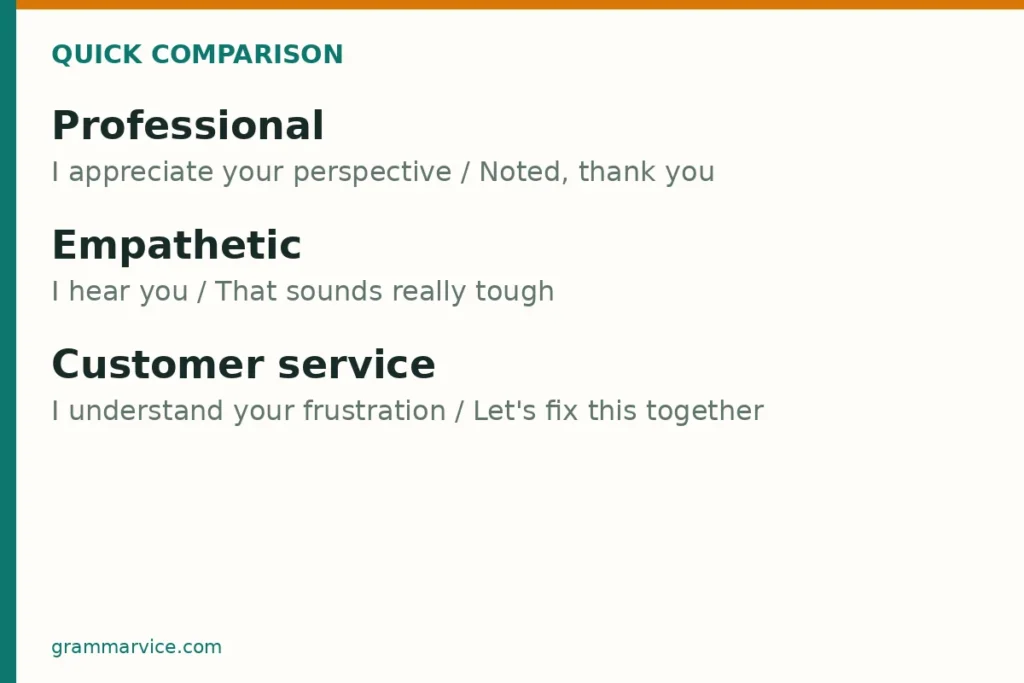
- I acknowledge your point. Best for formal discussions and professional emails.
- I appreciate the context. Best when someone provides additional information or background.
- I follow your reasoning. Best for understanding an explanation or business decision.
- I hear what you’re saying. Best for showing that you’re listening attentively.
- I can see why that would be difficult. Best for expressing empathy.
- We’re on the same page. Best for confirming shared understanding and alignment.
- Got it. Best for quick, casual acknowledgments.
- Thank you for explaining the issue. Best for customer-service conversations.
The following guide covers all 35 alternatives, including these eight recommendations. The phrases are grouped by their primary purpose so you can find an expression that matches your intended tone.
Professional and Email-Safe Alternatives to “I Understand”
When communicating with clients, managers, coworkers, or business partners, your response should sound respectful and confident. Instead of repeating “I understand” in every email, choose wording that acknowledges the information and demonstrates that you’ve considered it.
These professional ways to say I understand are particularly useful for responding to instructions, discussing business decisions, confirming requirements, and acknowledging feedback.
1. I Acknowledge Your Point
Tone and usage: Formal, respectful, and objective. This expression is useful when someone presents an opinion, concern, or argument that you want to recognize professionally. It doesn’t necessarily mean you agree with their position.
Example: “I acknowledge your point regarding the revised budget and will consider it during the next planning meeting.”
2. I Appreciate the Context
Tone and usage: Professional and appreciative. Use this phrase when someone provides background information that helps you understand a situation or decision. It shows that you value the explanation rather than simply acknowledging receipt.
Example: “I appreciate the context you’ve provided regarding the client’s revised expectations.”
3. I Follow Your Reasoning
Tone and usage: Analytical and professional. This expression confirms that you understand the logic behind someone’s explanation or recommendation. It works particularly well during meetings, project discussions, and decision-making conversations.
Example: “I follow your reasoning for prioritizing the existing customers before expanding into new markets.”
4. Your Explanation Is Clear
Tone and usage: Direct and courteous. Use this expression when someone has explained a process, requirement, or instruction effectively. It confirms that their message was understandable without unnecessary repetition.
Example: “Your explanation is clear, and I now have everything I need to complete the assignment.”
5. I Have a Clear Understanding of the Requirements
Tone and usage: Formal and confident. This phrase is especially useful when confirming project expectations, deadlines, responsibilities, or instructions. It reassures the recipient that you know what is expected of you.
Example: “I have a clear understanding of the requirements and will submit the completed report by Thursday.”
6. I Recognize the Issue
Tone and usage: Professional and problem-focused. Use this expression when someone brings a difficulty, concern, or potential problem to your attention. It communicates awareness without prematurely promising a solution.
Example: “I recognize the issue with the current reporting process and will discuss possible improvements with the team.”
7. I See the Implications
Tone and usage: Thoughtful and analytical. This phrase demonstrates that you understand not only what someone has explained but also its possible consequences. It works well in strategic discussions and professional decision-making.
Example: “I see the implications of moving the launch date, particularly for the marketing schedule.”
8. That Is Clear to Me
Tone and usage: Neutral, concise, and professional. Use this expression when confirming that information or instructions are understandable. It is suitable for emails, meetings, and formal workplace conversations.
Example: “That is clear to me, and I’ll make sure the revised guidelines are followed.”
9. I’ve Taken That Into Account
Tone and usage: Considerate and businesslike. This phrase is useful when someone provides feedback, raises a concern, or suggests a change that you will consider while making a decision.
Example: “I’ve taken that into account while preparing the updated project proposal.”
Professional writing tip: If you’re looking for other ways to say I understand in an email, choose a phrase that reflects what the sender actually communicated. For example, use “I follow your reasoning” for an explanation and “I’ve taken that into account” when responding to feedback.
Empathetic Alternatives That Focus on Feelings
When someone shares a personal problem, disappointment, or difficult experience, a simple acknowledgment may not communicate enough support. In these situations, the best alternative focuses on the person’s emotions rather than your ability to understand their words.
If you’re wondering how to show empathy without saying I understand, try expressions that recognize someone’s experience, validate their feelings, or demonstrate that you’re available to listen.
10. I Hear What You’re Saying
Tone and usage: Attentive, gentle, and empathetic. This expression reassures someone that you’re listening and taking their concerns seriously. It is especially useful when a person needs to express frustration without immediately receiving advice.
Example: “I hear what you’re saying, and I understand why this situation has been weighing on you.”
11. I Can See Why That Would Be Difficult
Tone and usage: Compassionate and validating. Use this phrase when someone describes a challenging experience. It acknowledges the difficulty without assuming that you know exactly how the person feels.
Example: “I can see why that would be difficult, especially when you’re managing so many responsibilities at once.”
12. That Sounds Challenging
Tone and usage: Supportive and considerate. This expression recognizes that someone is dealing with a demanding or stressful situation. It works well when you want to show concern without making assumptions about their emotions.
Example: “That sounds challenging, and I hope you have the support you need to work through it.”
13. I Can Imagine How That Feels
Tone and usage: Warm and sympathetic. This phrase communicates an effort to understand another person’s emotional experience. It is suitable for personal conversations when you want to offer reassurance without claiming to have experienced exactly the same situation.
Example: “I can imagine how that feels after spending so much time preparing for the opportunity.”
14. I Recognize How Much This Affects You
Tone and usage: Sensitive and thoughtful. Use this expression when someone’s situation has a noticeable emotional or practical impact on their life. It communicates that you are not overlooking the seriousness of their experience.
Example: “I recognize how much this affects you, and I don’t want you to feel that your concerns are being ignored.”
15. Your Feelings Are Valid
Tone and usage: Reassuring and emotionally supportive. This phrase is useful when someone questions whether they have a reasonable reaction to a difficult experience. It acknowledges their emotions without judging them.
Example: “Your feelings are valid, and you don’t have to pretend that everything is fine.”
16. I Appreciate You Sharing This With Me
Tone and usage: Warm, respectful, and appreciative. Use this expression when someone trusts you with personal information or discusses something difficult. It acknowledges their openness and helps create a supportive conversation.
Example: “I appreciate you sharing this with me, and I’m glad you felt comfortable talking about it.”
17. I’m Listening
Tone and usage: Direct, gentle, and reassuring. This short expression tells someone that they have your attention and can continue speaking without being interrupted or judged.
Example: “Take your time. I’m listening, and you can tell me whatever is on your mind.”
18. I Won’t Pretend to Know Exactly How You Feel, but I’m Here
Tone and usage: Sincere and deeply considerate. This expression is particularly helpful when someone is experiencing grief, loss, or a personal difficulty that you haven’t experienced yourself. It avoids making assumptions while offering genuine support.
Example: “I won’t pretend to know exactly how you feel, but I’m here if you need someone to talk to.”
These phrases are especially helpful when searching for another way to say I understand how you feel. Rather than claiming complete knowledge of someone’s emotions, they demonstrate respect for that person’s individual experience.
Alternatives That Show Agreement and Solidarity
Sometimes, you want to communicate more than basic comprehension. You may want to show that you agree with someone’s reasoning, share their perspective, or support their decision.
These expressions are useful in professional discussions, collaborative projects, personal conversations, and situations where building a sense of shared understanding matters.
19. I See Your Point
Tone and usage: Respectful and open-minded. This phrase acknowledges someone’s argument or perspective. It can be used during disagreements because recognizing a point does not automatically mean accepting the entire argument.
Example: “I see your point about reducing expenses before approving additional investments.”
20. I Agree With Your Assessment
Tone and usage: Confident and professional. Use this expression when you genuinely share someone’s evaluation or conclusion. It is particularly appropriate for workplace decisions, performance reviews, and business discussions.
Example: “I agree with your assessment that the current marketing strategy needs some adjustments.”
21. We’re on the Same Page
Tone and usage: Collaborative and friendly. This expression communicates that two or more people share the same understanding of a situation, plan, or expectation. It is especially common in workplace communication.
Example: “It sounds like we’re on the same page regarding the project’s priorities and delivery schedule.”
22. I Share That View
Tone and usage: Formal and thoughtful. This phrase communicates that you hold a similar opinion or perspective. It works well in professional emails, discussions, and written responses where a slightly more polished tone is appropriate.
Example: “I share that view and believe the team would benefit from a more flexible approach.”
23. That Aligns With My Understanding
Tone and usage: Formal and precise. Use this expression when someone’s explanation matches the information or expectations you already have. It is useful for confirming project details and professional decisions.
Example: “That aligns with my understanding of the agreement we discussed last week.”
24. I Support That Approach
Tone and usage: Positive and collaborative. This phrase communicates active support for someone’s proposed method or plan. Unlike a simple acknowledgment, it indicates that you are comfortable moving forward with the suggested approach.
Example: “I support that approach because it gives the team more time to review the final results.”
25. I’m With You on This
Tone and usage: Friendly and supportive. Use this expression when you want someone to know that you share their position or stand behind their decision. It works in informal professional discussions and personal conversations.
Example: “I’m with you on this; we should make sure everyone has an opportunity to contribute.”
Casual and Friendly Alternatives to “I Understand”
When chatting with friends, relatives, or familiar coworkers, formal expressions can sound unnecessarily stiff. Casual alternatives help conversations flow naturally while still showing that you’re paying attention.
26. Got It
Tone and usage: Casual, brief, and direct. This expression is useful when acknowledging instructions, receiving information, or confirming a simple request. It is common in text messages and informal workplace chats.
Example: “Got it! I’ll pick up the documents before heading to the office.”
27. I Get You
Tone and usage: Informal and friendly. This phrase communicates that you understand someone’s point of view or situation. It works best with friends and people you know well rather than in formal business correspondence.
Example: “I get you; sometimes you just need a little time away from everything.”
28. I Know What You Mean
Tone and usage: Conversational and relatable. Use this expression when someone’s explanation or description is familiar to you. It can create a sense of connection, particularly when discussing everyday experiences.
Example: “I know what you mean; finding time to relax after a busy week isn’t always easy.”
29. That Clicks for Me
Tone and usage: Relaxed and conversational. This phrase indicates that an explanation has helped something become clear. It is particularly useful when someone explains a confusing idea or connects information in a helpful way.
Example: “That clicks for me now that you’ve explained how the two processes work together.”
30. I’m Following
Tone and usage: Friendly and attentive. Use this phrase when someone is explaining a sequence of events, sharing a story, or walking you through a process. It confirms that you can follow the explanation so far.
Example: “I’m following; what happened after you spoke with the manager?”
Alternatives for Customer Service
In customer service, acknowledging a customer’s concern is an important part of providing a helpful response. However, simply saying “I understand” may not be enough when someone is reporting a problem, requesting a refund, or expressing frustration.
Effective I understand alternatives for customer service should demonstrate active listening, recognize the customer’s experience, and establish what will happen next.
31. I Recognize the Inconvenience This Has Caused
Tone and usage: Professional and empathetic. This expression acknowledges the practical difficulties a customer has experienced. It is appropriate for delivery delays, billing problems, service interruptions, and other customer complaints.
Example: “I recognize the inconvenience this has caused and appreciate your patience while we investigate the issue.”
32. Thank You for Explaining the Issue
Tone and usage: Courteous and attentive. Use this phrase when a customer provides details about a problem. It acknowledges their effort and creates a natural transition into the next steps of the support process.
Example: “Thank you for explaining the issue; I’ll review the transaction details and check what happened.”
33. I Have a Clear Picture of What Happened
Tone and usage: Reassuring and professional. This expression confirms that you’ve gathered enough information to understand the customer’s situation. It is particularly useful after asking questions or reviewing a complaint.
Example: “I have a clear picture of what happened, and I’ll now forward the case to our billing department.”
34. I See Why You’re Concerned About This
Tone and usage: Empathetic and respectful. Use this phrase when a customer is worried about an unexpected charge, delayed order, account problem, or service interruption. It recognizes the reason behind their concern without dismissing it.
Example: “I see why you’re concerned about this unexpected charge, and I’ll help you review the details.”
35. I’ll Make Sure Your Concern Is Addressed
Tone and usage: Reassuring and action-oriented. This phrase moves beyond acknowledgment by communicating a commitment to take appropriate action. Use it when you can genuinely follow up or direct the issue to someone who can help.
Example: “I’ll make sure your concern is addressed by forwarding the case to the appropriate support specialist.”
Customer-service tip: When learning how to say I understand your concern, avoid making the customer repeat information unnecessarily. Acknowledge the specific issue, explain what you can do, and provide a realistic next step. This makes your response feel more personal and useful.
“I Understand” vs “I Agree”: An Important Distinction
“I understand” and “I agree” are not interchangeable. Understanding means you comprehend someone’s explanation, reasoning, or perspective. Agreement means you share their opinion, accept their conclusion, or support their position.
You can understand someone’s point without agreeing with it. Similarly, you can agree with a decision without fully understanding every detail behind it.
Consider these examples:
Understanding without agreement: “I understand why you prefer the original design, although I believe the updated version would work better for our audience.”
Understanding with agreement: “I understand your concerns about the deadline, and I agree that we should request an extension.”
Agreement without complete understanding: “I support the proposed decision, although I’d like to review the technical details before implementation.”
The distinction matters in professional communication because saying “I understand” should not accidentally suggest that you’ve approved something or agreed to a request.
Here is a quick comparison:
- I understand: I comprehend what you’re communicating.
- I acknowledge your point: I recognize the perspective you’ve shared.
- I agree: I share your opinion or conclusion.
- I’m on board: I support the plan or am willing to participate.
- I’ve taken that into account: I’ve considered the information when making a decision.
Choose the expression that accurately represents your position. If you disagree, you can still demonstrate respect by acknowledging someone’s reasoning without pretending to share their opinion.
If you’re interested in related expressions for confirming that an explanation is logical, read our guide to other ways to say that makes sense.
Example: An Email Reply, Rewritten With Empathy
Professional emails often contain short acknowledgments that technically answer the sender but fail to communicate genuine attention. Replacing a flat “I understand” with a more specific response can make your message warmer and more helpful.
Consider the following situation: A colleague explains that a personal emergency has affected their ability to complete an assignment on time.
Example 1: A Flat “I Understand” Reply
Subject: Re: Project Submission Deadline
Hi Alex,
I understand. Thanks for letting me know about the situation.
We can discuss the deadline later.
Best,
Michael
Why this response could be better: The message is polite, but it feels brief and impersonal. It doesn’t acknowledge the difficulty the colleague is experiencing or clearly explain what will happen next.
Example 2: A More Empathetic Rewrite
Subject: Re: Project Submission Deadline
Hi Alex,
Thank you for letting me know. I can see why this has made it difficult to complete the assignment on the original timeline, and I appreciate you keeping me informed.
Please take the time you need to address the situation. We can review the project schedule together and agree on a more manageable submission date when you’re ready.
Let me know if there’s anything I can do to help in the meantime.
Best regards,
Michael
Why this response works: The revised email acknowledges the colleague’s circumstances, communicates understanding without making assumptions, and offers a practical next step. It sounds supportive without becoming overly emotional.
Example 3: A Customer-Service Reply
Situation: A customer contacts a company because an unexpected charge appeared on their account.
Subject: Re: Question About Your Recent Charge
Hi Taylor,
Thank you for bringing this to our attention. I see why you’re concerned about the unexpected charge, and I appreciate you giving us the opportunity to review it.
I’ve received the transaction details and will forward them to our billing team for investigation. We’ll review the charge and provide an update as soon as we have more information.
Thank you for your patience. Please let me know if you have any additional details that could help us investigate the issue.
Best regards,
Customer Support Team
Why this response works: Instead of using a generic acknowledgment, the message recognizes the customer’s concern, confirms that the information has been received, and explains the next action. It also avoids promising a specific outcome before the investigation is complete.
Which One Should You Use? A Quick Guide
The best alternative depends on your relationship with the recipient and the reason you’re responding. Use the following recommendations to choose the right expression for common communication situations.
For a Client or Professional Email
Choose clear, respectful expressions that demonstrate attention and professionalism. Avoid overly casual language unless you already have an informal relationship with the client.
- “I acknowledge your point.”
- “I appreciate the context.”
- “I follow your reasoning.”
- “That aligns with my understanding.”
Best choice: “I appreciate the context” when responding to an explanation, or “I acknowledge your point” when recognizing a client’s perspective.
For a Colleague or Workplace Chat
Use conversational expressions that confirm you have received the information without making the exchange unnecessarily formal.
- “Got it.”
- “I’m following.”
- “We’re on the same page.”
- “That clicks for me.”
Best choice: “Got it” for simple instructions and “We’re on the same page” when confirming shared expectations.
For a Customer Complaint
Prioritize empathy and action. Customers should feel that their problem has been heard and that someone is taking responsibility for the next step.
- “I see why you’re concerned about this.”
- “I recognize the inconvenience this has caused.”
- “Thank you for explaining the issue.”
- “I’ll make sure your concern is addressed.”
Best choice: “I see why you’re concerned about this,” followed by a clear explanation of how you will help.
For a Friend or Personal Conversation
Choose warmer language that recognizes someone’s feelings or experiences. A natural response is often more meaningful than a formal acknowledgment.
- “I hear what you’re saying.”
- “That sounds challenging.”
- “I know what you mean.”
- “I won’t pretend to know exactly how you feel, but I’m here.”
Best choice: “I hear what you’re saying” when someone needs to talk, or “I’m here” when they need emotional support.
Mistakes to Avoid When Saying “I Understand”
Even a polite expression can create the wrong impression if you use it without considering the conversation. Here are some common mistakes to avoid when choosing an alternative.
1. Giving a Flat “I Understand” to Someone Sharing a Problem
A simple “I understand” can sound dismissive when someone is explaining a painful or frustrating experience. It may suggest that you want to end the conversation rather than listen.
Instead, acknowledge the specific situation. For example, “I can see why that would be difficult, especially after everything you’ve done to prepare.”
2. Using “Understood” Without Additional Context
Bare “Understood” can sound abrupt in an email or workplace conversation. Although it is acceptable for quick operational messages, it may feel cold when someone has shared detailed information or raised an important concern.
Instead, try “Understood. I’ll update the schedule accordingly” or “Thanks for explaining. I’ll take care of the requested changes.”
3. Pretending to Know Exactly How Someone Feels
Avoid claiming that you completely understand someone’s emotions when you haven’t experienced their circumstances. This can unintentionally minimize their feelings.
Use expressions such as “I can imagine how difficult that must be” or “I won’t pretend to know exactly how you feel, but I’m here to listen.”
4. Confusing Understanding With Agreement
Don’t say “I agree” when you only mean that you’ve understood an explanation. Similarly, avoid using “We’re on the same page” if you haven’t actually reached a shared decision.
Choose precise wording that reflects your real position.
5. Repeating the Same Acknowledgment in Every Message
Using “I understand” at the beginning of every response can make your writing sound repetitive. It can also make your messages feel less personal.
Vary your language based on the situation. Use “I appreciate the context” for explanations, “I see your point” for opinions, and “I hear what you’re saying” for emotional conversations.
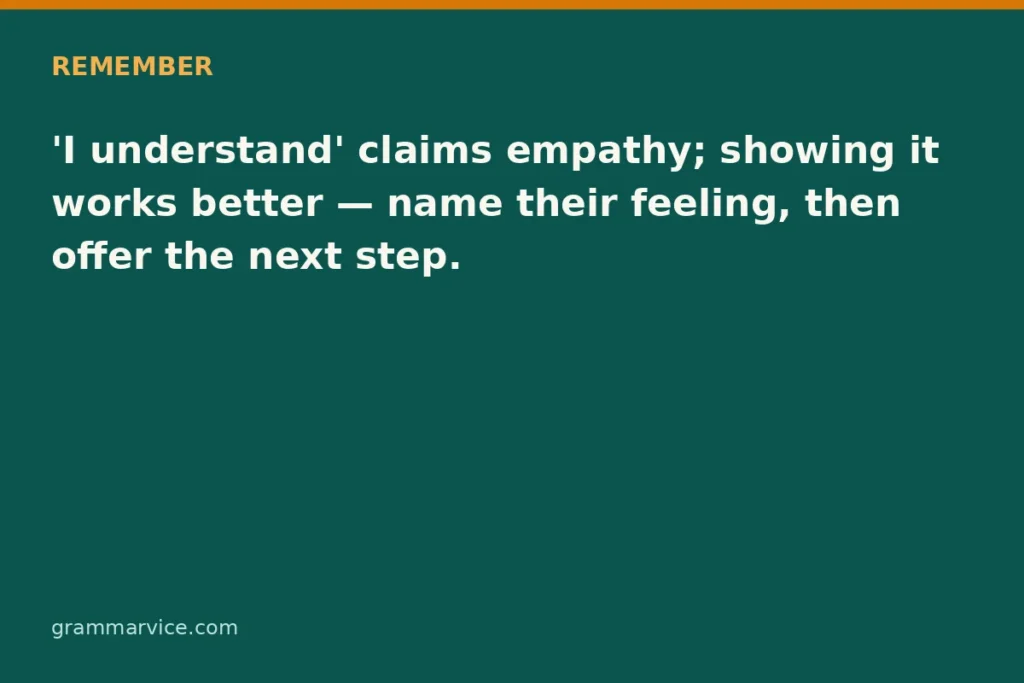
6. Offering Empathy Without Taking Action
In professional and customer-service settings, acknowledging someone’s concern is only the beginning. If the person needs help, provide a next step, request relevant information, or explain what you can do.
For example, instead of saying only “I understand your concern,” write “I see why you’re concerned about the charge. I’ll review the transaction and contact our billing team for clarification.”
One last thought: what to say instead of I understand always depends on what you actually mean — agreement, empathy, or simple acknowledgment. If you need a formal way to say I understand, “I acknowledge your point” and “I follow your reasoning” are the safest upgrades. Readers also ask: is it rude to say I understand? Not by itself — I understand, in other words, is a neutral confirmation; it only falls flat when the moment calls for empathy. And when the other person answers in kind, our guide to other ways to say “same here” offers just as many fresh replies.
Frequently Asked Questions
What can I say instead of “I understand” in a professional email?
You can say “I acknowledge your point,” “I appreciate the context,” “I follow your reasoning,” or “That aligns with my understanding.” These expressions sound professional and demonstrate that you’ve considered the sender’s message. Choose one based on whether you’re acknowledging an opinion, confirming instructions, or responding to an explanation.
Is “I understand” rude or insincere?
No, “I understand” is not inherently rude or insincere. However, it can sound dismissive when used as a brief response to someone’s personal difficulties or concerns. Adding a specific acknowledgment, such as “I can see why that would be frustrating,” makes your response feel more thoughtful and considerate.
How can I sound more empathetic than just saying “I understand”?
Focus on recognizing the other person’s feelings instead of simply confirming that you comprehend their words. Try expressions such as “I can see why that would be difficult,” “I hear what you’re saying,” or “I appreciate you sharing this with me.” You can also offer support by asking what would help them most.
Can I reply with just “Understood” in an email?
Yes, replying with “Understood” is acceptable for brief, routine workplace messages, especially when confirming simple instructions. However, it can sound abrupt when responding to detailed feedback, personal concerns, or important requests. A warmer alternative is “Understood. I’ll make the requested changes and send you an updated version by Friday.”
Does “I understand” mean “I agree”?
No, understanding and agreement have different meanings. “I understand” means you comprehend someone’s explanation or recognize their perspective, while “I agree” means you share their opinion or support their conclusion. You can understand someone’s position without agreeing with it. For example, you can say, “I understand your reasoning, although I have a different recommendation.”
What should I say instead of “I understand” in customer service?
In customer service, use expressions such as “I see why you’re concerned,” “I recognize the inconvenience this has caused,” or “Thank you for explaining the issue.” These phrases acknowledge the customer’s experience and help establish a supportive tone. Follow your response with a practical next step, such as reviewing the issue, checking an order, or arranging further assistance.
Conclusion
Choosing the right alternative to “I understand” can make your communication sound more thoughtful, professional, and empathetic. Expressions such as “I appreciate the context” and “I follow your reasoning” work well in business emails, while “I hear what you’re saying” and “I can see why that would be difficult” are better suited to emotional conversations.
When responding to customers, focus on acknowledging their concerns and explaining how you can help. Remember that understanding doesn’t automatically mean agreement, and a short acknowledgment isn’t always enough to show genuine empathy.
Ultimately, the best other ways to say I understand are those that match the situation and make the other person feel heard. Choose specific, natural expressions that communicate what you actually mean, and your conversations will become clearer, warmer, and more effective.