25 Other Ways to Say “Unfortunately” (With Examples)
Quick Answer: If you want other ways to say unfortunately, try “regrettably,” “I’m afraid,” “I’m sorry to say,” or “I wish I had better news.” For professional emails, use “after careful consideration” or “we are unable to accommodate your request.” In customer service, acknowledge the problem and explain what you can do next.
Using the same word every time you deliver disappointing news can make your emails sound repetitive, impersonal, or unnecessarily negative. Although “unfortunately” is polite and grammatically correct, choosing a more specific expression can make your message feel warmer, more professional, and easier to understand.
Whether you are declining a business request, explaining a delay, responding to a customer complaint, or sharing personal news, the right wording makes a difference. This guide explores 32 unique alternatives, organized by tone and situation, so you can choose an expression that communicates your message without sounding cold or overly apologetic.
You will also find practical examples, professional email phrases, customer-service responses, and two complete email rewrites that demonstrate how to deliver bad news politely without repeating the same negative opener.
What Does “Unfortunately” Mean?
“Unfortunately” is an adverb used to introduce information about an undesirable, disappointing, unlucky, or regrettable situation. It tells readers that something did not happen as expected or that circumstances have produced an unfavorable result.
For example:
- Unfortunately, the meeting has been canceled.
- Unfortunately, we cannot approve your application.
- Unfortunately, the package will arrive later than expected.
In each sentence, the word prepares the reader for disappointing information. It can communicate regret without necessarily expressing deep sadness or accepting personal responsibility for the situation.
Merriam-Webster’s definition of unfortunately describes the word in terms of something being unfortunate or happening in a regrettable, unlucky, or unsuitable manner.
However, not every alternative communicates exactly the same feeling. Some expressions emphasize regret, others acknowledge someone’s disappointment, and some move directly toward a solution.
Therefore, if you are searching for “unfortunately” in other words, consider the purpose of your sentence before choosing a replacement. A formal business announcement needs different wording from a friendly text message or a customer-service apology.
Is “Unfortunately” Professional or Polite?
Yes, “unfortunately” is both professional and polite when used appropriately. It is perfectly acceptable in workplace conversations, business correspondence, formal announcements, and customer-service emails.
For example, this sentence sounds professional:
“Unfortunately, we will need to reschedule Thursday’s meeting because of a scheduling conflict.”
However, repeating the word several times in the same email can make the message feel negative and impersonal. It can also distract readers from the actual information or solution.
Compare these two examples:
Repetitive: “Unfortunately, your order is delayed. Unfortunately, we cannot provide an exact delivery date. Unfortunately, we cannot offer immediate replacement.”
More professional: “Your order is taking longer than expected. We are waiting for an updated delivery estimate from the carrier. In the meantime, I can help you explore alternative arrangements.”
The second version communicates the same problem while providing useful information and a possible solution.
If you are looking for an unfortunately synonym formal enough for professional communication, “regrettably” is a reliable choice. However, complete sentence rewrites can often sound more natural than replacing one adverb with another.
Quick Top Picks: The 8 Best Alternatives at a Glance
Here are eight particularly useful alternatives, depending on the message you want to communicate.
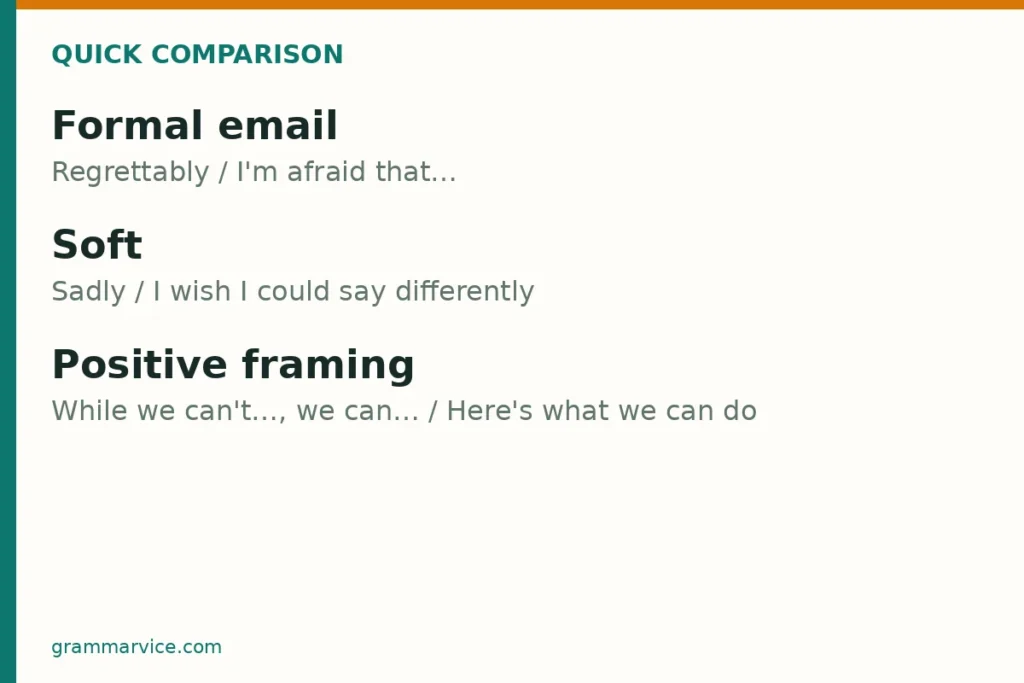
- Regrettably: Best for formal emails, business announcements, and official decisions.
- After careful review: Best for explaining a rejection or a considered business decision.
- I’m afraid: Best for softening disappointing information in everyday professional conversations.
- I wish I had better news: Best for delivering disappointing updates with empathy.
- I’m sorry this happened: Best for acknowledging a customer’s frustrating experience.
- Here’s what we can do next: Best for shifting attention toward practical solutions.
- The good news is: Best when you have a genuine positive development to share alongside a setback.
- Although this option isn’t available, we can: Best for communicating limitations while offering an alternative.
These expressions are not all direct dictionary synonyms. Some replace “unfortunately” with a more specific explanation, acknowledgment, or next step. That distinction is important because the best wording depends on what you are trying to accomplish.
Formal Alternatives to “Unfortunately” for Emails
When writing to clients, managers, business partners, hiring candidates, or professional contacts, your wording should communicate disappointing information without sounding overly emotional.
The following expressions are useful synonyms for unfortunately in a formal email, particularly when communicating rejections, scheduling changes, policy limitations, and business decisions.
1. Regrettably
Tone and usage: Formal, professional, and concise. This is one of the closest direct replacements for “unfortunately” and works particularly well in business correspondence and official announcements.
Example: “Regrettably, we cannot approve your application because it does not meet the current eligibility requirements.”
2. We Regret to Inform You
Tone and usage: Highly formal and respectful. Use this expression when delivering significant negative news, such as a job rejection, application decision, or cancellation of an important service.
Example: “We regret to inform you that your proposal was not selected for the upcoming project.”
3. After Careful Review, We Have Decided
Tone and usage: Objective and diplomatic. This expression emphasizes that a decision was considered rather than made casually. It is particularly effective when declining proposals or requests.
Example: “After careful review, we have decided not to proceed with the proposed partnership.”
4. The Application Was Not Selected
Tone and usage: Neutral, direct, and professional. Instead of announcing regret, this expression communicates the actual outcome without unnecessary emotional language. It works well in recruitment and selection emails.
Example: “Your application was not selected for the next stage of the recruitment process.”
5. We Are Unable to Accommodate Your Request
Tone and usage: Formal and respectful. Use this phrase when a request cannot be fulfilled because of company policies, scheduling limitations, available resources, or operational restrictions.
Example: “We are unable to accommodate your request for an additional extension under the current agreement.”
6. The Submission Arrived After the Deadline
Tone and usage: Factual and straightforward. This expression works when a disappointing outcome results from a specific requirement or missed deadline. It explains the situation instead of simply labeling it unfortunate.
Example: “The submission arrived after the deadline, so we cannot include it in this review cycle.”
7. This Falls Outside the Scope of Our Agreement
Tone and usage: Diplomatic and business-focused. Use this expression when declining additional work, services, or responsibilities that are not covered by an existing contract or arrangement.
Example: “The requested maintenance falls outside the scope of our current agreement, but we can provide a separate estimate.”
8. We Must Postpone the Launch Until
Tone and usage: Formal and action-oriented. This phrase communicates a necessary scheduling change while keeping the message focused on what needs to happen next.
Example: “We must postpone the product launch until the final quality checks have been completed.”
Writing tip: When learning how to say unfortunately professionally, remember that a clear explanation is often more effective than an elaborate expression of regret. If your email also involves introducing another recipient into an ongoing conversation, see our guide to other ways to say you’re adding someone to an email chain.
Soft and Conversational Alternatives to “Unfortunately”
Not every disappointing message requires formal business language. When speaking with colleagues, friends, relatives, or familiar clients, softer expressions can make your communication feel more natural and approachable.
These alternatives are particularly useful when you want to share disappointing information without making the conversation feel unnecessarily serious.
9. I’m Afraid
Tone and usage: Gentle, polite, and conversational. This expression softens a refusal or disappointing update without making the message overly emotional. It works well in professional conversations and everyday emails.
Example: “I’m afraid we won’t be able to finish the presentation before Friday.”
10. I’m Sorry to Say
Tone and usage: Warm and apologetic. Use this phrase when you want to acknowledge that the information may disappoint the recipient. It sounds more personal than a simple negative statement.
Example: “I’m sorry to say that the concert tickets have already sold out.”
11. I Wish I Had Better News
Tone and usage: Empathetic and sincere. This expression prepares someone for disappointing information while showing that you understand the outcome is not what they hoped for.
Example: “I wish I had better news, but the client has decided to postpone the project indefinitely.”
12. I Hate to Say This, But
Tone and usage: Informal and candid. Use this phrase with people you know reasonably well when you need to share something disappointing. It is generally too casual for formal business announcements.
Example: “I hate to say this, but we’ll have to cancel our weekend plans because of the weather.”
13. It’s a Shame That
Tone and usage: Friendly and sympathetic. This expression communicates mild disappointment about a missed opportunity, canceled plan, or undesirable outcome without sounding overly dramatic.
Example: “It’s a shame that we couldn’t meet before you moved to another city.”
14. It Turns Out That
Tone and usage: Neutral and conversational. This phrase is especially useful when sharing an unexpected discovery or explaining why something did not happen as originally expected.
Example: “It turns out that the restaurant was fully booked when we arrived.”
15. Sadly
Tone and usage: Personal and emotional. Use this expression when the situation genuinely involves sadness or disappointment. It works better in personal messages and heartfelt updates than in routine corporate communication.
Example: “Sadly, we won’t be able to attend your graduation ceremony this year.”
16. Things Didn’t Go as Planned
Tone and usage: Relaxed, honest, and conversational. This phrase acknowledges a setback without placing too much emphasis on negative emotions. It works well when explaining delays, failed plans, or unexpected changes.
Example: “Things didn’t go as planned, so we’ll need another week to finish the renovation.”
Empathetic Alternatives for Customer Service
Customer-service communication requires more than finding another word for unfortunately. Customers generally want to know that you understand their problem, take their concerns seriously, and have a plan to help them.
These unfortunately alternatives for customer service focus on empathy, accountability, transparency, and practical solutions. They are useful for support emails, order updates, refund requests, delivery problems, and service complaints.
17. I’m Sorry This Happened
Tone and usage: Compassionate and personal. Use this expression when a customer has experienced an inconvenience, service problem, or disappointing situation. It acknowledges their experience rather than simply announcing a problem.
Example: “I’m sorry this happened, and I understand how frustrating it must be to receive a damaged item.”
18. I Understand How Frustrating This Is
Tone and usage: Understanding and empathetic. This phrase validates the customer’s feelings and shows that you recognize the inconvenience. It is particularly helpful when responding to complaints about delays or repeated problems.
Example: “I understand how frustrating this is, especially when you were expecting your order before the weekend.”
19. Thank You for Bringing This to Our Attention
Tone and usage: Professional and appreciative. This expression acknowledges a customer’s complaint or reported problem without beginning with negative language. It also creates a natural transition into an explanation or resolution.
Example: “Thank you for bringing this to our attention; our support team is reviewing the billing issue now.”
20. Here’s Where Things Stand With Your Order
Tone and usage: Transparent and informative. This phrase works well when customers need a clear update about a delayed shipment, pending refund, or unresolved request. It focuses on useful information rather than regret.
Example: “Here’s where things stand with your order: the package has left our distribution center and is awaiting its next carrier scan.”
21. Your Delivery Is Taking Longer Than Expected
Tone and usage: Direct and considerate. Use this expression when communicating a delivery delay. It tells the customer exactly what is happening without adding unnecessary emotional language.
Example: “Your delivery is taking longer than expected, and we are checking with the carrier for an updated arrival estimate.”
22. We Haven’t Resolved This Yet
Tone and usage: Honest and accountable. This expression is appropriate when an issue remains open and you do not yet have a confirmed solution. It avoids making promises that your team cannot guarantee.
Example: “We haven’t resolved this yet, but our technical team is investigating the account-access problem.”
23. I Appreciate Your Patience While We Investigate
Tone and usage: Courteous and reassuring. Use this phrase when a problem requires additional investigation or coordination. It recognizes the customer’s time while explaining that work is continuing.
Example: “I appreciate your patience while we investigate the unexpected charge on your account.”
24. I Can Offer You an Alternative
Tone and usage: Helpful and solution-oriented. This expression is especially useful when the original request cannot be fulfilled but another option is available. It shifts the conversation toward resolving the customer’s problem.
Example: “I can offer you an alternative: we can send a replacement product at no additional shipping cost.”
Customer-service tip: A good support message should acknowledge the problem, explain what is known, and identify the next action. Avoid using sympathetic wording without providing meaningful assistance.
Positive Framing: Deliver the News Without the Negative Opener
Sometimes the best way to say unfortunately in a positive way is to remove the negative opener altogether. Instead of emphasizing what cannot happen, explain what remains possible, what action is available, or how the situation can move forward.
Positive framing does not mean hiding bad news or pretending a problem is good. It means communicating the limitation honestly while giving the reader a useful next step.
25. The Good News Is
Tone and usage: Optimistic and reassuring. Use this expression when you have a genuine positive development that can balance disappointing information. Do not use it if there is no meaningful good news to share.
Example: “The original delivery date is no longer possible, but the good news is that we can arrange collection from your local store.”
26. Here’s What We Can Do Next
Tone and usage: Practical and constructive. This phrase redirects attention from the problem toward an actionable solution. It is especially effective in professional discussions and customer-service communication.
Example: “Here’s what we can do next: reschedule the consultation for Monday or arrange a virtual appointment.”
27. We Have Another Option
Tone and usage: Reassuring and collaborative. Use this expression when your preferred option is unavailable but another reasonable alternative exists. It helps prevent a refusal from ending the conversation.
Example: “The requested color is currently unavailable, but we have another option in the same design.”
28. We Can Still Move Forward By
Tone and usage: Encouraging and forward-looking. This phrase emphasizes continued progress despite a setback. It works particularly well in project management, workplace discussions, and business planning.
Example: “We can still move forward by completing the approved sections while the remaining documents are being reviewed.”
29. To Keep Things Moving
Tone and usage: Proactive and professional. Use this expression when a delay or limitation requires an adjustment but you want to maintain progress toward the larger goal.
Example: “To keep things moving, we’ll begin the initial design work while waiting for the final budget approval.”
30. Although This Option Isn’t Available, We Can
Tone and usage: Diplomatic and solution-focused. This construction acknowledges a limitation directly before presenting an alternative. It is particularly useful for client communication and customer support.
Example: “Although next-day delivery isn’t available for your address, we can arrange priority shipping for the following business day.”
31. This Gives Us an Opportunity to
Tone and usage: Optimistic and constructive. Use this phrase when a setback creates a genuine opportunity to improve a process, reconsider a plan, or explore a better approach.
Example: “This gives us an opportunity to review the original design and make the necessary improvements before launch.”
32. Let’s Focus on What We Can Control
Tone and usage: Supportive and practical. This expression is useful when circumstances are outside your control and the conversation needs to move toward realistic next steps.
Example: “We cannot change the supplier’s revised schedule, so let’s focus on what we can control and adjust our delivery plan.”
These alternatives show that you do not always need a direct synonym to communicate effectively. Sometimes, a solution-focused sentence is the most natural replacement for a negative opening.
If your message needs stronger wording to describe an unfavorable situation itself, you may also find our guide to other ways to say that’s not good helpful.
Example Emails: Two “Unfortunately” Rewrites
One of the easiest ways to improve professional writing is to replace repeated negative openers with clear explanations, appropriate empathy, and useful next steps.
Here are two complete examples showing how to deliver bad news politely in an email without starting every paragraph with “unfortunately.”
Example Email 1: Rejection Email
Situation: A company needs to inform a job candidate that they were not selected for a position.
Original repetitive approach: An email that repeatedly begins with “Unfortunately, we cannot offer you the position,” “Unfortunately, another candidate was selected,” and “Unfortunately, we cannot provide further feedback” can sound impersonal and discouraging.
Improved email:
Subject: Update on Your Job Application
Hi Jordan,
Thank you for taking the time to interview with our team and share your experience with us.
After careful review, we have decided to move forward with another candidate whose qualifications more closely match the current requirements of the position.
We genuinely appreciate your interest in joining our company and the effort you invested throughout the interview process. Although we cannot offer you this particular opportunity, we encourage you to consider future openings that align with your experience and professional goals.
Thank you again for your time and understanding. We wish you every success in your job search.
Best regards,
Recruitment Team
Why this works: The email communicates the rejection clearly without repeating regretful language. “After careful review” introduces the decision professionally, while the remaining paragraphs acknowledge the candidate’s effort and close the conversation respectfully.
Example Email 2: Customer-Service Delay Email
Situation: A customer contacts a business because their order has not arrived by the expected delivery date.
Original repetitive approach: Repeatedly saying “Unfortunately, your package is delayed,” “Unfortunately, we cannot guarantee delivery,” and “Unfortunately, we cannot provide an immediate replacement” makes the company sound unhelpful.
Improved email:
Subject: Update Regarding Your Order
Hi Maya,
I’m sorry your package hasn’t arrived by the expected delivery date. I understand how inconvenient this delay must be, especially when you were counting on receiving your order sooner.
Your shipment is currently delayed in transit, and we are waiting for an updated delivery estimate from the carrier. Our support team has contacted the shipping provider to request further information.
In the meantime, I will continue monitoring the shipment and follow up with you by the end of the next business day. If the carrier cannot confirm a delivery date, we’ll review the available replacement or refund options with you.
Thank you for your patience while we work to resolve this issue. We appreciate the opportunity to make things right.
Best regards,
Customer Support Team
Why this works: The revised email begins with empathy rather than a negative announcement. It explains the current situation, identifies the action being taken, and gives the customer a clear expectation for the next update.
Which One Should You Use? A Quick Guide
Choosing the right alternative depends on your relationship with the recipient, the seriousness of the news, and the communication setting. The following guide can help you decide what to say instead of unfortunately.
For a Client Email
Choose a formal, respectful expression that communicates the situation without sounding overly apologetic. Clients generally appreciate clarity, professionalism, and practical next steps.
- “Regrettably, we cannot meet the original deadline.”
- “After careful review, we have decided to revise the proposal.”
- “We are unable to accommodate the requested changes under the current agreement.”
Best choice: “After careful review” or “Regrettably.”
For a Colleague Chat
Workplace conversations with familiar colleagues can be more relaxed. A natural expression usually sounds better than a formal announcement.
- “I’m afraid I’ll need another day to finish this.”
- “Things didn’t go as planned with the presentation.”
- “I wish I had better news about the project.”
Best choice: “I’m afraid” or “Things didn’t go as planned.”
For a Customer Complaint
Prioritize empathy and accountability. Customers want to know that you understand the problem and are taking appropriate action.
- “I’m sorry this happened.”
- “I understand how frustrating this is.”
- “Here’s what we can do next.”
Best choice: “I’m sorry this happened,” followed by a specific solution or next step.
For Personal News
When communicating with friends or family, you can use warmer expressions that acknowledge disappointment or personal feelings.
- “Sadly, I won’t be able to make it.”
- “I hate to say this, but our plans have changed.”
- “I wish I had better news.”
Best choice: “Sadly” or “I wish I had better news.”
Remember that there is no single perfect alternative for every situation. A phrase that sounds natural in a friendly conversation may seem too casual in a formal rejection letter.
Mistakes to Avoid When Replacing “Unfortunately”
Finding another expression is only part of effective communication. The replacement should also match the seriousness of the situation and preserve the original meaning.
Here are some common mistakes to avoid.
1. Stacking Multiple Negative Expressions
Avoid combining several regretful expressions in the same sentence. For example, “Regrettably, we regret to inform you that we are unfortunately unable to approve your request” sounds repetitive and unnecessarily negative.
A better version is: “After reviewing your request, we are unable to approve it under the current policy.”
2. Using Overly Emotional Language in Formal Emails
Expressions such as “It breaks my heart to say” and “It’s with a heavy heart” may sound sincere in personal messages, but they can feel exaggerated in routine business correspondence.
For professional communication, choose straightforward phrases such as “Regrettably” or “After careful review.”
3. Choosing a Positive Expression That Hides the Problem
Positive framing should not make disappointing information confusing. If a shipment is delayed, tell the customer clearly before explaining what alternatives are available.
For example, do not say “The good news is that we’re making progress” if the customer still needs to know that their delivery will be late.
4. Replacing Specific Information With Vague Excuses
Expressions such as “Due to unforeseen circumstances” can be useful when the details are genuinely unknown or confidential. However, using them unnecessarily can make your message appear evasive.
Whenever possible, explain the actual reason. For example, “The shipment is delayed because of a carrier scheduling issue” is more informative.
5. Using “Sadly” for Every Professional Situation
“Sadly” expresses emotional disappointment, so it is not always the right choice for routine business communication. A neutral phrase such as “The requested option is unavailable” may be more appropriate.
6. Offering Reassurance Without a Real Next Step
Saying “We appreciate your patience” is polite, but it does not resolve the recipient’s concern by itself. When possible, include an action, a timeline, or a specific update so the person knows what to expect.
The goal is not simply to replace one word with another. It is to communicate difficult information clearly, respectfully, and honestly.
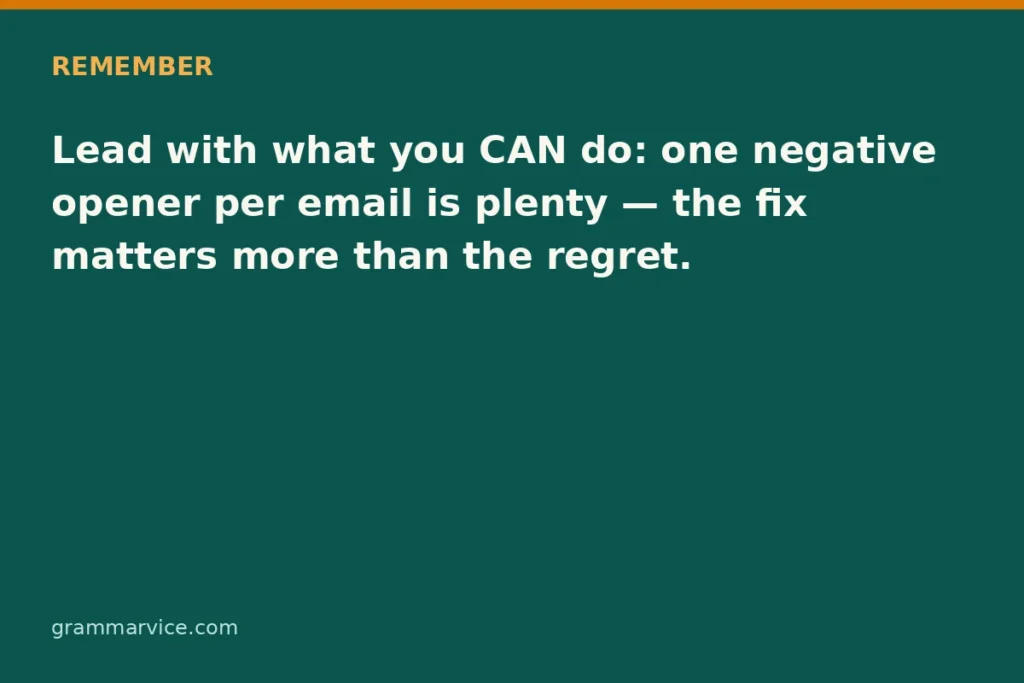
A final note before the FAQs: most readers looking for other ways to say unfortunately in an email want one of two things — a formal way to say unfortunately that still sounds human, such as “regrettably” or “we regret to inform you,” or a softer way to break the news. For the second, learning how to say unfortunately in a positive way simply means leading with what can still be done, as the positive-framing options above show.
Frequently Asked Questions
Can I use “unfortunately” in a professional email?
Yes, “unfortunately” is completely acceptable in professional emails. It politely introduces disappointing information, such as a delayed project, rejected request, or canceled meeting. However, repeating it several times can make your message sound negative. Alternatives such as “regrettably,” “after careful review,” and “we are unable to accommodate your request” can create a more polished tone.
What is the most formal replacement for “unfortunately”?
“Regrettably” is one of the most formal single-word replacements for “unfortunately.” For official announcements and important decisions, “We regret to inform you” is another suitable option. If you want a more neutral business tone, consider “After careful review, we have decided” because it communicates the decision without emphasizing regret.
How can I say “unfortunately” in a more positive way?
Focus on what remains possible instead of emphasizing what cannot happen. Expressions such as “Here’s what we can do next,” “We have another option,” and “We can still move forward by” create a constructive tone. You can also use “The good news is” when you have a genuine positive development to share.
What can I say instead of “unfortunately” in customer service?
In customer service, try “I’m sorry this happened,” “I understand how frustrating this is,” or “Thank you for bringing this to our attention.” These phrases acknowledge the customer’s experience and sound more personal. Follow them with a clear explanation, an available solution, or a realistic timeline for the next update.
Is “sadly” too emotional for business writing?
Not necessarily, but “sadly” is more emotional than “regrettably” or “unfortunately.” It can work in personal business announcements, sensitive employee communications, or messages about genuinely disappointing situations. For routine client updates, application decisions, and operational problems, a neutral expression is generally more appropriate.
How can I deliver bad news politely without starting every sentence with “unfortunately”?
Start by explaining the actual situation, acknowledge how it affects the recipient, and provide a next step. For example, replace “Unfortunately, your order is delayed” with “Your order is taking longer than expected. We’re checking with the carrier and will update you tomorrow.” This approach sounds more helpful and avoids repetitive negative wording.
Conclusion
Choosing the right alternative depends on your audience, purpose, and desired tone. “Regrettably” and “We regret to inform you” work well in formal correspondence, while “I’m afraid” and “I’m sorry to say” make everyday conversations softer. For customer service, prioritize empathy and practical solutions. When possible, use positive framing to show what can happen next.
Ultimately, the best other ways to say unfortunately are the ones that communicate difficult information honestly without making your message sound unnecessarily negative. Focus on clarity, consideration, and useful next steps, and your professional and personal communication will feel more natural and effective.