
30 Other Ways to Say “Making a Change” (With Examples)
Quick answer: The best all-purpose alternatives to “making a change” are making an adjustment, revising, and updating. For a small tweak, use tweaking or refining; for a major overhaul, use transforming or overhauling; and for a formal workplace change, use implementing or introducing.
We say “making a change” when we want to sound careful, but the phrase is vague. It does not tell the reader whether the change is small or large, personal or professional, or temporary or permanent. That vagueness is why it appears in so many emails, resumes, and essays — and why it often weakens the message.
This guide gives you other ways to say making a change that are clearer, stronger, and easier to use. You will find everyday verb phrases, fresh-start language, workplace alternatives, and personal-growth options, each with a tone note and a natural example. Whether you need another word for making a change for a resume, a make a change synonym formal enough for a report, or another word for making small changes to a document, you will find a precise fit below.
What Does “Making a Change” Mean?
“Making a change” means altering something from its current state to a different state. It can describe a plan, a habit, a process, a document, a career, or a way of thinking. The phrase itself does not say how big the change is, why it is happening, or what will be different afterward.
That flexibility is also its weakness. In writing, readers often have to guess the scale and purpose of the change. A stronger alternative solves that problem immediately. For example, revising suggests editing and improving, overhauling suggests a complete rebuild, and transitioning suggests a gradual move from one state to another.
The Cambridge Dictionary defines “change” as making someone or something different. A good synonym should keep that core meaning — altering something — while adding useful detail about tone, scale, or context.
Is “Making a Change” Professional or Polite?
Yes, “making a change” is both professional and polite. It is neutral, non-confrontational, and safe in almost any setting. That is why managers use it in announcements and why writers use it when they want to avoid sounding blunt.
However, neutral is not always effective. In a resume, “making a change” sounds passive and does not show impact. In a workplace announcement, it can sound evasive if the team needs to know what is actually changing. In those cases, a more specific verb — such as implementing, streamlining, or restructuring — is more professional because it is clearer.
Use “making a change” when you want to be gentle or general. Use a precise alternative when you want to be credible, persuasive, or actionable.
“Making a Change” vs “Making a Difference”: What’s the Difference?
These two phrases are often confused, but they mean different things. “Making a change” means altering something. “Making a difference” means having a positive effect or impact on someone or something.
You can make a change without making a difference — for example, changing a meeting time does not necessarily improve anything. You can also make a difference without announcing a change — for example, mentoring a colleague improves their work even if no policy changes.
If you want other ways to say making a difference, you need impact language, not change language. Phrases such as “having an impact” or “creating a positive effect” belong in that category. This article focuses on change language only: verbs and phrases that describe altering, revising, or replacing something.
For a full guide to impact language, see our article on other ways to say make a difference.
Quick Top Picks: The 8 Best Alternatives at a Glance
If you need a fast answer, start with these eight. Each one appears again below as a detailed entry.
- Make an adjustment — Best all-purpose replacement for a small or moderate change.
- Modify — Best for documents, plans, and technical changes.
- Revise — Best for writing, policies, and anything edited in drafts.
- Tweak — Best casual option for a small, precise improvement.
- Overhaul — Best for a complete, large-scale rebuild.
- Start fresh — Best for personal new beginnings.
- Implement — Best formal workplace option for putting a new process in place.
- Introduce a new approach — Best for presenting a different method or strategy.
Everyday Verb Phrases for Making a Change
These alternatives work in conversation, emails, essays, and everyday writing. They are clear, natural, and easy to drop into a sentence.
1. Make an adjustment
Tone: Neutral and practical. Works for small to moderate changes in plans, schedules, or methods.
Example: “We need to make an adjustment to the schedule so the team can finish by Friday.”
2. Modify
Tone: Neutral and slightly formal. Best for plans, documents, designs, and systems.
Example: “Please modify the proposal to include the updated budget figures.”
3. Alter
Tone: Neutral and direct. Slightly more formal than “change” and useful in writing.
Example: “She decided to alter her travel plans after the flight was delayed.”
4. Revise
Tone: Professional and thoughtful. Implies careful editing and improvement, not just a random change.
Example: “I revised the first chapter after getting feedback from my editor.”
5. Update
Tone: Neutral and modern. Best when the change brings something up to date.
Example: “We updated the employee handbook to reflect the new remote-work policy.”
6. Amend
Tone: Formal. Common in legal, official, and policy writing.
Example: “The committee voted to amend the bylaws at last month’s meeting.”
7. Adapt
Tone: Positive and flexible. Implies adjusting to new conditions rather than forcing a change.
Example: “The team adapted its strategy when customer demand shifted.”
8. Switch
Tone: Casual and clear. Best for replacing one option with another.
Example: “I switched to a morning workout because evenings were too busy.”
9. Shift
Tone: Neutral and versatile. Works for focus, direction, schedules, and priorities.
Example: “We shifted our focus from sales to customer retention this quarter.”
10. Tweak
Tone: Casual and precise. Best for another word for making small changes — a minor improvement, not a rebuild.
Example: “She tweaked the recipe by adding a little more lemon zest.”
11. Refine
Tone: Professional and positive. Suggests polishing and improving something that already works.
Example: “He refined his presentation after practicing it three times.”
12. Overhaul
Tone: Strong and dramatic. Use only for a complete, large-scale change.
Example: “The company overhauled its website to improve speed and navigation.”
13. Rework
Tone: Practical and hands-on. Implies rebuilding or redoing part of something.
Example: “We reworked the opening paragraph to make the argument clearer.”
14. Reshape
Tone: Descriptive and slightly formal. Best for changing the form or structure of something.
Example: “The new manager reshaped the team into smaller, focused groups.”
15. Reorganize
Tone: Professional and structural. Best for changing how parts are arranged.
Example: “She reorganized her desk and filing system to work more efficiently.”
Fresh Starts and New Beginnings
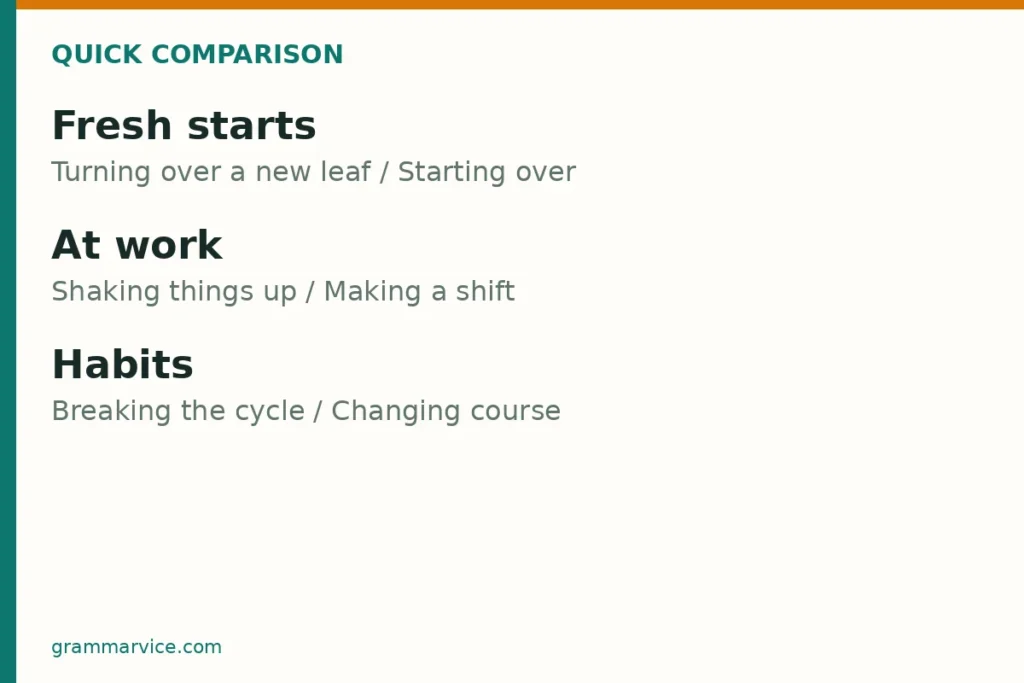
These alternatives are best when the change feels like a new chapter, not just a correction. They work well in personal writing, motivational content, and life-change stories.
16. Turn over a new leaf
Tone: Warm and idiomatic. Best for a personal decision to improve behaviour or habits.
Example: “After years of late nights, he decided to turn over a new leaf and get more sleep.”
17. Start over
Tone: Direct and emotional. Implies beginning again from scratch.
Example: “She lost her job, but she decided to start over in a new city.”
18. Begin anew
Tone: Formal and literary. Best for reflective or inspirational writing.
Example: “After the move, they began anew with a smaller home and a simpler routine.”
19. Embrace a new chapter
Tone: Positive and reflective. Best for life transitions such as graduation, retirement, or relocation.
Example: “She embraced a new chapter by enrolling in university at 40.”
20. Start fresh
Tone: Warm and encouraging. The best all-purpose fresh-start phrase for personal growth.
Example: “I deleted the old draft and started fresh with a clearer outline.”
21. Reinvent yourself
Tone: Bold and aspirational. Best for a major personal transformation in career, image, or lifestyle.
Example: “He reinvented himself as a freelance designer after 15 years in corporate marketing.”
22. Take a new direction
Tone: Neutral and hopeful. Best for career, creative, or life-path changes.
Example: “After a decade in teaching, she took a new direction and trained as a counsellor.”
Workplace and Professional Alternatives
These are the strongest options for resumes, reports, announcements, and formal emails. They sound decisive and show exactly what you did.
23. Implement
Tone: Formal and action-oriented. Best make a change synonym formal for putting a new system, policy, or process into effect.
Example: “We implemented a new onboarding process that cut training time by 20%.”
24. Introduce a new approach
Tone: Professional and strategic. Best for presenting a different method without sounding abrupt.
Example: “The team introduced a new approach to client feedback based on weekly surveys.”
25. Streamline
Tone: Professional and efficient. Implies simplifying a process to make it faster or clearer.
Example: “She streamlined the approval process from five steps to two.”
26. Restructure
Tone: Formal and organisational. Best for changing how a team, department, or company is organised.
Example: “The company restructured its sales team to focus on regional markets.”
27. Transition
Tone: Professional and gradual. Best for a planned move from one system, role, or method to another.
Example: “We are transitioning to a new software platform over the next three months.”
28. Adopt a new policy
Tone: Formal and official. Best for organisational or policy changes.
Example: “The school adopted a new policy on homework and screen time.”
Personal Growth and Habit Changes
These alternatives work best for health, habits, mindset, and personal development. They sound intentional and human, not corporate.
29. Break a habit
Tone: Direct and personal. Best for stopping an unwanted behaviour.
Example: “He broke the habit of checking email first thing every morning.”
30. Build a new routine
Tone: Positive and practical. Best for replacing an old pattern with a healthier one.
Example: “She built a new routine around morning exercise and evening reading.”
31. Transform your mindset
Tone: Inspirational and reflective. Best for a deep internal shift in attitude or perspective.
Example: “She transformed her mindset from fear of failure to curiosity about learning.”
32. Make a positive change
Tone: Warm and general. Best for another word for making positive change when you want to emphasise the benefit, not just the alteration.
Example: “Volunteering every weekend was a positive change that gave her more purpose.”
Which One Should You Use? A Quick Guide
Match the phrase to the situation, not just to the word “change.” The table below shows the best fit for common contexts.
| Situation | Best phrase | Why it works |
| A small edit to a document | Revise / Tweak | Shows a precise, limited improvement. |
| A formal workplace announcement | Implement / Introduce a new approach | Sounds decisive and professional. |
| A personal new beginning | Start fresh / Embrace a new chapter | Feels warm and hopeful. |
| A complete rebuild | Overhaul / Restructure | Signals large-scale change. |
| A habit you want to stop | Break a habit / Build a new routine | Focuses on behaviour, not abstraction. |
| A resume achievement | Streamlined / Implemented / Restructured | Shows action and measurable impact. |
| A gradual move to something new | Transition / Adapt | Implies a smooth, planned shift. |
| An official policy update | Amend / Adopt a new policy | Matches formal, official tone. |
Example: A Change-Announcement Email, Rewritten
Before (vague):
“Hi team, We are making a change to how we handle client requests. Please note the change and let us know if you have questions. Thanks, Maya”
This version tells the team almost nothing. What is changing? When? Why? What should they do differently?
After (precise):
“Hi team, Starting Monday, we are streamlining how we handle client requests. Instead of emailing individual team members, please submit requests through the new shared form. This change will help us respond within one business day and track requests more clearly. Please use the form for all new requests from Monday onward, and let me know if you have questions. Thanks, Maya”
The rewrite works because it replaces the vague phrase with a specific verb (streamlining), adds a start date, explains the new action, and gives the reason. The same technique works for resumes, essays, and announcements: name the action, not just the idea of change.
For related workplace language, see our guide to other ways to say going the extra mile.
Mistakes to Avoid
- Using transformation language for a tiny tweak. Do not say you “transformed” or “overhauled” something if you only fixed a typo or moved a meeting. Overstatement damages credibility.
- Mixing up change and difference. Do not use “making a difference” when you mean “making a change.” One describes alteration; the other describes impact.
- Using over-formal verb phrases in casual writing. “Implement” and “restructure” sound stiff in a text to a friend. Save formal verbs for work and use “tweak,” “switch,” or “start fresh” in casual contexts.
- Repeating “making a change” in every sentence. If you use the same phrase three times in one paragraph, replace at least two instances with a more specific verb.
- Choosing a synonym that changes the meaning. “Modify” and “overhaul” are not interchangeable. Check the scale before you swap words.
Writers searching for other ways to say make a change often start from a simpler question: what is the best making a change synonym for this exact sentence? Sometimes the answer is another phrase for making a change that names the scale — a tweak, a revision, an overhaul — and sometimes it is another word for making changes to something specific, like a policy, a schedule, or a draft.
The same approach works for the shorter forms readers look up: other ways to say change when the verb stands alone, and other ways to say changes when the noun is plural. Match the replacement to the job — document, habit, process, or mindset — and the sentence will always read sharper than the vague original.
Frequently Asked Questions
What is a more powerful way to say “making a change”?
A more powerful way to say “making a change” depends on scale. For a major change, use overhauling, transforming, or restructuring. For a confident workplace change, use implementing or streamlining. These verbs sound stronger because they describe a specific action rather than a vague idea.
What’s another word for making a change?
The simplest single-word alternatives are alter, modify, revise, update, and shift. For a phrase, make an adjustment is the most versatile replacement. Choose based on context: “revise” for writing, “modify” for plans or designs, and “shift” for focus or direction.
How do you say “making a change” professionally — on a resume or at work?
On a resume, use strong action verbs with results, such as implemented, streamlined, restructured, or introduced. For example, “Streamlined the onboarding process, reducing training time by 20%” is far stronger than “Made a change to onboarding.” At work, pair the verb with a clear outcome and timeline.
What’s the difference between “making a change” and “making a difference”?
“Making a change” means altering something from one state to another. “Making a difference” means having a positive effect or impact. A change can be neutral or even negative, while a difference implies a meaningful benefit. Use change language for alterations and impact language for results.
Which phrase is best for personal growth and new beginnings?
For personal growth, start fresh is the warmest all-purpose option. Embrace a new chapter works best for major life transitions, while reinvent yourself suits a bold career or lifestyle transformation. For habits, build a new routine and break a habit are the most practical choices.
Are these alternatives formal or casual, and how do I use them naturally in a sentence?
They range from casual to formal. Casual options include tweak, switch, and start fresh. Formal options include implement, amend, and restructure. Neutral options such as revise, update, and make an adjustment work in most settings. To use them naturally, replace “making a change” with the verb and keep the rest of the sentence the same: “We are making a change to the schedule” becomes “We are making an adjustment to the schedule.”
Conclusion
“Making a change” is safe, but it is rarely the best choice. A precise alternative — whether it is tweaking a detail, revising a document, implementing a new process, or starting fresh in a new chapter — tells your reader exactly what is happening and why it matters. Choose the phrase that matches the scale, tone, and context of your change, and your writing will sound clearer, stronger, and more confident. The next time you are tempted to write “making a change,” pause, pick a specific verb from this guide, and let the action speak for itself.