30 Other Ways to Say “Furthermore” (With Examples)
What can you say instead of “furthermore”? Try moreover, in addition, additionally, what’s more, or on top of that. The best alternative depends on your audience, writing style, and the strength of the point you’re adding. This guide covers 35 useful alternatives, from formal academic transitions to casual expressions, with examples for essays, IELTS writing, reports, and everyday conversations.
Using “furthermore” repeatedly can make an essay or professional email sound predictable. Although it is a useful transition word, varying your language makes your writing more natural and helps readers understand how each new idea connects to the previous one.
Below, you’ll find alternatives organized by tone and purpose, along with punctuation guidance, practical examples, and explanations of which expressions actually communicate addition. One important distinction: words that show similarity or comparison are not automatically suitable replacements for “furthermore.”
What Does “Furthermore” Mean?
“Furthermore” is a formal transition word used to introduce additional information, evidence, reasons, or arguments that support or develop a previous statement. It tells readers that you are adding another relevant point rather than changing direction or presenting an opposing idea.
For example:
Original: The new training program improves employee productivity. Furthermore, it helps reduce workplace stress.
Meaning: The program provides two benefits: improved productivity and reduced stress.
According to the Cambridge Dictionary definition of furthermore, the word introduces additional information and can also emphasize the importance of that information.
In everyday writing, “furthermore” often performs the same basic function as “moreover” and “in addition.” However, other alternatives can communicate a slightly different tone, level of emphasis, or relationship between ideas.
Consider these common situations:
- Academic writing: Adding another supporting argument or piece of evidence.
- Professional writing: Introducing another benefit, concern, or consideration.
- Business emails: Providing additional details or explaining another requirement.
- Casual conversations: Adding another thought without sounding overly formal.
- Persuasive writing: Introducing a stronger reason that reinforces your position.
Understanding this function is the first step toward choosing a suitable furthermore synonym instead of simply replacing one word with another.
Is “Furthermore” Professional or Polite?
Yes, “furthermore” is professional and appropriate for formal communication, academic assignments, business reports, and structured presentations. However, it is not inherently polite. Politeness depends on the complete sentence, the message, and how you communicate with your reader.
For example, consider this professional sentence:
Furthermore, we recommend reviewing the updated project requirements before approving the proposal.
It sounds formal and appropriate in a workplace document. However, using the same transition repeatedly in a short email can make the message feel unnecessarily stiff.
If you want to know how to say furthermore professionally without sounding repetitive, consider these options:
- Additionally: Suitable for reports, business emails, and formal updates.
- In addition: A straightforward choice for presenting another point.
- Moreover: Useful when introducing another important supporting argument.
- Another consideration is: Appropriate when discussing business decisions or recommendations.
- What’s more: Professional enough for many approachable workplace messages.
For a formal report, “moreover” or “additionally” usually works well. For a friendly email, “also” or “what’s more” may sound more natural.
Quick Top Picks: The 8 Best Alternatives at a Glance
These eight expressions are particularly useful because they cover different writing situations without changing the basic meaning of “furthermore.” Each one also appears in the detailed alternatives below.
- Moreover: Best for formal essays and persuasive arguments.
- In addition: Best for introducing another supporting point.
- Additionally: Best for professional reports and emails.
- It is also worth noting that: Best for introducing an important detail.
- What’s more: Best for natural, readable writing.
- To add to this: Best for connecting related ideas.
- Plus: Best for casual conversations and informal messages.
- More importantly: Best for introducing a stronger or more significant point.
The following sections cover all 35 alternatives, including these eight recommendations. Each expression has a usage note and a natural example sentence so you can understand when it works best.
Formal and Academic Alternatives to “Furthermore”
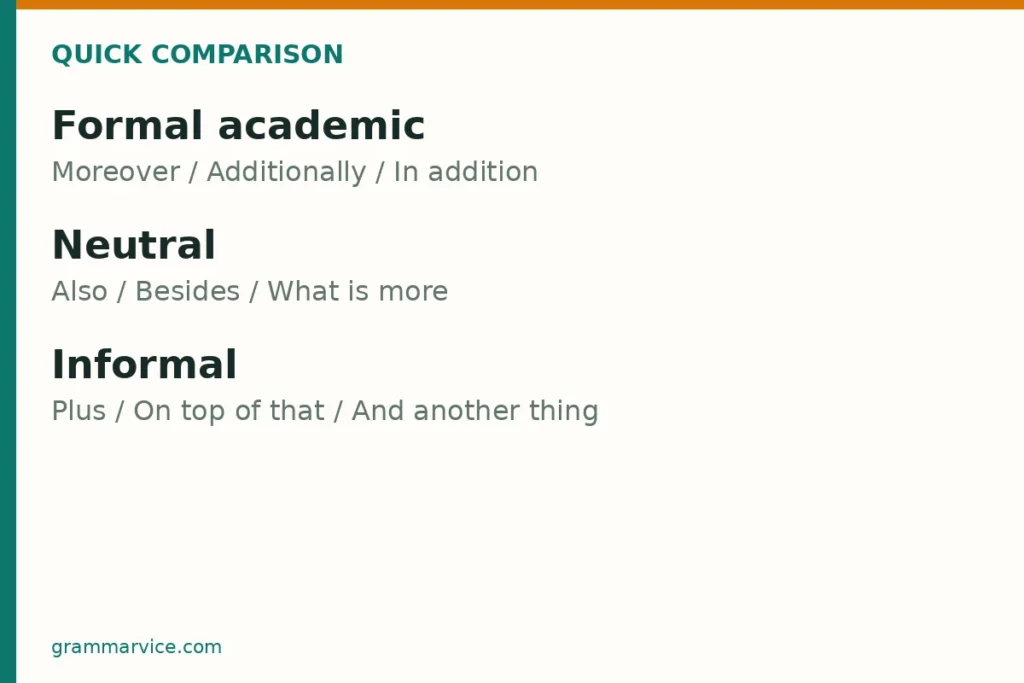
Formal and academic alternatives are particularly useful in research papers, university assignments, argumentative essays, reports, and IELTS Writing Task 2. They help introduce additional evidence and supporting arguments while maintaining a professional tone.
If you’re searching for a furthermore synonym for academic writing, the following expressions are strong options. However, choose transitions according to their meaning rather than inserting them simply to make your writing sound more sophisticated.
1. Moreover
Tone: Formal and academic.
“Moreover” is one of the closest synonyms for “furthermore.” It introduces another supporting point and can give the additional information slightly greater persuasive weight. It works particularly well in argumentative essays, research discussions, and professional reports.
Example: The proposed policy would improve public transportation; moreover, it could reduce traffic congestion in major cities.
2. Additionally
Tone: Formal and professional.
“Additionally” introduces another piece of information without necessarily suggesting that it is more important than the previous point. It is a versatile choice for academic papers, business reports, presentations, and professional correspondence.
Example: The research identified significant improvements in student performance. Additionally, it highlighted the benefits of personalized instruction.
3. In addition
Tone: Formal and neutral.
“In addition” is a clear, widely understood expression for introducing another supporting idea. It works well when you want to maintain a formal tone without making your writing sound overly complicated.
Example: The university provides financial assistance to eligible students. In addition, it offers free academic counseling throughout the semester.
4. Further
Tone: Formal and concise.
“Further” can introduce additional information, especially in formal documents and academic discussions. It is particularly useful when you want a shorter transition rather than a longer introductory phrase.
Example: Further, the findings suggest that regular physical activity may improve concentration and overall academic performance.
5. A further point is that
Tone: Formal and explanatory.
This expression explicitly signals that you are introducing another argument. It is useful in essays and structured discussions where you want readers to recognize each supporting point clearly.
Example: A further point is that renewable energy systems can reduce a country’s dependence on imported fossil fuels.
6. A further implication is that
Tone: Academic and analytical.
Use this expression when your additional point explains a consequence or broader meaning of something already discussed. It is especially appropriate in research papers, analytical essays, and policy discussions.
Example: A further implication is that schools may need to redesign their teaching methods to accommodate different learning preferences.
7. Another consideration is
Tone: Formal and professional.
This phrase introduces another factor that readers should consider when evaluating a situation or making a decision. It is useful in academic arguments, business proposals, and analytical reports.
Example: Another consideration is the long-term maintenance cost associated with installing the new equipment.
8. Another factor is
Tone: Formal and analytical.
Use this expression when adding another cause, influence, condition, or element to an explanation. It is particularly effective when discussing research findings, social issues, or complex decisions.
Example: Another factor is the availability of affordable housing, which influences where young professionals choose to live.
9. It is also worth noting that
Tone: Formal and informative.
This phrase introduces a relevant detail that deserves attention. It is a natural choice for essays, reports, research summaries, and explanatory writing, particularly when the additional information provides useful context.
Example: It is also worth noting that the survey included participants from several different age groups.
10. It is also important to recognize that
Tone: Formal and emphatic.
Use this expression when adding information that readers should carefully consider. It works well when introducing a significant limitation, qualification, or supporting argument in academic and professional writing.
Example: It is also important to recognize that access to reliable internet varies considerably between rural and urban communities.
11. Beyond this
Tone: Formal and analytical.
“Beyond this” introduces an additional dimension of an argument or discussion. It works especially well when moving from an immediate benefit or finding to a broader consideration.
Example: The initiative provides immediate financial assistance. Beyond this, it creates opportunities for long-term economic development.
12. To supplement this point
Tone: Academic and precise.
This expression introduces additional information that strengthens or expands an argument already presented. It is useful when discussing supporting research, examples, or evidence in formal writing.
Example: To supplement this point, the researchers examined employment records from five different industries.
13. Further to this
Tone: Formal, particularly British English.
“Further to this” introduces additional information connected to an earlier statement. It appears in formal correspondence and some academic contexts, particularly in British English. In American writing, “additionally” or “in addition” may sound more natural.
Example: Further to this, the committee recommended introducing additional safeguards for employees working remotely.
Neutral and Professional Alternatives for Reports and Emails
Not every professional message needs a highly formal transition. Sometimes, a straightforward expression communicates the same idea more clearly.
These neutral and professional alternatives are useful for workplace emails, business presentations, project updates, explanatory articles, and everyday professional writing.
14. Also
Tone: Neutral and versatile.
“Also” is one of the simplest alternatives to “furthermore.” It introduces additional information without making the sentence sound overly formal. It works in professional and everyday writing, although its placement within a sentence requires some attention.
Example: The new software improves reporting accuracy. It also makes collaboration between departments easier.
15. As well
Tone: Neutral and conversational.
“As well” adds another item, feature, or point to a statement. It is particularly natural near the end of a sentence and works well in professional messages that use a friendly tone.
Example: The package includes installation support, technical assistance, and regular software updates as well.
16. What’s more
Tone: Neutral and slightly emphatic.
“What’s more” introduces additional information that strengthens the previous statement. It sounds more conversational than “furthermore” while remaining suitable for many articles, presentations, and approachable business communications.
Example: The apartment is close to public transportation. What’s more, it includes secure parking and modern appliances.
17. To add to this
Tone: Neutral and explanatory.
This phrase makes the relationship between two ideas clear. It works well when adding another observation, supporting detail, or reason without creating an excessively formal tone.
Example: The company has expanded its customer support team. To add to this, it has introduced a faster online response system.
18. Added to that
Tone: Neutral and conversational.
“Added to that” introduces another relevant detail and is particularly useful in discussions and informal professional writing. It sounds natural when you want to connect two related observations.
Example: The conference offers excellent networking opportunities. Added to that, attendees can participate in practical industry workshops.
19. There is also the fact that
Tone: Neutral and explanatory.
This expression introduces an additional circumstance or piece of information that supports your position. It is useful in discussions, opinion writing, and explanatory paragraphs, although shorter alternatives may be preferable in concise reports.
Example: There is also the fact that many employees prefer flexible schedules because they help balance work and family responsibilities.
20. Alongside this
Tone: Neutral and professional.
“Alongside this” introduces another feature, development, or consideration that accompanies the previous point. Use it when the two ideas are connected parts of a broader situation.
Example: The organization provides professional development opportunities. Alongside this, it offers mentoring programs for new employees.
21. Not to mention
Tone: Neutral and emphatic.
“Not to mention” adds another noteworthy detail, often one that makes the previous statement even more convincing. It is suitable for persuasive writing and conversational professional communication.
Example: The new office provides a comfortable working environment, not to mention convenient access to restaurants and public transportation.
22. A further benefit is
Tone: Professional and informative.
This expression is especially useful when discussing advantages, product features, workplace policies, or proposed improvements. It clearly identifies the next statement as another benefit rather than an unrelated observation.
Example: A further benefit is the reduced amount of time employees spend completing routine administrative tasks.
23. This is also supported by
Tone: Academic and professional.
Use this expression when introducing additional evidence that strengthens an existing argument. It is particularly useful in reports, research summaries, presentations, and evidence-based discussions.
Example: Customer satisfaction increased during the first quarter. This is also supported by the positive feedback collected through independent surveys.
24. Coupled with that
Tone: Professional and explanatory.
“Coupled with that” introduces another factor that combines with the previous one to strengthen an overall point. It works particularly well when discussing multiple conditions, benefits, or contributing factors.
Example: The company offers competitive salaries. Coupled with that, its flexible working arrangements make it an attractive employer.
Casual and Conversational Alternatives
If you’re looking for a furthermore synonym that sounds natural in everyday conversations, text messages, blog posts, or informal emails, you probably don’t need a formal academic expression.
These casual alternatives communicate additional information without making your language sound unnecessarily complicated.
25. Plus
Tone: Casual and friendly.
“Plus” is a short, natural way to add another reason, benefit, or detail. It works especially well in conversations, social media posts, informal emails, and relaxed writing.
Example: The restaurant has excellent food. Plus, it offers affordable lunch specials throughout the week.
26. On top of that
Tone: Casual and emphatic.
This expression introduces another detail that adds to an already established situation. It can emphasize additional advantages, challenges, or reasons, depending on the context.
Example: I have three assignments to finish tonight. On top of that, I need to prepare for tomorrow’s presentation.
27. And another thing
Tone: Informal and conversational.
“And another thing” introduces an additional thought during a conversation. It can sound enthusiastic or slightly frustrated, depending on the speaker’s delivery, so it is best suited to informal situations.
Example: The hotel was comfortable, the staff were friendly, and another thing, the breakfast was included in the price.
28. Not only that
Tone: Casual and emphatic.
“Not only that” introduces another point that reinforces what you have already said. It is useful when telling stories, making persuasive arguments, or highlighting multiple benefits in an informal style.
Example: The new phone has an excellent camera. Not only that, it offers impressive battery life.
29. To boot
Tone: Informal and expressive.
“To boot” is a conversational expression meaning that something is added to what has already been mentioned. It often introduces an extra advantage and can make your writing sound lively.
Example: The vacation rental was spacious, beautifully decorated, and affordable to boot.
30. As a bonus
Tone: Friendly and positive.
Use “as a bonus” when introducing an additional advantage, feature, or pleasant surprise. It is particularly effective in promotional writing, recommendations, casual conversations, and product descriptions.
Example: The membership includes unlimited gym access. As a bonus, members receive discounts on personal training sessions.
31. Oh, and
Tone: Very casual and conversational.
“Oh, and” introduces an additional thought that naturally comes to mind during a conversation. It works well in personal messages and relaxed writing but is generally unsuitable for formal academic papers or professional reports.
Example: I’ll send you the meeting notes this afternoon. Oh, and I’ll include the updated project schedule, too.
Adding a Stronger Point: Escalation Alternatives
Sometimes, you don’t just want to add another piece of information. You want to introduce a point that carries greater importance, provides stronger evidence, or makes your argument more convincing.
In these situations, escalation alternatives can be more effective than ordinary transition words. They signal that the next idea deserves particular attention.
32. More importantly
Tone: Formal and emphatic.
“More importantly” introduces an additional point that you consider more significant than the previous one. It is useful in persuasive essays, presentations, and professional recommendations.
Example: The new system reduces administrative expenses. More importantly, it improves the accuracy of customer records.
33. More significantly
Tone: Formal and analytical.
Use this expression when the additional information has greater practical, measurable, or broader significance. It works particularly well in academic writing, research discussions, and business reports.
Example: The treatment reduced short-term discomfort. More significantly, it improved patients’ long-term mobility.
34. More strikingly
Tone: Academic and persuasive.
“More strikingly” introduces an additional finding or observation that is particularly noticeable or surprising. It is effective when presenting research results, comparisons, or unexpected developments.
Example: The survey revealed differences in customer preferences. More strikingly, younger respondents were twice as likely to recommend the service.
35. To make the case even stronger
Tone: Persuasive and explanatory.
This phrase introduces another supporting reason or piece of evidence that strengthens an existing argument. It works well in opinion essays, presentations, proposals, and persuasive professional writing.
Example: The proposed changes would reduce operating costs. To make the case even stronger, they would also improve employee satisfaction.
Punctuation and Placement: A Mini-Guide
Choosing the right furthermore synonym is only part of writing clearly. You also need to understand where transition words belong in a sentence and which punctuation marks should accompany them.
Should you use a comma after “furthermore” at the beginning of a sentence?
Yes. When “furthermore” introduces a sentence, place a comma immediately after it.
Correct: Furthermore, the results demonstrate the effectiveness of the proposed strategy.
Incorrect: Furthermore the results demonstrate the effectiveness of the proposed strategy.
The same rule generally applies to introductory expressions such as “moreover,” “additionally,” “in addition,” and “what’s more.”
When should you use a semicolon before “furthermore”?
Use a semicolon before “furthermore” when connecting two closely related independent clauses within the same sentence. Place a comma after the transition word.
Correct: The first study produced encouraging results; furthermore, the second study confirmed the same pattern.
A semicolon is appropriate because both parts can stand as complete sentences.
Incorrect: The first study produced encouraging results; furthermore the second study confirmed the same pattern.
The comma after “furthermore” is missing.
Remember that a semicolon should not connect a complete independent clause to an incomplete phrase simply because “furthermore” appears between them.
Can you use “furthermore” in the middle of a sentence?
Yes. “Furthermore” can appear within a sentence when it introduces an additional comment or reinforces an earlier statement. When it is used parenthetically, set it off with commas.
Example: The proposed solution is, furthermore, affordable for smaller organizations.
However, placing the transition at the beginning of a new sentence is often clearer and easier to read.
Can you start a paragraph with “furthermore”?
Yes. Starting a paragraph with “furthermore” is grammatically acceptable when the paragraph continues an argument or discussion from the previous paragraph.
Example: Furthermore, improving public transportation can make employment opportunities more accessible to people living in underserved communities.
However, the new paragraph must genuinely add information. If you are introducing a different topic, a transition such as “on another note” may be more appropriate, depending on the relationship between the ideas.
Do you need a comma after alternatives such as “moreover” and “additionally”?
Usually, yes, when these expressions introduce a sentence or independent clause.
- Moreover, the proposed changes would improve efficiency.
- Additionally, employees would receive further training.
- What’s more, the program is available at no additional cost.
- More importantly, the new approach would protect customer information.
For more natural writing, avoid adding unnecessary punctuation around words that are integrated into a sentence rather than used as introductory or parenthetical transitions.
Not the Same Job: Similarity Words That Are Not “Furthermore”
One common mistake when searching for other transition words for furthermore is choosing expressions that sound similar but perform a different grammatical or logical function.
Furthermore introduces additional information. Similarity transitions show that two things share a quality, pattern, or characteristic. These functions are related in some contexts, but they are not interchangeable.
For example, the following expressions are not reliable direct replacements for “furthermore”:
- Likewise: Shows that something is similar to or consistent with something previously mentioned.
- In the same way: Indicates that another action, situation, or process follows a similar pattern.
- Equally: Highlights equal importance, degree, or treatment rather than simply introducing another point.
- By the same token: Introduces a related conclusion or consideration based on a similar principle.
Consider the difference:
Similarity: The first school introduced digital textbooks. Likewise, the second school adopted technology-based learning materials.
Addition: The first school introduced digital textbooks. Furthermore, it expanded its online tutoring services.
The first example compares similar developments. The second introduces another action performed by the school.
Using similarity words as direct furthermore synonyms can make an essay logically confusing. Always identify whether you are adding another argument or showing how two ideas resemble each other.
Which One Should You Use? A Quick Guide
The best alternative depends on the type of writing, your audience, and the relationship between your ideas. The following table helps you choose an appropriate transition without making your sentences unnecessarily formal or repetitive.
| Situation | Best phrase | Why it works |
|---|---|---|
| Academic essay | Moreover | Introduces another supporting argument in a formal tone. |
| IELTS Writing Task 2 | Furthermore / In addition | Clearly connects supporting ideas in an organized argument. |
| Research paper | Additionally | Introduces another finding without unnecessary emphasis. |
| Formal business report | Moreover | Maintains a professional tone while strengthening a point. |
| Professional email | Additionally | Sounds clear, polite, and appropriately businesslike. |
| Project update | Another consideration is | Introduces another factor that readers should evaluate. |
| Evidence-based argument | This is also supported by | Connects a claim to additional evidence. |
| Friendly email | What’s more | Adds information without sounding overly formal. |
| Casual conversation | Plus | Provides a short and natural way to add another point. |
| Personal message | On top of that | Introduces another detail in a conversational style. |
| Persuasive essay | More importantly | Signals that the next argument deserves greater attention. |
| Presenting a major finding | More significantly | Emphasizes the importance of an additional result. |
| Introducing an unexpected result | More strikingly | Highlights an additional observation that stands out. |
| Adding a benefit | A further benefit is | Makes the additional advantage immediately clear. |
Which furthermore synonym is best for IELTS?
For IELTS Writing Task 2, “moreover,” “furthermore,” “additionally,” and “in addition” are useful academic transitions. They help connect supporting arguments and make relationships between ideas easier to follow.
However, IELTS writing is not improved simply by using more complicated transition words. Clear arguments, accurate grammar, appropriate vocabulary, and logical organization matter more than repeatedly using formal expressions.
Avoid beginning every paragraph with the same transition. Use different expressions only when they accurately represent the relationship between your ideas.
What should you say instead of “furthermore” in a professional email?
For workplace communication, “additionally,” “also,” and “in addition” are generally reliable choices. If you are introducing a new requirement, “another consideration is” may be more informative.
For example:
Additionally, please review the attached document before Friday’s meeting.
This sounds professional without making the email unnecessarily complicated.
What is a casual furthermore synonym?
“Plus,” “on top of that,” “what’s more,” and “not only that” are useful casual alternatives. They are suitable for conversations, friendly emails, informal blog posts, and personal messages.
For example:
The movie was entertaining. Plus, the soundtrack was fantastic.
Before and After: An Essay Paragraph Rewritten
One of the best ways to understand other ways to say furthermore in an essay is to see how transition words work together in a complete paragraph.
Consider this example about the benefits of public transportation.
Before: Repetitive use of “furthermore”
Public transportation provides several benefits to urban communities. Furthermore, it reduces the number of private vehicles on the road. Furthermore, it helps reduce air pollution. Furthermore, affordable transportation makes it easier for people to access employment opportunities. Furthermore, it can reduce household transportation expenses.
This paragraph communicates relevant information, but the repeated transition makes the writing sound mechanical. Every additional point receives the same introduction, even though some ideas could be connected more naturally.
After: Varied and natural transitions
Public transportation provides several benefits to urban communities. In addition, it reduces the number of private vehicles on the road, helping to ease traffic congestion. Moreover, fewer vehicles can contribute to improved air quality. Another important benefit is that affordable transportation makes employment opportunities more accessible to residents. More importantly, reliable public transportation can reduce household expenses and improve overall quality of life.
The revised paragraph uses different transitions according to their purpose. “In addition” introduces another benefit, “moreover” strengthens the discussion, “another important benefit” identifies a new supporting point, and “more importantly” emphasizes a broader advantage.
This approach creates better flow without introducing unrelated comparison words or unnecessary expressions.
If you’re developing an essay, you can also explore other ways to say “this shows” when introducing evidence-based explanations. When you need to explain a consequence rather than add another supporting point, see our guide to other ways to say “as a result”.
Mistakes to Avoid
Even though “furthermore” is a useful transition, using it incorrectly can interrupt the flow of your writing. The following mistakes are worth avoiding in academic, professional, and everyday communication.
1. Repeating “furthermore” in every paragraph
Using the same transition repeatedly makes your writing predictable. Readers may notice the repeated structure instead of focusing on your ideas.
Instead: Alternate between appropriate expressions such as “moreover,” “additionally,” “in addition,” and “another consideration is.” You can also connect ideas directly without using a transition every time.
2. Stacking two transitions in one sentence
Avoid using two expressions that perform the same connecting function together.
Incorrect: Furthermore, in addition, the company introduced a new customer support system.
Correct: Furthermore, the company introduced a new customer support system.
One appropriate transition is generally enough. Combining several transitions makes the sentence unnecessarily wordy.
3. Using “furthermore” to introduce contrast
“Furthermore” adds information that supports or develops a previous point. It does not introduce an opposing argument or disagreement.
Incorrect: The product is affordable. Furthermore, its quality is disappointing.
Better: The product is affordable. However, its quality is disappointing.
Use contrast transitions such as “however,” “nevertheless,” or “on the other hand” when the relationship between your ideas involves opposition.
4. Confusing addition with similarity
Words such as “likewise,” “equally,” and “in the same way” communicate similarity rather than straightforward addition. They should only be used when the second statement actually resembles the first.
5. Choosing overly formal words for casual messages
Not every conversation needs “moreover” or “furthermore.” These expressions can sound unnatural in friendly texts and relaxed discussions.
Instead: Use “plus,” “also,” or “on top of that” when the situation calls for a conversational tone.
6. Adding transitions without a logical connection
A transition word cannot make two unrelated statements logically connected. The additional sentence should genuinely contribute to the previous discussion.
Before using “furthermore” or any alternative, ask yourself whether the new sentence adds a relevant reason, example, detail, or supporting argument.
A quick orientation before the questions below: if you are unsure what to say instead of furthermore, start with moreover — it is a furthermore synonym formal reports accept and a furthermore synonym academic examiners reward. The furthermore vs moreover choice is mostly about emphasis, as the third question below explains. For exams, a furthermore synonym ielts candidates can safely use is “in addition”; hunts for other ways to say in addition and other ways to say moreover lead to the same shortlist above. And when the setting is relaxed, a furthermore synonym casual enough for a friendly email is simply “plus.”
Frequently Asked Questions
What can I say instead of “furthermore” in an essay?
You can use “moreover,” “in addition,” “additionally,” “what’s more,” or “another important consideration is.” These expressions introduce additional supporting information while maintaining a clear academic tone. Choose the transition that best matches your argument, and avoid repeating the same expression throughout your essay.
Is “furthermore” too formal for everyday writing?
“Furthermore” is relatively formal, but it is not incorrect in everyday writing. It may sound overly serious in casual conversations, text messages, or friendly emails. Expressions such as “plus,” “also,” “what’s more,” and “on top of that” usually sound more natural in informal situations.
What is the difference between “furthermore” and “moreover”?
Both words introduce additional information that supports or develops a previous statement. “Furthermore” generally adds another relevant point, while “moreover” can place slightly greater emphasis on the importance of that point. In most formal writing situations, they are interchangeable, but the surrounding context should determine your choice.
Can I start a paragraph with “furthermore”?
Yes, you can begin a paragraph with “furthermore” when the paragraph continues an argument or adds information to the previous discussion. Place a comma after the word. However, make sure the new paragraph introduces a genuinely additional point rather than repeating information from the preceding paragraph.
What are less formal alternatives to “furthermore”?
Less formal alternatives include “plus,” “also,” “what’s more,” “on top of that,” “not only that,” and “as well.” These expressions are useful in conversations, personal messages, blog posts, and friendly workplace emails. Choose one that matches the tone of your audience and the relationship between your ideas.
Do I need a comma after “furthermore”?
Yes, generally use a comma after “furthermore” when it introduces a sentence or independent clause. For example: “Furthermore, the results support the original hypothesis.” When connecting two independent clauses with a semicolon, place a comma after “furthermore” as well: “The first test was successful; furthermore, the second confirmed the results.”
Conclusion
Choosing the right alternative to “furthermore” can make your writing clearer, more natural, and less repetitive. For formal essays, consider “moreover,” “additionally,” and “in addition.” For professional communication, try “also” or “another consideration is.” In casual situations, “plus” and “what’s more” are often better choices.
The most important thing is to select a transition that accurately connects your ideas. Whether you’re writing an academic assignment, IELTS essay, business report, or everyday message, these 35 alternatives to “furthermore” give you more flexibility to communicate additional information with confidence.