30 Other Ways to Say “Even Though” (With Examples)
Quick answer: The safest ways to say “even though” are although, despite, in spite of, and notwithstanding. For academic writing, “notwithstanding” and “albeit” work well; for everyday writing, “though” and “even so” sound natural. Every alternative below is a genuine substitute in its stated grammatical role — no invented phrases, and no non-synonyms counted as alternatives.
Finding other ways to say even though should be simple, but most lists mix true synonyms with words that change the meaning. “Even if” talks about a hypothetical situation, “whereas” compares two facts, and “regardless of” cannot be followed by a clause at all. That confusion makes essays sound less precise, not more varied.
This guide fixes that problem. It gives you 32 honestly substitutable alternatives, grouped by grammatical job, each with a grammar label, a usage note, and a natural example. It also shows you which popular “synonyms” to avoid, how to choose between even though vs although, and how to rewrite the same essay sentence five different ways.
If you are looking for another word for even though to start a sentence, for an essay, or for professional writing, start with the eight safest swaps below, then explore the full list.
What Does “Even Though” Mean?
“Even though” is a subordinating conjunction. It introduces a clause that is true, but surprising or unexpected given the main clause. In other words, it signals concession: something happens despite an obstacle, difficulty, or contrasting fact.
For example:
Even though it was raining, we went for a walk.
The rain is real, and the walk happened anyway. That “real fact + surprising result” pattern is the key test for every alternative in this article. If a replacement does not preserve that pattern, it is not counted here.
“Even though” is stronger and slightly more emphatic than “although.” It draws attention to the contrast. That is why it appears so often in essays, speeches, and persuasive writing — and why repeating it can quickly become noticeable.
Common uses include:
- Academic writing: conceding a limitation before presenting a finding.
- Professional writing: acknowledging a difficulty while stating a decision.
- Everyday writing: explaining why you did something unexpected.
Is “Even Though” Professional or Polite?
Yes, “even though” is both professional and polite. It is standard English, appropriate for essays, reports, emails, and formal speeches. It is not slang, and it is not rude.
However, “professional” does not always mean “best choice.” In very formal academic writing, “although” or “notwithstanding” may sound more polished. In short business emails, “despite” is often tighter. The best even though synonym formal choice depends on register, not politeness.
For example:
Professional: Even though the budget was reduced, the project was completed on time.
More formal: Notwithstanding the budget reduction, the project was completed on time.
Both are correct. The second is more concise and more formal. If you need a professional even though synonym essay option, “although” is almost always safe.
For other transition needs, see our guide to other ways to say “as a result” and other ways to say “furthermore”.
Quick Top Picks: The 8 Safest Alternatives at a Glance
These eight swaps are the safest starting points. Each one also appears as a numbered entry in the detailed sections below, so the quick list and the full list are the same set.
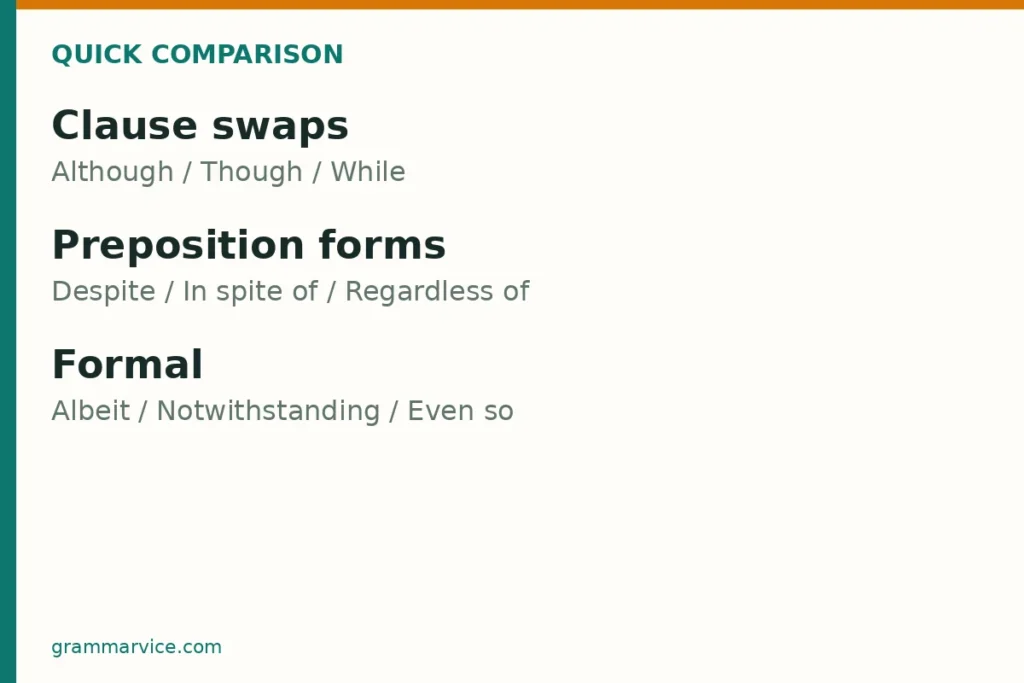
- Although — conjunction. The closest, most neutral substitute.
- Despite — preposition. Followed by a noun or -ing form, not a full clause.
- In spite of — preposition. Slightly more emphatic than “despite.”
- Notwithstanding — preposition. Formal, common in academic and legal writing.
- Despite being — preposition + -ing construction. For describing a state or quality.
- Although + adjective — conjunction construction. For short, punchy concessions.
- However + adjective — concessive construction. Formal, mainly for adjectives and adverbs.
- Though — conjunction. Shorter, slightly more conversational than “although.”
Use “although” when you are unsure. It works in almost every position where “even though” works.
True Clause Synonyms for “Even Though”
These are direct clause-for-clause swaps. They introduce a full clause, just as “even though” does, and they preserve the “real fact + surprising result” meaning.
1. Although — conjunction
The most reliable even though synonym. Slightly less emphatic than “even though,” but interchangeable in most sentences.
Example: Although she was tired, she finished the report.
2. Though — conjunction
A shorter, slightly more informal version of “although.” It can also appear at the end of a sentence as a comment, but here it is used as a clause introducer.
Example: Though the task was difficult, the team completed it ahead of schedule.
3. Even as — conjunction
Formal and literary. It suggests that two things happen at the same time, with a concessive edge. Use it sparingly, and only when the timing overlap is clear.
Example: Even as the company expanded, its customer service remained personal.
4. While — conjunction
“While” can mean “although” when it introduces a contrast, not just time. Make sure the concessive reading is clear from context.
Example: While the course was expensive, it was worth every penny.
Whereas — NOT counted here; see the myth-busting section
This entry is included only to prevent confusion. “Whereas” compares two parallel facts; it does not introduce a surprising concession in the same way. It is not numbered as a synonym in this guide — see “Listed Everywhere — But NOT Synonyms” below.
Correction: Do not write “Whereas it was raining, we went for a walk” as a substitute for “Even though it was raining, we went for a walk.” Use “Although it was raining, we went for a walk.”
5. Albeit — conjunction
Formal and concise. “Albeit” introduces a short concessive phrase, usually an adjective, adverb, or short phrase — not a full clause with a subject and verb.
Example: She accepted the job, albeit with some hesitation.
6. Granted — conjunction / construction
“Granted” concedes a point before presenting a contrast. It is often followed by a clause and then a main clause beginning with “but” or a new sentence.
Example: Granted, the plan was ambitious, but it succeeded.
7. Admittedly — connector / construction
“Admittedly” introduces a conceded fact as a sentence adverb, usually at the start of a sentence or clause. It works best when you are openly acknowledging a weakness.
Example: Admittedly, the first draft was weak, but the revision is strong.
8. It is true that — construction
A full concessive construction. It states a fact openly, then allows a contrasting main clause to follow.
Example: It is true that the journey was long, but it was enjoyable.
9. True, — construction
A shorter version of “It is true that.” Common in essays and speeches for a quick concession before a contrast.
Example: True, the evidence is limited, but it points in a clear direction.
10. For all — preposition / construction
“For all” followed by a noun phrase concedes a fact while suggesting it did not prevent the result. It is slightly formal and idiomatic.
Example: For all her experience, she still felt nervous before the interview.
Preposition Forms: Despite, In Spite Of and Notwithstanding
Prepositions cannot be followed by a full clause. They take a noun, pronoun, or -ing form. These forms are powerful because they make sentences shorter — but only if you change the clause into a noun phrase.
For a full explanation of “although” and its grammar, see the Cambridge Dictionary entry for although.
11. Despite — preposition
The most common prepositional alternative. Follow it with a noun or -ing form.
Example: Despite the rain, we went for a walk.
12. In spite of — preposition
Slightly more emphatic than “despite.” Same grammar: noun or -ing form only.
Example: In spite of the delay, she arrived in time for the meeting.
13. Notwithstanding — preposition
Formal. Often used in academic, legal, and official writing. It can appear before or after a noun phrase.
Example: Notwithstanding the risks, the committee approved the proposal.
14. Despite being — preposition + -ing construction
Use this when the concession describes a state, quality, or condition of the subject.
Example: Despite being exhausted, he stayed to help.
15. In spite of being — preposition + -ing construction
The “in spite of” version of the same pattern. Slightly more emphatic.
Example: In spite of being new to the city, she found her way easily.
16. Regardless of — preposition (noun / -ing only)
“Regardless of” is a genuine alternative only when followed by a noun or -ing form. It must never be followed by a full clause.
Example: Regardless of the weather, the event will go ahead.
17. Irrespective of — preposition
Formal synonym of “regardless of.” Same rule: noun or -ing form only.
Example: Irrespective of cost, safety must come first.
18. In the face of — preposition / construction
Idiomatic and slightly dramatic. It suggests overcoming opposition or difficulty.
Example: In the face of strong criticism, the author defended her argument.
19. In defiance of — preposition / construction
Stronger and more deliberate than “despite.” It implies active resistance, not just a difficulty.
Example: In defiance of the warning, he continued with the experiment.
No-Matter Clauses: Whatever, However and No Matter What
These constructions concede a range of possibilities. They do not mean “although this one fact is true” — they mean “no matter which fact is true, the result holds.” That is why they belong in their own group, honestly labelled.
20. No matter how + adjective/adverb — construction
Use this when the concession covers any degree of a quality.
Example: No matter how tired she was, she never missed a class.
21. No matter what — construction
Use this when the concession covers any situation or thing.
Example: No matter what happened, he kept his promise.
22. Whatever — conjunction / construction
“Whatever” can introduce a concessive clause meaning “no matter what.” It is more informal than “no matter what.”
Example: Whatever the weather, we will go ahead with the picnic.
23. However + adjective/adverb — construction
Formal. “However” here does not mean “but” — it means “to whatever degree.” It is followed by an adjective or adverb, then a clause.
Example: However difficult the exam, she was determined to pass.
24. Although + adjective — construction
A short concessive construction. It drops the subject and verb when they are clear from context.
Example: Although tired, she finished the report.
25. Much as — conjunction / construction
Formal and literary. “Much as” concedes a feeling or attitude before a contrast.
Example: Much as I admire her work, I disagree with this conclusion.
Sentence Connectors That Carry the Contrast
The following words do not replace “even though” inside a clause. They carry the contrast between sentences. They are counted here only in this clearly labelled connector group, honestly described as sentence connectors — never passed off as clause swaps.
For example, instead of:
Even though it was raining, we went for a walk.
You can write:
It was raining. Even so, we went for a walk.
The contrast is preserved, but the grammar is different. That distinction matters, especially in academic writing.
26. Even so — connector
Introduces a second sentence that happens despite the first. It does not join clauses.
Example: It was raining. Even so, we went for a walk.
27. Nevertheless — connector
Formal. Introduces a surprising result after a previous statement.
Example: The task was difficult. Nevertheless, the team completed it on time.
28. Nonetheless — connector
Formal, very close to “nevertheless.” Slightly more common in American academic writing.
Example: Funding was cut. Nonetheless, the project continued.
29. Still — connector
Short and natural. “Still” as a connector means “despite that,” not “up to now.”
Example: The evidence was weak. Still, it pointed in a clear direction.
30. Yet — connector
Formal and concise. “Yet” at the start of a sentence signals a surprising contrast.
Example: He had little experience. Yet he performed brilliantly.
31. All the same — connector
Idiomatic and slightly informal. It means “despite that fact.”
Example: The journey was long. All the same, it was worth it.
32. That said — connector
Conversational and common in essays and articles. It introduces a qualification or contrast to the previous sentence.
Example: The plan has risks. That said, the potential benefits are significant.
Formal and Literary Alternatives
The formal alternatives above are already included in the numbered list, but they deserve a quick guide for even though synonym academic writing. If you are writing an essay, thesis, or formal report, these are your safest choices:
- Although — neutral, always safe.
- Notwithstanding — very formal, concise.
- Albeit — formal, for short phrases.
- However + adjective — formal, for degree concessions.
- Much as — literary, for attitudes and feelings.
- Granted / Admittedly — for openly conceding a point.
Avoid stacking formal words to sound more academic. One clear concession is stronger than two competing ones.
“Even Though” vs “Although” vs “Despite”: A Quick Comparison
This is the core of the even though vs although vs despite question, and the even though vs although difference is smaller than many students expect.
| Word | Formality | What follows it | Comma rules |
|---|---|---|---|
| Even though | Neutral to formal | Full clause (subject + verb) | Comma after the clause if it comes first: “Even though it rained, we went out.” |
| Although | Neutral to formal | Full clause (subject + verb) | Same rule: “Although it rained, we went out.” |
| Despite | Neutral to formal | Noun or -ing form only | Comma after the phrase if it comes first: “Despite the rain, we went out.” |
Key takeaway: “even though” and “although” take clauses; “despite” does not. Never write “Despite it rained, we went out.” Write “Despite the rain, we went out” or “Although it rained, we went out.”
Listed Everywhere — But NOT Synonyms
These words appear on many “even though synonym” lists, but they are not synonyms. They are included here only to help you avoid mistakes, with a corrected sentence for each.
Even if — NOT a synonym
“Even if” introduces a hypothetical condition, not a real fact. Compare:
Wrong as a swap: Even if it was raining, we went for a walk. (This suggests the rain might not have happened.)
Correct original: Even though it was raining, we went for a walk. (The rain definitely happened.)
Corrected: Although it was raining, we went for a walk.
Even when — NOT a synonym
“Even when” is about time or a recurring condition, not concession alone.
Wrong as a swap: Even when she was tired, she finished the report. (This can mean “on occasions when she was tired.”)
Corrected: Although she was tired, she finished the report.
Even so much as — NOT a synonym
“Even so much as” is an intensifier, used in negative contexts to mean “even the smallest amount.” It does not introduce a concessive clause.
Wrong: Even so much as it was raining, we went for a walk.
Corrected: Even though it was raining, we went for a walk.
Whereas — NOT a synonym
“Whereas” compares two parallel facts, often about two different subjects. It does not signal that one fact surprisingly failed to prevent another.
Wrong: Whereas it was raining, we went for a walk.
Corrected: Although it was raining, we went for a walk.
Regardless of + a clause — UNGRAMMATICAL
“Regardless of” is a preposition. It must be followed by a noun or -ing form, never by a full clause.
Wrong: Regardless of it was raining, we went for a walk.
Corrected: Regardless of the rain, we went for a walk.
If a list counts these as alternatives, its count is inflated. This guide does not.
Before and After: One Essay Sentence Rewritten Five Ways
Original essay sentence:
Even though the study had limitations, its findings remain valuable.
Here is the same sentence rewritten once per group:
- True clause synonym: Although the study had limitations, its findings remain valuable.
- Preposition form: Despite its limitations, the study’s findings remain valuable.
- No-matter clause: No matter what its limitations were, the study’s findings remain valuable.
- Sentence connector: The study had limitations. Nevertheless, its findings remain valuable.
- Formal / literary: Notwithstanding its limitations, the study’s findings remain valuable.
Each version preserves the meaning. None changes the claim from a real limitation to a hypothetical one, and none turns a concession into a comparison.
Mistakes to Avoid
1. Writing “despite of”
“Despite” never takes “of.” Write “despite the rain,” not “despite of the rain.” If you want “of,” use “in spite of.”
Wrong: Despite of the delay, we arrived on time.
Correct: Despite the delay, we arrived on time.
2. Using “although… but” in one sentence
In standard English, do not combine “although” (or “even though”) with “but” in the same sentence. One concessive marker is enough.
Wrong: Although it was raining, but we went for a walk.
Correct: Although it was raining, we went for a walk.
3. Using “even though” for hypotheticals
Use “even though” only for real facts. For hypotheticals, use “even if.”
Wrong: Even though it rains tomorrow, we will go. (The rain has not happened yet.)
Correct: Even if it rains tomorrow, we will go.
4. Following “despite” with a clause
“Despite” takes a noun or -ing form. If you need a clause, switch to “although” or “even though.”
Wrong: Despite it was expensive, we bought it.
Correct: Despite its cost, we bought it. / Although it was expensive, we bought it.
5. Counting connectors as clause swaps
“Nevertheless” and “even so” are useful, but they start a new sentence. Do not use them to join two clauses with a comma in the same way as “even though.”
Students ask the same question in several forms — what can I say instead of even though, and what are the different ways to say even though in an essay or at work? Teachers collecting even though synonyms professional writers actually use will find them in the formal and preposition groups above: although, despite, in spite of and notwithstanding cover almost every real sentence.
Frequently Asked Questions
What is the difference between “even though” and “although”?
There is very little difference in meaning. “Even though” is slightly more emphatic and draws more attention to the contrast, while “although” is slightly more neutral. Both introduce a full clause, both are standard in formal and informal writing, and they are interchangeable in most sentences. If you need a safe another word for even though in an essay, choose “although.”
Can I use “despite” instead of “even though”?
Yes, but you must change the grammar. “Even though” is followed by a clause (“even though it rained”), while “despite” is followed by a noun or -ing form (“despite the rain” / “despite raining”). If you keep the clause unchanged, the sentence becomes ungrammatical. Change “Even though it was raining” to “Despite the rain” for a correct swap.
Is “even if” the same as “even though”?
No. “Even though” refers to a real, known fact: the rain happened, and we went out anyway. “Even if” refers to a hypothetical or uncertain condition: we will go out whether or not it rains. Using “even if” in place of “even though” changes the meaning from fact to possibility, so it is not a true synonym.
What is the most formal alternative to “even though” for an essay?
“Notwithstanding” is the most formal prepositional option, and “albeit” is the most formal option for short phrases. For a full clause, “although” remains the safest formal choice. In even though synonym academic writing, avoid overly literary options like “much as” unless the tone of your essay supports them.
Can “even though” start a sentence?
Yes. “Even though” can start a sentence, and it is a common way to ask another word for even though to start a sentence. When it comes first, put a comma after the concessive clause: “Even though it was late, she kept working.” You can also place it in the middle: “She kept working even though it was late.” Both are correct.
Why is “even so” not a true synonym of “even though”?
“Even so” is a sentence connector, not a subordinating conjunction. It cannot join two clauses in one sentence the way “even though” does. Instead, it starts a new sentence that contrasts with the previous one: “It was raining. Even so, we went for a walk.” It carries the same contrast, but with different grammar, so it is grouped honestly as a connector in this guide, not as a clause swap.
Conclusion
The best other ways to say even though are not the longest lists — they are the most accurate ones. Use “although” for a safe clause swap, “despite” or “in spite of” for a tighter noun phrase, “notwithstanding” or “albeit” for formal writing, and “nevertheless” or “even so” when you want to carry the contrast into a new sentence.
Above all, test every replacement: does it preserve a real fact and a surprising result, and does it fit the grammar of the sentence? If it does, it belongs in your writing. If it turns a fact into a hypothetical, a concession into a comparison, or a clause into an ungrammatical phrase, leave it out — no matter how often it appears on other lists.
With these 32 alternatives, you can vary your writing without sacrificing precision. Choose the option that matches your register, check its grammar, and let the contrast do the work.