30 Other Ways to Say “Make a Difference” (With Examples)
We all want to be told that our work matters, but repeating the same phrase can make it sound generic. If you want to express gratitude, write a stronger resume, or inspire a team, there are many other ways to say make a difference that sound more specific, professional, or heartfelt.
Quick answer: The best all-purpose alternatives to “make a difference” are “make an impact,” “add value,” and “drive meaningful change.” For formal writing, use “contribute to measurable outcomes” or “deliver tangible results.” For thank-you messages, “your support has changed lives” or “you’ve made a real difference in my life” sound warmer and more personal.
What Does “Make a Difference” Mean?
“Make a difference” means to have a noticeable, positive effect on a person, situation, or outcome. It suggests that something you did changed the result for the better, even if the change was small. For example, a teacher who stays late to help a struggling student can make a difference in that student’s confidence and grades.
The phrase is broad, which is both its strength and its weakness. It works in almost any context, from charity work to business, but it does not explain how something changed. That is why more precise alternatives often sound stronger. According to the Cambridge Dictionary definition of “make a difference,” the phrase means to have an important effect on something.
Some common situations where people use “make a difference” include:
- Thanking a volunteer, teacher, nurse, or colleague
- Describing achievements on a resume or cover letter
- Encouraging donations or community action
- Motivating a team or audience in a speech
- Writing an essay about social change or personal growth
Is “Make a Difference” Professional or Polite?
Yes, “make a difference” is both professional and polite. It is appropriate in workplace emails, performance reviews, speeches, essays, and thank-you notes. It is positive, respectful, and easy to understand.
However, it can sound vague in formal writing. A hiring manager may prefer a phrase that shows measurable results, such as “increased efficiency by 20%” or “improved customer satisfaction.” In a thank-you message, a more personal phrase like “you changed my life for the better” may feel more sincere.
The key is to match the phrase to the situation. In general, “make a difference” is safe, but a stronger make a difference synonym can make your message more memorable.
Quick Top Picks: The 8 Best Alternatives at a Glance
If you need a quick replacement, start with these eight. Each one appears in the detailed list below, so you can find examples and usage notes for every phrase.
- Add value – Best for resumes and business writing.
- Make an impact – Best all-purpose replacement.
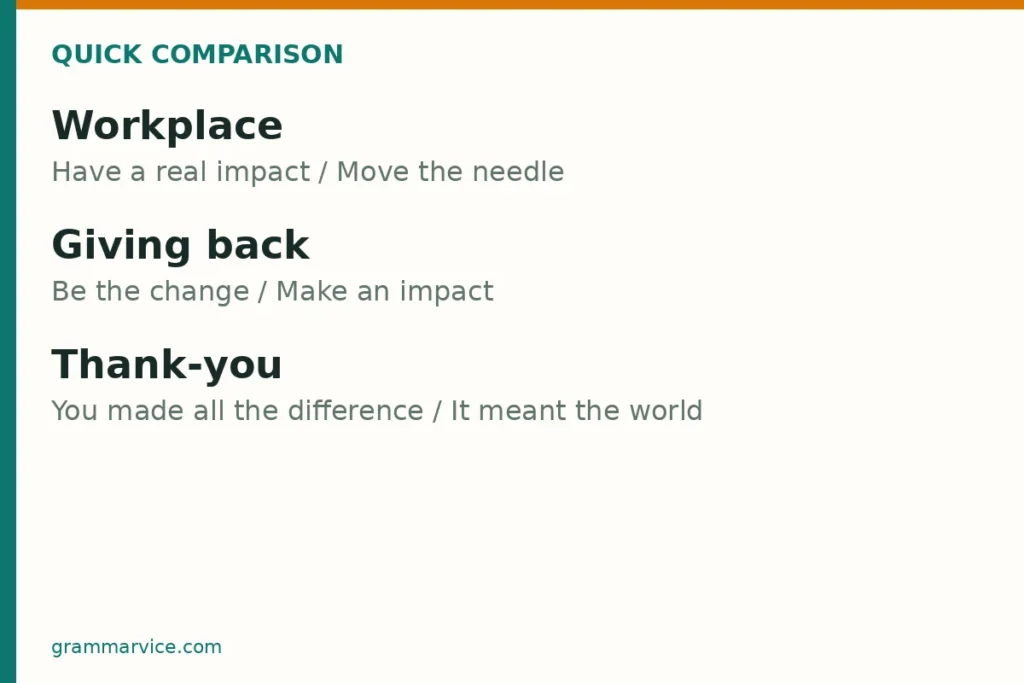
- Move the needle – Best for measurable business results.
- Give back to the community – Best for charity and volunteering.
- Champion a cause – Best for advocacy and social change.
- Be a force for good – Best for motivational speeches.
- Lead by example – Best for leadership and mentoring.
- Your work truly matters – Best for thank-you messages.
Professional and Workplace Alternatives to “Make a Difference”
Workplace writing needs to be clear, confident, and results-focused. These alternatives help you describe your contribution without sounding vague, and they work especially well on resumes, cover letters, performance reviews, and business reports.
1. Add Value
Tone and usage: Professional and business-like. Use it when you want to show that your work improved a process, product, or team.
Example: In my previous role, I added value by redesigning the onboarding process, which reduced training time by two weeks.
2. Make an Impact
Tone and usage: Confident and versatile. This is the most common make a difference synonym and works in almost any professional context.
Example: Her presentation made an impact on the leadership team, and they approved the project the same day.
3. Drive Results
Tone and usage: Strong and action-oriented. Ideal for resumes and performance reviews where outcomes matter.
Example: As team lead, I drove results by setting clear weekly goals and tracking progress daily.
4. Deliver Tangible Results
Tone and usage: Formal and evidence-based. Use it when you can point to specific numbers or improvements.
Example: The new marketing strategy delivered tangible results, including a 30% increase in qualified leads.
5. Contribute to Measurable Outcomes
Tone and usage: Formal and precise. Best for cover letters, grant proposals, and business reports.
Example: I contributed to measurable outcomes by improving customer retention from 78% to 89% in one year.
6. Move the Needle
Tone and usage: Modern business language. Use it to describe a noticeable improvement in performance or metrics.
Example: The new pricing model really moved the needle, boosting monthly sales by 15%.
7. Create Lasting Change in the Workplace
Tone and usage: Professional and forward-looking. Best when describing long-term improvements, not one-time wins.
Example: By introducing a mentorship program, she created lasting change in the workplace culture.
8. Strengthen the Team
Tone and usage: Collaborative and positive. Use it in performance reviews or leadership examples.
Example: He strengthened the team by encouraging open communication and sharing knowledge across departments.
9. Improve Efficiency
Tone and usage: Practical and professional. Perfect for describing process improvements.
Example: Automating the weekly reports improved efficiency and saved the team six hours every week.
10. Boost Performance
Tone and usage: Direct and results-focused. Works well on resumes and in business presentations.
Example: The revised training program boosted performance across all three regional offices.
11. Shape Strategy
Tone and usage: Senior and strategic. Use it when your ideas influenced major decisions.
Example: As a consultant, I helped shape strategy for the company’s expansion into new markets.
12. Drive Innovation
Tone and usage: Ambitious and modern. Best for technology, product development, and creative roles.
Example: Her research drove innovation in our product line, leading to two new patents.
Community, Charity and Volunteering Alternatives
When talking about charity, volunteering, or community work, the tone should be warm, generous, and action-oriented. These phrases describe how people help others and improve their neighborhoods.
13. Give Back to the Community
Tone and usage: Warm and generous. Ideal for charity appeals, volunteer stories, and social media posts.
Example: Every Saturday, our team gives back to the community by serving meals at the local shelter.
14. Support Those in Need
Tone and usage: Compassionate and sincere. Use it for fundraising, charity work, and community outreach.
Example: The fundraiser helped support those in need by providing winter coats to 500 families.
15. Transform Lives
Tone and usage: Powerful and emotional. Best for charity campaigns and inspirational stories.
Example: Your donations transform lives by giving children access to education and healthcare.
16. Champion a Cause
Tone and usage: Passionate and committed. Use it for advocacy, activism, and long-term campaigns.
Example: She champions a cause close to her heart: clean water for rural communities.
17. Serve Others
Tone and usage: Humble and respectful. Perfect for volunteering, faith-based work, and service roles.
Example: He spends his weekends serving others at the food bank and mentoring young people.
18. Build a Better Future
Tone and usage: Hopeful and forward-looking. Ideal for youth programs, environmental projects, and education.
Example: By planting trees in our neighborhood, we are building a better future for the next generation.
19. Empower Others
Tone and usage: Inspiring and respectful. Use it when helping people gain skills, confidence, or independence.
Example: The program empowers others by teaching job skills to adults returning to work.
Motivational Alternatives for Speeches and Social Media
Speeches and social media posts need energy, emotion, and memorable language. These alternatives are bold, uplifting, and easy to remember, making them perfect for motivational talks, captions, and essays.
20. Be a Force for Good
Tone and usage: Inspiring and powerful. Best for speeches, graduation talks, and social media.
Example: You don’t need to be famous to be a force for good — small acts of kindness count too.
21. Lead by Example
Tone and usage: Motivational and leadership-focused. Use it to encourage action through personal behavior.
Example: If you want to change your workplace, lead by example and treat everyone with respect.
22. Inspire Others to Act
Tone and usage: Encouraging and persuasive. Ideal for speeches, campaigns, and calls to action.
Example: Her story inspired others to act, and within a month, 200 people had signed up to volunteer.
23. Change the World, One Step at a Time
Tone and usage: Hopeful and accessible. This phrase makes big goals feel achievable.
Example: You can change the world, one step at a time, by starting with your own neighborhood.
24. Leave a Lasting Legacy
Tone and usage: Reflective and emotional. Best for retirement speeches, tributes, and long-term projects.
Example: Through her teaching, she left a lasting legacy that her students will carry for years.
25. Turn Compassion Into Action
Tone and usage: Passionate and practical. Use it when encouraging people to move from feeling to doing.
Example: Instead of just feeling sorry, turn compassion into action by donating or volunteering today.
26. Be the Change You Wish to See
Tone and usage: Classic and motivational. This well-known phrase encourages personal responsibility.
Example: If you want a kinder community, be the change you wish to see and start today.
27. Rise to the Occasion
Tone and usage: Confident and encouraging. Best for challenges, competitions, and difficult moments.
Example: When the team needed help, Maria rose to the occasion and delivered the project on time.
Ways to Say “You Make a Difference” in Thank-You Messages
Thank-you messages should feel personal and specific. Instead of a generic compliment, these phrases show exactly how someone helped you or others. They work for teachers, nurses, volunteers, employees, friends, and family members.
28. Your Work Truly Matters
Tone and usage: Warm and respectful. Perfect for employees, teachers, and healthcare workers.
Example: Thank you for your dedication — your work truly matters to every student in this school.
29. You’ve Changed My Life for the Better
Tone and usage: Deeply personal and emotional. Best for mentors, teachers, and close friends.
Example: Thank you, Mrs. Lee — you’ve changed my life for the better with your patience and encouragement.
30. Your Support Has Changed Lives
Tone and usage: Grateful and impactful. Ideal for donors, volunteers, and community leaders.
Example: Your support has changed lives by funding scholarships for first-generation college students.
31. You’ve Made a Real Difference in My Life
Tone and usage: Sincere and heartfelt. Use it in personal thank-you notes and speeches.
Example: I want you to know you’ve made a real difference in my life, and I’m forever grateful.
32. I’m Grateful for Everything You Do
Tone and usage: Simple, warm, and versatile. Works for colleagues, nurses, caregivers, and volunteers.
Example: To all our nurses: I’m grateful for everything you do, day and night, for your patients.
33. Your Kindness Has Touched So Many Lives
Tone and usage: Emotional and appreciative. Best for retirement tributes and community awards.
Example: Your kindness has touched so many lives in this town, and we will always remember it.
34. You Make Every Day Better
Tone and usage: Friendly and upbeat. Perfect for coworkers, friends, and family.
Example: Thank you for always bringing energy and humor — you make every day better.
35. You’re Making the World a Kinder Place
Tone and usage: Uplifting and general. Ideal for social media tributes and volunteer appreciation.
Example: To everyone who volunteers: you’re making the world a kinder place, one act at a time.
If you want more ideas for expressing appreciation, explore these other ways to say going the extra mile for thanking people who go above and beyond. You can also find related phrases in our guide to other ways to say making a change.
Which One Should You Use? A Quick Guide
Choosing the right phrase depends on your audience and goal. Use this table to find the best fit quickly.
| Situation | Best Phrase | Why It Works |
|---|---|---|
| Resume or cover letter | Add value / Deliver tangible results | Shows measurable, professional impact. |
| Performance review | Drive results / Boost performance | Focuses on outcomes and growth. |
| Business presentation | Move the needle / Shape strategy | Sounds modern and strategic. |
| Charity appeal | Transform lives / Support those in need | Emotional and action-oriented. |
| Motivational speech | Be a force for good / Lead by example | Inspiring and memorable. |
| Thank-you note to a teacher | You’ve changed my life for the better | Personal and heartfelt. |
| Thank-you note to a nurse | Your work truly matters | Respectful and sincere. |
| Social media post | Be the change you wish to see | Short, familiar, and shareable. |
Example: A Resume Bullet and a Thank-You Note, Rewritten
Seeing a weak phrase rewritten with a stronger alternative makes the difference clear.
Resume Bullet: Before and After
Before (flat): “Made a difference in the sales department.”
After (stronger): “Added value to the sales department by redesigning the lead follow-up process, increasing conversions by 18% in six months.”
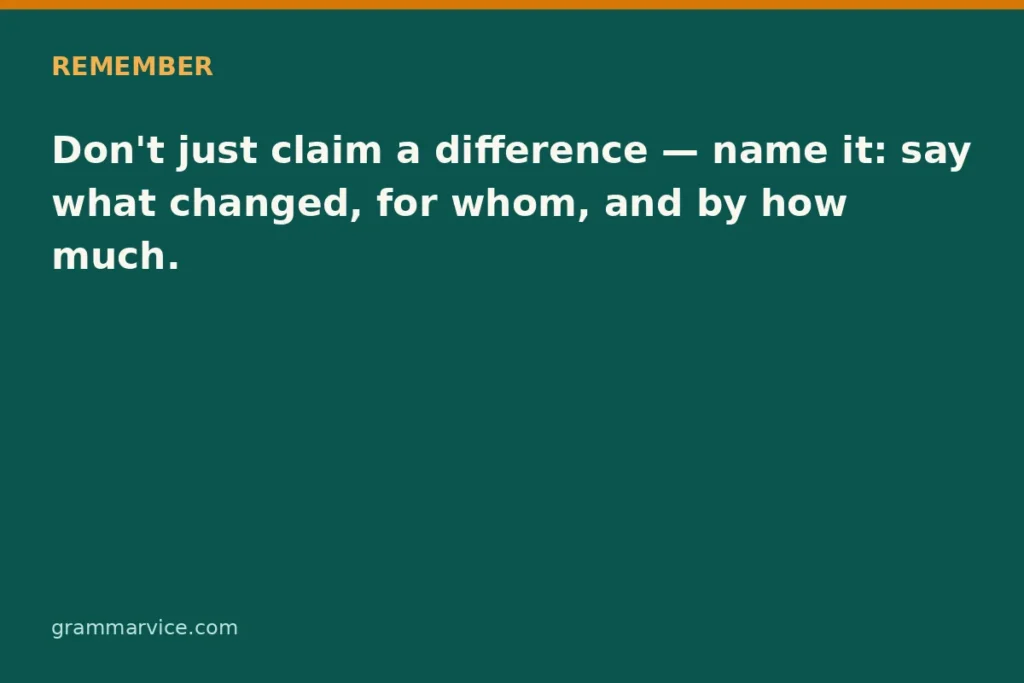
Why it works: The rewritten version names the action, the method, and the result. It is specific, professional, and easy for a hiring manager to understand.
Thank-You Note: Before and After
Before (generic): “Thank you for making a difference.”
After (personal): “Thank you for staying late to help me prepare for my presentation. Your patience and encouragement changed my confidence, and I’m grateful for everything you do.”
Why it works: The rewritten note mentions a specific action and its emotional impact, making it feel genuine rather than generic.
Mistakes to Avoid
Even good alternatives can sound wrong if used carelessly. Avoid these common mistakes:
- Being too vague: Saying “I made an impact” without explaining how is almost as vague as the original phrase. Add a result or example.
- Using formal language in personal notes: “Contribute to measurable outcomes” sounds cold in a thank-you card. Use warmer language instead.
- Overusing motivational clichés: Phrases like “be the change” lose power if repeated too often. Save them for moments that truly matter.
- Using incorrect grammar: Never say “make an influence.” The correct phrase is “have an influence” or “influence others.”
- Sounding boastful: On a resume, focus on results and teamwork, not just self-praise. For example, “strengthened the team” sounds better than “single-handedly changed everything.”
Readers often ask how to say make a difference in other words, and the honest answer is that the best replacement depends on tense and tone. If you need another way to say made a difference for a report about past work, try “delivered tangible results.” If you need a make a difference synonym formal enough for a board paper, “contribute to measurable outcomes” fits, and if you need a make a difference synonym positive and warm for a card, “your support has changed lives” works beautifully.
The same logic covers the bigger searches. Anyone looking for another way to say make a difference in the world is usually writing about charity or community work, where “transform lives” is the strongest make a difference in the world synonym. Lists of other ways to say make an impact overlap heavily with this one, because impact and difference are near-twins. And if your real question is how to say you make a difference to a specific person, or you simply want another way to say make a change or another way to say make a positive difference in an essay, the thank-you and motivational groups above give you the exact wording.
Frequently Asked Questions
What can I say instead of “make a difference” in a professional setting?
In a professional setting, use “add value,” “deliver tangible results,” “drive results,” or “contribute to measurable outcomes.” These phrases sound more specific and results-focused. For example, instead of saying “I made a difference in sales,” say “I added value by increasing sales by 18% in six months.” Choose the phrase that best matches your achievement and audience.
Is “make an impact” the same as “make a difference”?
Yes, “make an impact” is very close in meaning to “make a difference,” but it often sounds slightly stronger and more active. “Impact” suggests a noticeable effect, while “difference” can be more general. Both are appropriate in professional and personal contexts, but “make an impact” is often preferred in resumes, speeches, and business writing.
How do you say “make a difference” in a motivational speech?
In a motivational speech, use bold, emotional phrases like “be a force for good,” “lead by example,” or “be the change you wish to see.” These phrases inspire action and are easy for an audience to remember. Pair them with a story or example to make the message more powerful.
What is a stronger word for “make a difference”?
There is no single stronger word, but stronger phrases include “transform,” “revolutionize,” and “drive lasting change.” For example, “transform lives” sounds more powerful than “make a difference” in a charity context. In business, “drive innovation” or “shape strategy” can sound more impressive and specific.
How do I say “you make a difference” to thank someone?
To thank someone personally, say “your work truly matters,” “you’ve changed my life for the better,” or “I’m grateful for everything you do.” Add a specific example to make it sincere. For example: “Thank you for helping me through a difficult time — you’ve made a real difference in my life.”
Can I use “make a difference” on a resume or cover letter?
Yes, you can use “make a difference” on a resume or cover letter, but it is better to replace it with a more specific phrase. Hiring managers prefer measurable achievements. Instead of “made a difference in customer service,” write “improved customer satisfaction from 82% to 94% by redesigning the feedback process.” Specific results always sound stronger.
Conclusion
Finding the right words can turn a generic compliment into a powerful message. Whether you are writing a resume, thanking a teacher, or inspiring a community, choosing a precise alternative helps your audience understand exactly how someone helped.
From professional phrases like “add value” and “deliver tangible results” to heartfelt options like “you’ve changed my life for the better,” there are many other ways to say make a difference that fit every situation. Pick the one that matches your tone, add a specific example, and your message will be far more memorable.