25 Other Ways to Say ‘Another Way’ (With Examples)
Another way is more than just a replacement phrase. It can change the tone of a suggestion, make an instruction easier to follow, or signal that you are offering a better route instead of simply repeating a failed one.
People search for other ways to say another way because the phrase itself can feel flat when used repeatedly. In emails, essays, instructions, creative writing, and everyday conversation, a small change in wording can make your point sound more thoughtful, confident, or polite.
Whether you are hunting for an alternative way synonym for a report, an another option synonym for an email, a different way synonym for an essay, or clearer another method synonyms for instructions, the right choice depends on context — which is exactly what readers asking “what can I say instead of another way?” usually need.
This guide gives you 33 practical alternatives, organized by situation. You will find formal options for work and academic writing, natural choices for everyday life, creative phrasing for storytelling, and rephrasing frames for explaining the same idea differently. Each alternative includes a short tone note and an example sentence, so you can choose quickly without guessing.
What Does “Another Way” Mean? A Guide to Other Ways to Say Another Way
“Another way” means a different method, route, option, or form of expression that can achieve the same goal or communicate the same idea. It does not always mean a completely different result; it often means a different path to a similar outcome.
For example, saying “There is another way to solve this problem” suggests that the current method is not the only possible one. The phrase is useful because it opens a conversation without directly criticizing the first approach.
The exact replacement depends on what you are changing: a method, an option, a route, a wording choice, or a point of view. A Merriam-Webster thesaurus entry for “alternative” lists related ideas such as “different,” “other,” and “substitute,” which shows how broad this word family can be.
That breadth is also why precision matters. “Another option” sounds different from “a different approach,” and “put another way” does not mean the same thing as “an alternative method.” The sections below separate those uses so you can choose the right one.
Quick Top Picks: The 8 Most Useful Alternatives
If you need a fast answer, these eight alternatives cover most situations.
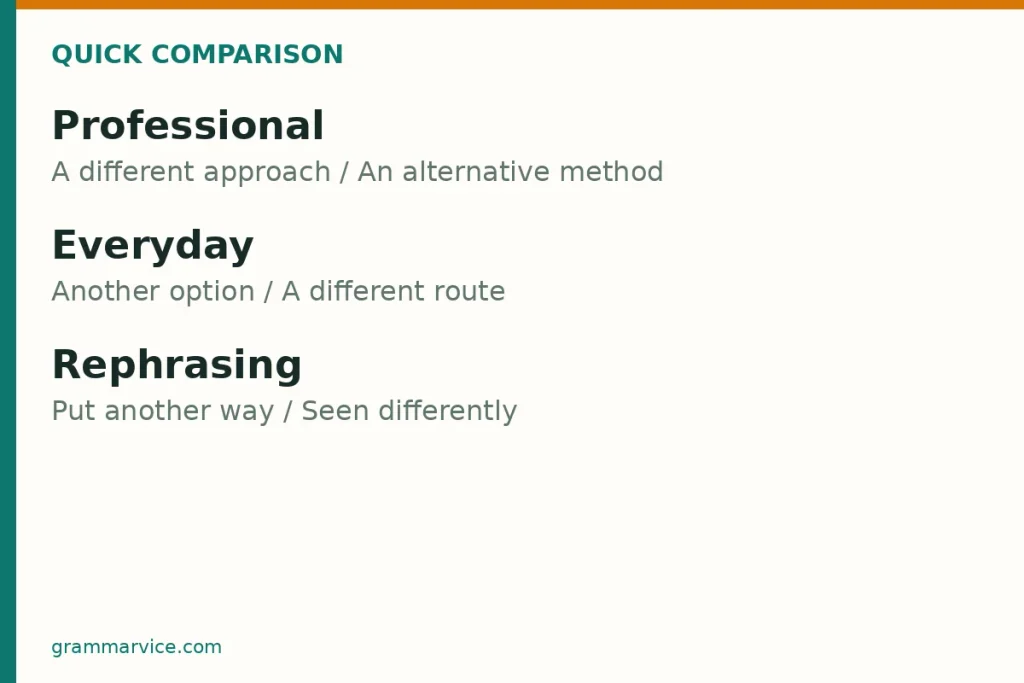
- An alternative approach: A polished, professional way to propose a different method.
- A different approach: A clear, neutral option for work, school, and everyday suggestions.
- Another option: Best when the listener can choose between two or more possibilities.
- Another method: Ideal for instructions, processes, and practical problem-solving.
- A different route: Useful for plans, journeys, and step-by-step directions.
- Put another way: Best for rewording an idea rather than changing a plan.
- Another perspective: Ideal for discussions, opinions, and creative thinking.
- An alternative plan: Best when the original plan needs a backup or replacement.
Keep these eight in mind, then use the fuller list below when you want a more precise tone.
Professional and Formal Alternatives: Another Way Synonym Formal and Essay Options
Formal writing calls for alternatives that sound measured rather than casual. If you need an another way synonym formal enough for a report, or an another way synonym essay option that will not weaken your argument, start with these choices.
1. An Alternative Approach
Tone: Formal, professional, and solution-focused.
Example: An alternative approach would be to test the new system with a smaller group before rolling it out company-wide.
2. A Different Approach
Tone: Neutral, professional, and easy to use in essays and reports.
Example: A different approach could help the team reduce errors without increasing the overall workload.
3. An Alternative Method
Tone: Precise, formal, and useful for research, instructions, and technical writing.
Example: An alternative method involves collecting the data weekly instead of waiting until the end of the project.
4. Another Method
Tone: Clear and professional, especially in procedures and explanations.
Example: Another method is to compare the results from both groups before choosing a final recommendation.
5. A Different Method
Tone: Formal but accessible, and suitable for academic and workplace writing.
Example: A different method might produce more accurate results if the sample size is increased.
6. An Alternative Strategy
Tone: Strategic, businesslike, and confident.
Example: An alternative strategy would focus on retaining existing customers rather than spending more on advertising.
7. A Viable Alternative
Tone: Formal and persuasive; suggests the option is practical, not merely theoretical.
Example: A viable alternative is to move the meeting online so team members in other time zones can participate.
8. A More Effective Approach
Tone: Professional and evaluative; useful when comparing methods.
Example: A more effective approach would be to review the draft earlier, when changes are easier to make.
Everyday Alternatives for Options and Fixes
In everyday conversation, you usually want a phrase that sounds natural, not stiff. These alternatives work well when suggesting a new plan, fixing a problem, or offering someone a choice.
9. Another Option
Tone: Friendly, practical, and conversational.
Example: Another option is to take the train instead of driving through rush-hour traffic.
10. A Different Option
Tone: Simple, neutral, and easy to understand.
Example: A different option would be to split the work into two shorter sessions.
11. A Different Route
Tone: Practical and direct, especially for travel and step-by-step plans.
Example: A different route could save us twenty minutes if the main road stays congested.
12. Another Route
Tone: Everyday and helpful; works literally and figuratively.
Example: Another route to the same result is to start with the simplest version and improve it later.
13. Another Plan
Tone: Casual and reassuring, especially when the first plan fails.
Example: Another plan is to meet on Thursday if the conference room is already booked on Wednesday.
14. A Backup Plan
Tone: Practical and calm; signals preparation rather than panic.
Example: A backup plan would be to record the presentation in case the live connection drops.
15. A Simpler Solution
Tone: Helpful and approachable; emphasizes ease rather than complexity.
Example: A simpler solution is to use one shared document instead of sending multiple versions by email.
16. A Quicker Fix
Tone: Informal and practical; best for small, immediate problems.
Example: A quicker fix is to restart the device before checking the more complicated settings.
Creative and Fresh-Eyes Alternatives
Creative writing benefits from alternatives that suggest imagination, discovery, or a shift in perspective. These phrases are less suited to formal reports, but they can make stories, essays, speeches, and brainstorming sessions feel more alive.
17. A Fresh Perspective
Tone: Creative, thoughtful, and reflective.
Example: A fresh perspective might reveal a solution that the team had overlooked for weeks.
18. Another Perspective
Tone: Open-minded and balanced; useful in discussions and essays.
Example: Another perspective is that the delay gave the team more time to improve the design.
19. A New Angle
Tone: Creative, energetic, and conversational.
Example: A new angle on the story could focus on the people affected, rather than only the statistics.
20. A Different Lens
Tone: Reflective and slightly literary; best for essays and creative analysis.
Example: A different lens might show the same event as a turning point instead of a setback.
21. An Outside-the-Box Idea
Tone: Creative and informal; signals originality.
Example: An outside-the-box idea is to turn the empty shop into a community reading room.
22. A Creative Workaround
Tone: Inventive and practical; useful when a direct solution is unavailable.
Example: A creative workaround is to use the old equipment for a different part of the project.
Rephrasing Frames and Transitions
Some alternatives do not change a method at all. They change how an idea is expressed. These rephrasing frames are especially useful when you want to clarify, soften, or restate a point without sounding repetitive.
23. Put Another Way
Tone: Natural, clear, and widely used in writing and speech.
Example: Put another way, the project is not behind schedule; it is simply being completed in a different order.
24. In Different Words
Tone: Straightforward and explanatory; close in meaning to a direct rewording.
Example: In different words, we need to focus on quality before increasing the number of tasks.
25. To Say It Differently
Tone: Conversational and flexible; works well in explanations and presentations.
Example: To say it differently, the goal is not to work longer, but to work with a clearer plan.
26. From Another Angle
Tone: Thoughtful and analytical; introduces a shift in viewpoint.
Example: From another angle, the criticism could be seen as useful feedback rather than rejection.
27. In Another Sense
Tone: Nuanced and academic; useful when a word or idea has more than one meaning.
Example: In another sense, freedom can mean having enough time, not just having many choices.
28. To Put It Differently
Tone: Polished and professional; a slightly more formal cousin of “put another way.”
Example: To put it differently, the team does not need more information; it needs a clearer decision.
When the Other Way Is Better or Revised
Sometimes the point is not merely that another option exists, but that it is better, simpler, or more current. These alternatives make that comparison clear without sounding aggressive.
29. A Better Alternative
Tone: Confident and evaluative; useful when recommending a change.
Example: A better alternative is to send one concise update instead of several long emails.
30. An Improved Method
Tone: Professional and forward-looking; emphasizes progress.
Example: An improved method would check the data automatically, reducing the chance of manual errors.
31. A Revised Approach
Tone: Formal and constructive; ideal for feedback and project updates.
Example: A revised approach could keep the original goal while changing the timeline and responsibilities.
32. A More Practical Option
Tone: Sensible and grounded; focuses on what can realistically be done.
Example: A more practical option is to begin with the available materials rather than waiting for new supplies.
33. An Alternative Course of Action
Tone: Very formal and deliberate; suitable for official proposals and decision-making.
Example: An alternative course of action would be to pause the rollout, review the feedback, and relaunch with clearer instructions.
Before and After: Upgrading Real Sentences
Seeing alternatives in context makes the difference easier to feel. Here are a few simple upgrades:
- Before: There is another way to do this. After: An alternative approach is to divide the task into smaller, clearer steps.
- Before: Can we try another way? After: Could we consider a different approach that takes less time?
- Before: That is another way of saying it. After: Put another way, the main problem is timing, not effort.
- Before: Is there another way? After: Is there a more practical option that fits our current budget?
Notice how the revised sentences do more than swap a phrase. They clarify whether you are changing a method, an option, or the wording itself.
Which Alternative Should You Use?
Use this quick guide to match the phrase to your purpose:
For formal writing and essays: Choose “an alternative approach,” “a different approach,” “an alternative method,” or “a revised approach.” These options sound measured and support an argument without drawing attention to themselves.
For professional emails: Try “another option,” “a viable alternative,” or “a more practical option.” They are polite, clear, and easy for the reader to act on.
For everyday conversation: Use “another option,” “a different route,” “another plan,” or “a simpler solution.” These phrases sound natural and do not make a simple suggestion feel overly formal.
For creative writing: Consider “a fresh perspective,” “a new angle,” or “a different lens.” They suggest imagination and invite the reader to see the subject differently.
For rephrasing an idea: Choose “put another way,” “to say it differently,” or “in different words.” These frames change expression, not necessarily the plan itself.
For recommending a better choice: Use “a better alternative,” “an improved method,” or “a more effective approach.” They make the comparison clear while remaining constructive.
If you are also working on rewording explanations, our guide to other ways to say “in other words” can help you choose a clearer transition for the next sentence. And when the honest answer is that either option works for you, our guide to other ways to say “I don’t care” covers the polite ways to say that, too.
Common Mistakes to Avoid
1. Using “another way” for every suggestion. Repetition makes even good advice sound vague. Vary the phrase, but also vary the sentence structure.
2. Confusing a new wording with a new method. “Put another way” rephrases an idea. “An alternative method” changes how something is done. Using one for the other can confuse the reader.
3. Choosing a formal phrase in a casual message. “An alternative course of action” can sound stiff in a friendly text. Save the most formal options for reports, proposals, and academic writing.
4. Offering an alternative without explaining the benefit. A suggestion is stronger when the reader understands why the new option helps. Add one short reason when it matters.
5. Using too many alternatives in one paragraph. Listing several options without a recommendation can make a message feel indecisive. Choose the strongest option, or clearly rank two choices.
All the Alternatives at a Glance
Here is the complete set in one place, grouped by use:
- Professional and formal: An alternative approach; a different approach; an alternative method; another method; a different method; an alternative strategy; a viable alternative; a more effective approach.
- Everyday options and fixes: Another option; a different option; a different route; another route; another plan; a backup plan; a simpler solution; a quicker fix.
- Creative and fresh-eyes: A fresh perspective; another perspective; a new angle; a different lens; an outside-the-box idea; a creative workaround.
- Rephrasing frames: Put another way; in different words; to say it differently; from another angle; in another sense; to put it differently.
- Better or revised: A better alternative; an improved method; a revised approach; a more practical option; an alternative course of action.
For related vocabulary, the Merriam-Webster thesaurus entry for “alternative” can help you compare nearby meanings before choosing a final phrase.

Frequently Asked Questions
What is a simple way to say “another way”?
“Another option” is one of the simplest replacements, especially when the listener can choose between possibilities. “A different approach” is also simple and works in both casual and professional contexts.
Can I use “another way” and its alternatives in professional emails?
Yes. “Another way” itself is acceptable in professional emails, but alternatives such as “an alternative approach,” “another option,” and “a viable alternative” often sound more precise. Choose a phrase that matches the formality of your message and the relationship with the reader.
How can I sound more natural when suggesting alternatives?
Use a conversational frame and a clear reason. Instead of only saying “another way,” try “Another option is to meet earlier, which would give us time to review the changes.” Short sentences and specific benefits sound more natural than vague suggestions.
What is the best phrase for creative writing?
“A fresh perspective” and “a new angle” are strong choices for creative writing because they suggest imagination rather than a routine change. “A different lens” also works well when you want a more literary or reflective tone.
How can I politely disagree using these phrases?
Frame the alternative as an addition rather than a rejection. For example, “A different approach could be to test the idea first” sounds more collaborative than “That way will not work.” Adding words such as “could” or “might” also softens the suggestion.
What is the difference between “another way” and “alternatively”?
“Another way” is a noun phrase that names a different method, option, or route. “Alternatively” is an adverb that introduces a different possibility within a sentence. For example, “Alternatively, we could start tomorrow” is more compact, while “Another way is to start tomorrow” names the option more directly.
Conclusion
Knowing other ways to say another way gives you more control over tone, clarity, and persuasion. The best phrase depends on whether you are proposing a method, offering a choice, rewording an idea, or recommending a better plan.
For formal writing, choose “an alternative approach” or “a different approach.” For everyday suggestions, “another option” and “a simpler solution” are easy and natural. For creative work, try “a fresh perspective” or “a new angle.” For rephrasing, “put another way” remains one of the clearest choices.
When you match the alternative to your purpose, your writing sounds less repetitive and your suggestions become easier to understand and act on. That is the real benefit of learning how to say this another way in a natural, confident style.