25 Other Ways to Say ‘In Other Words’ (With Examples)
Quick Answer: Some of the best alternatives to “in other words” include “to put it another way,” “put differently,” “simply put,” “that is to say,” “to clarify,” “in simpler terms,” “what I mean is,” and “in short.” The best choice depends on whether you are writing an academic essay, sending a professional email, explaining an idea, or summarizing information.
Using the same transition phrase repeatedly can make your writing sound predictable. Although “in other words” is useful for explaining an idea more clearly, switching to a suitable alternative can improve your sentence flow and make your communication more engaging.
Whether you are writing a research paper, preparing a business presentation, responding to an email, or having an everyday conversation, knowing other ways to say in other words gives you more flexibility. Some expressions sound formal and academic, while others are better suited to casual explanations and summaries.
In this guide, you will find 33 useful alternatives, complete with tone descriptions and natural example sentences. You will also learn which expressions work best in professional communication, academic writing, and everyday situations.
What Does “In Other Words” Mean? A Guide to Other Ways to Say In Other Words
“In other words” is a transitional expression used to explain, clarify, simplify, or restate something that has already been mentioned. It introduces a different version of the same idea, usually to make the original message easier to understand.
For example:
“The company needs to reduce operating expenses. In other words, it must spend less money to maintain its current operations.”
The second sentence communicates the same central idea using more accessible language. According to the Cambridge Dictionary definition of “in other words”, the expression introduces an explanation that is simpler than the one given earlier.
Depending on the situation, you might use a phrase that emphasizes clarification, provides a simpler explanation, introduces a specific detail, or summarizes the main point. These differences matter because not every synonym works naturally in every sentence.
Quick Top Picks: The 8 Best Alternatives
If you want a quick answer to the question “What is another way to say in other words?” these eight expressions are excellent starting points.
- To put it another way: A natural choice for restating an idea without changing its meaning.
- Put differently: A polished alternative for academic and professional writing.
- Simply put: Best for making complicated information easier to understand.
- That is to say: A formal expression for clarification or further explanation.
- Let me clarify: Useful when correcting confusion in a conversation or email.
- In simpler terms: Ideal for explaining technical or unfamiliar information.
- In short: A concise way to communicate the most important information.
- The bottom line is: Best for emphasizing the practical conclusion or main takeaway.
These alternatives cover different communication styles. If you need an academic expression, consider “put differently.” For a friendly explanation, choose “simply put.” When wrapping up an argument, “in short” may be more appropriate.
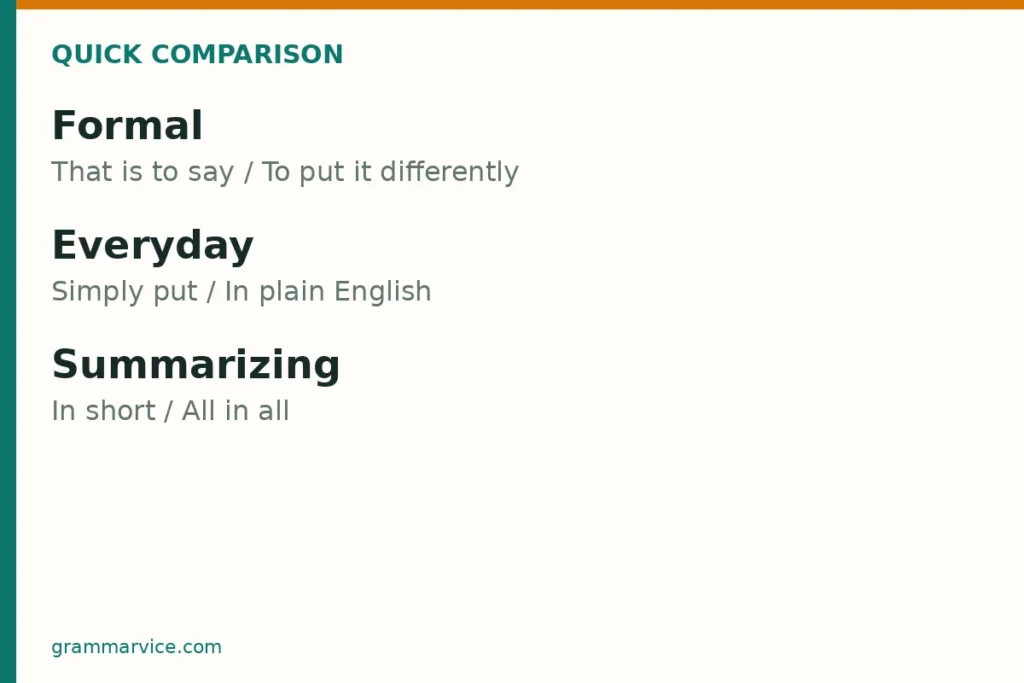
Formal and Academic Alternatives
When writing research papers, essays, reports, or professional documents, choose expressions that sound precise and maintain an appropriate level of formality. An in other words synonym formal enough for academic work should clarify your argument without making the writing sound unnecessarily complicated.
If you are searching for an in other words synonym in academic writing or an in other words synonym in an essay, the following expressions can help you introduce explanations, refine statements, and connect related ideas.
1. That Is to Say
Tone: Formal, academic, and precise.
“That is to say” introduces a clarification or a more specific explanation of something already mentioned. It works particularly well in essays, research papers, and formal discussions where you want to define an idea more clearly.
Example: The experiment produced inconsistent results; that is to say, the findings varied across the different test groups.
2. To Put It Another Way
Tone: Professional, neutral, and natural.
This expression introduces a restatement without changing the original meaning. It is suitable for academic paragraphs, presentations, business reports, and explanatory writing.
Example: The organization needs stronger financial planning. To put it another way, it must manage its available resources more carefully.
3. Put Differently
Tone: Polished, concise, and academic.
“Put differently” is a particularly useful alternative when you want to restate an argument in a fresh way. Its concise structure makes it suitable for formal essays and analytical writing without adding unnecessary words.
Example: Economic stability depends on consumer confidence. Put differently, people are more likely to spend when they feel financially secure.
4. For Clarity
Tone: Professional, direct, and informative.
Use “for clarity” when introducing an explanation intended to prevent misunderstanding. Unlike a simple restatement, it emphasizes that you are making a particular point easier to interpret.
Example: For clarity, the revised policy applies only to employees who joined after January 1.
5. To Be Precise
Tone: Formal, analytical, and exact.
“To be precise” is useful when your next statement narrows down or corrects the meaning of an earlier statement. It is especially appropriate for research, technical documents, and discussions involving specific details.
Example: The project took approximately six months to complete; to be precise, the final approval arrived 182 days after its launch.
6. More Specifically
Tone: Academic, detailed, and professional.
This expression introduces more specific information about a broader statement. It works well when moving from a general argument to a particular detail, example, or supporting explanation.
Example: Several factors influenced the research results. More specifically, participant age and previous experience affected the outcomes.
7. In Essence
Tone: Sophisticated, reflective, and academic.
“In essence” highlights the fundamental meaning of an idea without repeating every supporting detail. Use it when you want readers to focus on the central message behind a longer explanation.
Example: In essence, the research demonstrates that consistent practice improves long-term academic performance.
8. In Effect
Tone: Formal, analytical, and explanatory.
“In effect” is useful when explaining the practical result or implication of something. It is not always interchangeable with “in other words” because it often emphasizes what a situation means in practice rather than simply restating it.
Example: The new regulation limits access to certain financial services; in effect, fewer customers will qualify for those products.
Everyday and Conversational Alternatives
In everyday conversations, you generally do not need complicated expressions. Natural, straightforward language helps people understand your point without making the conversation feel overly formal.
If you are wondering how else to say in other words when talking with friends, family members, or coworkers, these alternatives sound approachable and easy to follow.
9. Simply Put
Tone: Friendly, clear, and straightforward.
“Simply put” is one of the most versatile alternatives. It introduces a shorter or easier explanation of an idea, making it especially useful when someone might find the original information complicated.
Example: Simply put, we need more time to finish the project properly.
10. Basically
Tone: Casual, conversational, and relaxed.
“Basically” works when you want to communicate the central meaning of something without explaining every detail. It is common in everyday speech, although it can sound too informal when repeatedly used in professional or academic writing.
Example: Basically, the restaurant is changing its schedule because fewer customers visit in the morning.
11. What I Mean Is
Tone: Friendly, natural, and conversational.
This expression is useful when you want to explain your intention more clearly after making a statement. It sounds personal and works particularly well during discussions when someone may have misunderstood your point.
Example: We should consider another option. What I mean is, the current plan may cost more than we can afford.
12. That Means
Tone: Simple, direct, and accessible.
“That means” connects an earlier statement to its explanation, consequence, or logical interpretation. It is particularly useful when explaining information to someone who needs a straightforward answer.
Example: The school is closing early tomorrow. That means students will need to arrange transportation before noon.
13. Here’s What I’m Getting At
Tone: Informal, engaging, and explanatory.
Use this expression when you have been discussing several details and want to bring the listener’s attention back to your central message. It works well in conversations and informal presentations.
Example: We have tried several marketing strategies without much success. Here’s what I’m getting at: we need to understand our customers better.
14. The Point Is
Tone: Direct, conversational, and confident.
“The point is” highlights the most important part of an explanation. It is particularly useful when someone needs to understand your central argument rather than focus on secondary details.
Example: We can discuss the budget again tomorrow, but the point is, we need approval before moving forward.
15. To Put It Plainly
Tone: Honest, straightforward, and approachable.
This expression introduces a direct explanation without unnecessary technical language. It can also make a complicated or uncomfortable statement sound more transparent, although the following words should still be respectful.
Example: To put it plainly, the business cannot afford to hire additional employees right now.
Alternatives for Rephrasing Yourself
Sometimes, the best alternative is not a formal synonym but an expression that signals you are explaining your own words differently. These phrases are especially helpful in meetings, interviews, discussions, presentations, and professional emails.
They also help you avoid repeating the same transition whenever you want to clarify a previous statement.
16. Let Me Rephrase That
Tone: Polite, professional, and thoughtful.
Use this phrase when your original statement did not communicate your intended meaning clearly. It acknowledges the need for better wording and gives you an opportunity to explain your point again.
Example: Let me rephrase that: we are improving the process, not replacing the entire system.
17. Let Me Clarify
Tone: Professional, respectful, and direct.
“Let me clarify” is particularly useful in workplace conversations and written communication. It signals that you want to remove confusion or explain an important detail rather than introduce an entirely new argument.
Example: Let me clarify: the deadline applies to the first draft, not the completed report.
18. What I’m Trying to Say Is
Tone: Personal, conversational, and sincere.
This expression helps you explain the intention behind your previous words. It is useful when discussing sensitive topics or when you want to communicate something carefully without sounding overly forceful.
Example: What I’m trying to say is that your contribution matters, even if the results are not immediately visible.
19. Let Me Explain What I Mean
Tone: Patient, supportive, and explanatory.
Choose this phrase when your original statement needs additional context. It is particularly useful when teaching, answering questions, or discussing a complicated subject with someone unfamiliar with it.
Example: Let me explain what I mean: the updated schedule gives every department enough time to complete its responsibilities.
20. To Restate the Argument
Tone: Formal, analytical, and academic.
This expression works when repeating the central claim of an argument using different wording. It is particularly suitable for academic discussions, essays, debates, and research presentations.
Example: To restate the argument, access to quality education can improve opportunities for individuals from different economic backgrounds.
21. To Reframe the Issue
Tone: Strategic, thoughtful, and professional.
“To reframe the issue” introduces a different perspective on an existing problem. Unlike a direct paraphrase, it may change the way readers or listeners think about the subject while keeping the underlying situation relevant.
Example: To reframe the issue, we should consider the project an opportunity for improvement rather than a financial setback.
Alternatives for Simplifying and Explaining
When explaining unfamiliar subjects, technical information, or complicated instructions, your priority should be making the message accessible. The following alternatives are useful when you want to translate a difficult idea into language that almost anyone can understand.
22. In Simpler Terms
Tone: Clear, educational, and approachable.
“In simpler terms” introduces an explanation that removes unnecessary complexity. It is particularly useful in educational materials, technical discussions, and articles written for general audiences.
Example: In simpler terms, inflation means that the same amount of money buys fewer goods and services over time.
23. To Break It Down
Tone: Friendly, instructional, and practical.
This phrase introduces a step-by-step or easier explanation of a complicated subject. It is particularly effective when discussing processes that involve several stages or unfamiliar concepts.
Example: To break it down, the application process involves completing a form, submitting identification, and waiting for approval.
24. In Everyday Terms
Tone: Accessible, educational, and conversational.
Use “in everyday terms” when translating technical or specialized information into language people commonly use. It is a good option for explaining scientific, financial, or professional subjects to beginners.
Example: In everyday terms, a mortgage is a loan that helps someone purchase a home and repay the amount over time.
25. To Make That Clearer
Tone: Helpful, patient, and professional.
This expression introduces an explanation intended to remove uncertainty. It works well in conversations, presentations, and emails when you want to make sure the other person understands an important detail.
Example: To make that clearer, employees can work remotely two days per week but must attend the Monday meeting in person.
26. To Spell It Out
Tone: Direct, emphatic, and explanatory.
“To spell it out” introduces an especially clear or detailed explanation. It can be useful when instructions need to be unmistakable, but it may sound impatient if the audience feels that the information should already be obvious.
Example: To spell it out, every application must include a completed form and the required supporting documents.
27. What This Means in Practice
Tone: Professional, informative, and practical.
Choose this expression when you want to explain how an idea, rule, or decision affects real situations. It is particularly useful in business reports, academic discussions, policy explanations, and instructional content.
Example: The company is introducing flexible working hours. What this means in practice is that employees can choose their starting time within the approved schedule.
28. At a Basic Level
Tone: Educational, neutral, and accessible.
This expression introduces a fundamental explanation of a subject. It works well when beginning with the essential idea before moving into more advanced information or technical details.
Example: At a basic level, computer programming involves writing instructions that tell a computer how to perform specific tasks.
Alternatives for Summarizing
Sometimes, you do not need to explain an entire statement again. You simply want to communicate its central message or conclude a discussion. In these situations, a summarizing expression may work better than a direct synonym.
29. In Short
Tone: Concise, neutral, and professional.
“In short” introduces a brief version of a longer explanation. It is suitable for essays, articles, presentations, and everyday communication when you want to highlight the essential information.
Example: In short, the new strategy improves customer service while reducing unnecessary operating costs.
30. To Sum Up
Tone: Natural, conclusive, and conversational.
Use “to sum up” when bringing together the most important points from a longer explanation or discussion. It works particularly well near the end of a presentation, report, or conversation.
Example: To sum up, the project succeeded because of careful planning, effective teamwork, and consistent communication.
31. In Summary
This phrase introduces a condensed account of the main information. It is a strong option for essays, research papers, business reports, and other structured documents that require a clear closing statement.
Example: In summary, the findings indicate that regular exercise can support better physical health and overall well-being.
32. The Bottom Line Is
Tone: Direct, confident, and business-oriented.
“The bottom line is” emphasizes the most important conclusion or practical takeaway. It is particularly useful in workplace discussions, financial explanations, and decision-making conversations.
Example: The bottom line is that we need to increase sales before committing to additional expenses.
33. In a Nutshell
Tone: Informal, friendly, and concise.
This expression introduces a very brief explanation of a larger subject. It is particularly effective in everyday conversations, informal articles, and presentations where a relaxed tone is appropriate.
Example: In a nutshell, the new application helps users organize their schedules and complete daily tasks more efficiently.
One Idea, Five Ways to Rephrase It
Understanding individual expressions is helpful, but seeing them used with the same original idea makes their differences easier to recognize. Consider this sentence:
Original sentence: The company extended the deadline because employees needed additional time to complete their assignments.
Here are five ways to communicate the same central idea using different expressions:
- To put it another way: The company gave employees more time because their assignments were not yet finished.
- Simply put: Employees needed more time, so the deadline was extended.
- To be precise: The deadline was extended specifically to give employees additional time to complete their assigned work.
- What I’m trying to say is: The schedule changed because employees needed sufficient time to finish their responsibilities.
- In short: The company extended the deadline to accommodate unfinished assignments.
Notice that each expression changes the presentation of the information without losing the central message. Some emphasize simplicity, others highlight precision, and some are better for summarizing.
This is the key to using alternatives effectively: choose the expression that matches the purpose of your sentence rather than selecting a synonym simply because it sounds different.
Quick Reference: Alternatives by Situation
If you are unsure which expression to choose, use this quick reference to find an alternative that matches your communication needs.
- Academic essays: Put differently, that is to say, in essence, and to be precise.
- Research papers: More specifically, for clarity, and in summary.
- Professional emails: To clarify, let me rephrase that, and to put it another way.
- Business presentations: The bottom line is, in effect, and what this means in practice.
- Everyday conversations: Basically, what I mean is, and simply put.
- Teaching and explanations: In simpler terms, to break it down, and in everyday terms.
- Conclusions: In short, to sum up, and in a nutshell.
- Correcting a misunderstanding: Let me clarify, to be precise, and to make that clearer.
For more vocabulary ideas, you can also explore our guide to other ways to say another way. It provides additional expressions that can help you communicate ideas more naturally.
Which Alternative Should You Use?
The best expression depends on your audience, the purpose of your message, and the type of explanation you want to introduce. Here is how to choose an appropriate alternative in common situations.
For academic writing: Choose “put differently,” “that is to say,” or “in essence.” These expressions help clarify arguments while maintaining a formal tone. Avoid relying too heavily on conversational words such as “basically” in research papers and formal essays.
For professional communication: Use “to clarify,” “for clarity,” or “let me rephrase that.” These expressions are suitable for workplace emails, reports, meetings, and presentations because they communicate your intention directly.
For everyday conversations: “Simply put,” “what I mean is,” and “that means” sound natural and easy to understand. They are particularly useful when explaining something to a friend or responding to a question.
For complicated explanations: Choose “in simpler terms,” “to break it down,” or “in everyday terms.” These expressions signal that you are making unfamiliar information easier to follow.
For summaries and conclusions: Use “in short,” “to sum up,” or “in summary.” These phrases help readers recognize that you are presenting the most important information rather than introducing another detailed explanation.
For correcting your own statement: Choose “let me clarify,” “let me rephrase that,” or “to be precise.” These options help you communicate more accurately without making the conversation unnecessarily uncomfortable.
If you are writing a professional email and want to improve other expressions in your message, our guide to other ways to say “I would like to” can help you choose more appropriate wording.
Common Mistakes and Overuse Traps
Although there are many alternatives to “in other words,” using them incorrectly can make your writing less accurate. Keep these common mistakes in mind when selecting a replacement.
1. Treating every alternative as interchangeable. Some expressions clarify an existing statement, while others introduce examples, consequences, or summaries. For instance, “in effect” highlights an implication, whereas “to be precise” introduces a more exact statement. Choose according to the meaning you want to communicate.
2. Confusing “in other words” with “for example.” These expressions perform different functions. “In other words” restates an existing idea, while “for example” introduces a specific instance that supports or illustrates an idea. Replacing one with the other can change the meaning of your sentence.
3. Using “basically” too frequently. Although it sounds natural in conversation, repeating it throughout an essay or business report can make your writing feel informal and repetitive. Use more precise alternatives when the situation requires a professional tone.
4. Using “namely” as a general synonym. “Namely” introduces specific information that identifies or explains something mentioned previously. It is not a suitable replacement when you simply want to restate an entire sentence.
5. Repeating transition phrases unnecessarily. You do not need to introduce every sentence with a phrase such as “put differently” or “to clarify.” Sometimes, directly rewriting the sentence creates a smoother and more natural result.
6. Changing the original meaning. A successful rephrasing should preserve the central message. Avoid choosing an alternative that introduces a new assumption, exaggerates a claim, or changes the relationship between two ideas.
How to Rephrase Well: Three Quick Rules
Finding another way to say something is not simply about replacing one expression with another. Good rephrasing requires attention to meaning, context, and readability. Follow these three rules to make your writing clearer.
1. Preserve the original meaning. Before changing a sentence, identify the main idea you want to communicate. Your new wording should express that same idea without adding unsupported information or removing an important qualification.
2. Match the tone to your audience. Academic papers generally benefit from precise expressions such as “put differently” or “that is to say.” Professional emails often work better with “to clarify,” while everyday conversations can use “simply put” or “what I mean is.”
3. Change the sentence structure, not just the transition. Replacing “in other words” with “put differently” does not automatically eliminate repetition. Try changing the sentence itself, shortening unnecessary explanations, or using a more direct statement when a transition is not needed.

Frequently Asked Questions
What is the best synonym for “in other words”?
“To put it another way” is one of the best general synonyms for “in other words” because it introduces a different explanation without changing the original meaning. “Put differently” is another excellent option for formal writing, while “simply put” works better when explaining complicated ideas in everyday language.
Can I use “in other words” in formal writing?
Yes, “in other words” is acceptable in formal writing, including academic essays, research papers, reports, and professional documents. It is a neutral expression that helps clarify an argument or explain an idea. However, varying your transitions with phrases such as “that is to say,” “put differently,” and “in essence” can improve readability.
How do I rephrase something without sounding repetitive?
Focus on changing the sentence structure rather than simply replacing one transition with another. Identify the original meaning, remove unnecessary words, and communicate the same idea using different wording. You can also vary your transitions or eliminate them entirely when the relationship between two sentences is already clear.
Is “basically” a professional alternative to “in other words”?
“Basically” can be appropriate in professional communication, particularly during informal meetings and everyday workplace discussions. However, it may sound too casual in formal reports, research papers, and important business documents. Alternatives such as “in essence,” “to clarify,” and “put differently” are generally better choices when you need a polished professional tone.
What is the difference between “in other words” and “for example”?
“In other words” introduces a restatement or clarification of an existing idea, while “for example” introduces a specific instance that illustrates a broader statement. For instance, saying “She enjoys outdoor activities, for example, hiking and cycling” provides examples. Saying “She enjoys outdoor activities; in other words, she prefers spending time outside” restates the idea.
Which phrase works best for summarizing?
“In short” is an excellent choice when you want to communicate the main point in a concise way. “To sum up” works well when concluding a discussion or presentation, while “in summary” is particularly suitable for formal reports and academic writing. For informal conversations, “in a nutshell” provides a friendly alternative.
Conclusion
Knowing different expressions can make your communication clearer, more natural, and less repetitive. The best alternative depends on what you want to accomplish, whether that means clarifying an argument, simplifying a complicated explanation, restating your own words, or summarizing important information.
For academic writing, consider “put differently” or “that is to say.” For professional communication, try “to clarify” or “let me rephrase that.” In everyday conversations, “simply put” and “what I mean is” are easy and effective choices.
Ultimately, the best other ways to say in other words are the ones that preserve your original meaning while matching your audience and communication style. Choose your expressions carefully, avoid unnecessary repetition, and focus on making every sentence easy to understand.