30 Other Ways to Say “I Don’t Care” (With Examples)
Looking for other ways to say “I don’t care” without sounding rude, dismissive, or unprofessional? The right alternative depends on what you actually mean. You might have no preference, want someone else to make the decision, feel genuinely uninterested, or simply want to set a boundary. This guide shares 36 different expressions, including polite, professional, casual, funny, and firm alternatives, with natural examples to help you choose the right words for every situation.
What Does “I Don’t Care” Really Mean?
“I don’t care” means you have little or no interest, concern, preference, or emotional investment in something. Depending on the situation, it can communicate that you are comfortable with any outcome, that a particular issue is unimportant to you, or that you do not want to get involved.
However, the expression can sound dismissive, especially when someone is asking for your opinion or sharing something important. Your intention might be harmless, but the other person may interpret your response as impatience, disrespect, or a lack of consideration.
There are several different meanings behind this expression:
- No preference: You are comfortable with either choice and do not have a favorite.
- Lack of interest: The topic does not capture your attention or concern.
- Emotional distance: You are not personally affected by the situation.
- Independence: Someone else’s opinion does not influence your decision.
- Setting boundaries: You do not want to spend additional time or energy on an issue.
These meanings are related but not identical. For example, saying “I don’t mind” communicates acceptance, while “I’m not interested” communicates a lack of interest. Choosing a more precise expression makes your message easier to understand.
The word indifferent is also associated with a lack of interest or concern. You can explore related expressions in Merriam-Webster’s thesaurus entry for indifferent.
Other Ways to Say “I Don’t Care”: The Short List: 10 Best Alternatives at a Glance
If you need a quick response, these ten expressions are useful alternatives to “I don’t care.” They cover different situations, from professional conversations to everyday discussions with friends.
- I have no particular preference. Best for professional and formal conversations.
- I don’t mind. A polite way to communicate acceptance.
- I’m comfortable with either option. Useful when two choices are equally acceptable.
- Please use your best judgment. Appropriate when you trust someone else’s decision.
- I’m happy to defer to the team. Professional and collaborative.
- I’m good either way. A relaxed expression for everyday conversations.
- Pick whichever you like. Friendly and straightforward.
- I’ll roll with whatever. Casual and easygoing.
- My interest has left the chat. A funny, modern alternative.
- I couldn’t care less. A stronger expression for genuine indifference.
Each expression has a slightly different meaning. The following alternatives explain when to use them and how to include them naturally in a sentence.
Polite and Professional Ways to Say “I Don’t Care”
When learning how to say I don’t care politely, focus on communicating flexibility, neutrality, or acceptance instead of sounding dismissive. These expressions are particularly useful in emails, meetings, workplace discussions, and conversations where maintaining a respectful tone matters.
If you’re wondering how to say I don’t care professionally, choose language that shows you are willing to cooperate without pretending to have a strong opinion. These options also work when you need to express indifference formally.
1. I Have No Particular Preference
Tone and usage: Neutral, respectful, and professional. This expression works well when someone asks you to choose between options but you genuinely do not favor one over another. It is especially appropriate for workplace emails and scheduling decisions.
Example: “I have no particular preference regarding the meeting time, so please choose whatever works best for everyone.”
2. I Don’t Mind
Tone and usage: Friendly, polite, and relaxed. This is one of the easiest ways to communicate that a particular option is acceptable to you. Use it when you are comfortable with someone’s suggestion, rather than when you want to express complete disinterest.
Example: “I don’t mind whether we have lunch before or after the meeting.”
3. I’m Comfortable With Either Option
Tone and usage: Professional and reassuring. This phrase communicates that both available choices meet your needs. It is useful when colleagues or managers want your input but you genuinely have no reason to prefer one alternative.
Example: “I’m comfortable with either option, so we can proceed with the schedule that works best for the department.”
4. Please Use Your Best Judgment
Tone and usage: Respectful and trusting. Rather than simply saying that you do not care about the outcome, you give another person permission to make the decision based on their knowledge or experience.
Example: “I don’t have a strong preference for the presentation layout, so please use your best judgment.”
5. I’m Open to Your Recommendation
Tone and usage: Collaborative and professional. Use this expression when you are willing to consider another person’s advice instead of insisting on a particular choice. It is particularly helpful when speaking with someone who has more experience in the subject.
Example: “I’m open to your recommendation regarding the marketing strategy, so feel free to suggest the approach you think is best.”
6. Either Option Would Be Suitable
Tone and usage: Formal and objective. This alternative is useful when both choices satisfy the requirements of a project or situation. It avoids suggesting that the decision is meaningless while clearly communicating that you have no preference.
Example: “Either option would be suitable for the presentation, provided we complete it before Friday.”
7. I’m Happy to Defer to the Team
Tone and usage: Cooperative and considerate. This phrase works well in group discussions when you want to let other team members decide. It communicates that you respect their judgment and do not need to control the final outcome.
Example: “I’m happy to defer to the team on this decision because everyone has a better understanding of the project’s requirements.”
8. I Can Accommodate Either Choice
Tone and usage: Professional and accommodating. Use this expression when you want to emphasize that your schedule, responsibilities, or personal arrangements can work with either option. It sounds more constructive than saying you do not care.
Example: “I can accommodate either choice for the client meeting, so let me know which date you prefer.”
9. This Isn’t a Deciding Factor for Me
Tone and usage: Calm and businesslike. This phrase is useful when someone is discussing a particular detail that does not influence your overall decision. It shows that you have considered the issue without making it seem unnecessarily important.
Example: “The office location isn’t a deciding factor for me, as long as the position offers flexible working hours.”
10. I Have No Objection to Either Approach
Tone and usage: Formal and diplomatic. This expression communicates that you are not opposed to either suggestion. It is especially suitable for workplace discussions, business correspondence, and situations where you want to express agreement without showing a strong personal preference.
Example: “I have no objection to either approach, provided both options meet the client’s expectations.”
If you’re writing a workplace request rather than expressing a lack of preference, you may also find these other ways to say I would like to useful for making your communication sound more natural and professional.
Casual and Friendly Ways to Say “I Don’t Care”
When talking with friends, relatives, or people you know well, you usually do not need formal language. Casual expressions can communicate that you are relaxed, flexible, or comfortable letting someone else decide.
These alternatives are especially useful when making plans, choosing restaurants, deciding what to watch, or responding to everyday questions.
11. I’m Good Either Way
Tone and usage: Relaxed and friendly. This expression tells someone that either available option works for you. It is a natural response when making simple decisions with friends or coworkers you know well.
Example: “We can order pizza or Chinese food tonight. I’m good either way.”
12. Pick Whichever You Like
Tone and usage: Casual and accommodating. Use this when you genuinely want the other person to choose according to their preference. It is a friendly way to remove pressure from a small decision.
Example: “I’m not particular about the movie, so pick whichever you like.”
13. You Can’t Go Wrong With Either
Tone and usage: Positive and reassuring. This expression works when you think both choices are perfectly acceptable. Unlike a blunt statement of indifference, it makes the other person feel that their options are equally good.
Example: “Both restaurants have great reviews, so you can’t go wrong with either.”
14. I’m Not Picky
Tone and usage: Informal and easygoing. This phrase communicates that you do not have strict preferences about a particular choice. It is particularly common when discussing food, entertainment, or weekend plans.
Example: “I’m not picky about where we eat, so anywhere near the park is fine.”
15. I’m Just Here for the Company
Tone and usage: Warm and friendly. This expression shifts the focus away from the activity and toward spending time with someone. It is a lovely alternative when you are more interested in enjoying someone’s company than deciding what to do.
Example: “You guys can choose the restaurant. I’m just here for the company.”
16. I’ll Roll With Whatever
Tone and usage: Casual and spontaneous. This phrase shows that you are comfortable adapting to whatever plans other people make. It is especially useful when you do not want to spend too much time discussing minor decisions.
Example: “I haven’t made any plans for Saturday, so I’ll roll with whatever everyone decides.”
17. No Skin Off My Back
Tone and usage: Informal and slightly humorous. This idiom communicates that a situation does not negatively affect you. It is best reserved for relaxed conversations because it can sound dismissive in a serious discussion.
Example: “If you want to change the game night to Sunday, that’s no skin off my back.”
18. It’s Not a Big Deal to Me
Tone and usage: Reassuring and conversational. Use this phrase when something is relatively unimportant to you and you do not want another person to worry about making the perfect choice.
Example: “Don’t worry about choosing a different table. It’s not a big deal to me.”
Funny Ways to Say “I Don’t Care”
Sometimes a little humor communicates indifference better than a serious response. If you’re wondering how to say I don’t care in a funny way, these playful expressions can make an ordinary conversation more entertaining.
They work best with friends, family members, and people who understand your sense of humor. Avoid sarcastic expressions in sensitive conversations where someone expects a thoughtful response.
19. My Give-a-Darn Meter Is at Zero
Tone and usage: Playful and exaggerated. This expression makes your lack of interest sound humorous rather than aggressive. It is a lighthearted alternative for situations where the outcome genuinely does not matter to you.
Example: “Whether we watch the comedy or the action movie, my give-a-darn meter is at zero.”
20. I’ve Officially Retired From Having an Opinion on This
Tone and usage: Dramatic and sarcastic. Use this when people keep asking you to choose between options that you find equally acceptable. It adds humor while suggesting that you would rather leave the decision to someone else.
Example: “I’ve officially retired from having an opinion on this dinner debate. Somebody just order the food.”
21. The Committee in My Head Abstains
Tone and usage: Clever and witty. This expression jokingly suggests that even your imaginary decision-making committee cannot choose a side. It is a creative response when you have absolutely no preference.
Example: “Should we take the highway or the scenic route? The committee in my head abstains.”
22. Surprise Me; I’m Out of Votes
Tone and usage: Playful and casual. This phrase works when you have already participated in too many discussions about a small decision. It gives someone else permission to make the final choice.
Example: “We’ve spent twenty minutes choosing dessert. Surprise me; I’m out of votes.”
23. I’m Saving My Enthusiasm for the Snacks
Tone and usage: Funny and lighthearted. Use this when you want to show that you are not particularly invested in the main activity but are still happy to participate.
Example: “I don’t have a favorite team tonight. I’m saving my enthusiasm for the snacks.”
24. I Have No Horse in This Race
Tone and usage: Witty and slightly idiomatic. This expression means you have no personal interest in the outcome and no particular side to support. It is useful during friendly debates, competitions, and disagreements.
Example: “You two can argue about which phone is better. I have no horse in this race.”
25. My Interest Has Left the Chat
Tone and usage: Modern, humorous, and informal. This expression uses internet-style language to communicate that you have lost interest in a conversation or topic. It is best suited to texting and social media conversations.
Example: “Another forty-minute discussion about the office coffee machine? My interest has left the chat.”
26. I’m Emotionally Invested in Neither Option
Tone and usage: Dry humor and playful exaggeration. This expression makes an ordinary lack of preference sound unnecessarily serious for comedic effect. It works well when friends are treating a small decision like a major event.
Example: “Whether we play cards or board games, I’m emotionally invested in neither option.”
Honest and Firm Ways to Say “I Don’t Care”
Sometimes you are not simply flexible about a decision. You genuinely have no interest in a subject, do not want to participate in an argument, or are tired of someone repeatedly asking for your opinion.
These alternatives are more direct. They are useful when you want to communicate boundaries, express genuine indifference, or find other ways to say you don’t really care without pretending to be interested.
They can also help when you need another way to say I don’t care what you think. However, remember that firm language can sound confrontational if you use it unnecessarily.
27. I Couldn’t Care Less
Tone and usage: Strong, direct, and sometimes dismissive. This expression communicates that you have absolutely no interest or concern about something. It is stronger than “I don’t mind” and is generally unsuitable for professional situations or sensitive conversations.
Example: “I couldn’t care less about the argument between those two celebrities.”
28. I’m Not Invested in This
Tone and usage: Direct and emotionally neutral. Use this when you want to explain that you have no personal involvement or emotional attachment to a particular situation. It is useful when discussing disagreements or decisions that do not affect you.
Example: “I’m not invested in this disagreement, so I’d rather let you both work it out.”
29. This Isn’t My Concern
Tone and usage: Firm and straightforward. This phrase communicates that a particular matter is outside your responsibilities or personal involvement. Use it carefully because it can sound cold if someone genuinely needs your help.
Example: “The disagreement between the two departments isn’t my concern, so I’ll focus on my assigned responsibilities.”
30. I Have Other Priorities
Tone and usage: Assertive and practical. This is a useful alternative when you want to explain that something does not deserve your time or attention right now. It communicates that you are choosing to focus on more important responsibilities.
Example: “I have other priorities this afternoon, so I won’t be joining another discussion about the same issue.”
31. I Don’t See This as Worth My Attention
Tone and usage: Firm and somewhat blunt. Use this expression when you believe a particular issue is not worth spending additional time discussing. It is appropriate when setting a boundary, but it may sound dismissive if directed at someone’s personal concerns.
Example: “I’ve already explained my position, and I don’t see this as worth my attention anymore.”
32. I Hear You, but I Stand by My Decision
Tone and usage: Confident and respectful. This phrase acknowledges another person’s opinion without allowing it to change your position. It is useful during disagreements when you want to remain calm and avoid unnecessary arguments.
Example: “I hear you, but I stand by my decision to accept the new position.”
33. I’m Not Going to Engage With This
Tone and usage: Firm and boundary-setting. Use this when a conversation becomes unnecessarily argumentative, repetitive, or unproductive. It makes your decision not to participate clear without requiring you to explain yourself repeatedly.
Example: “I think we’re going in circles, and I’m not going to engage with this argument anymore.”
34. I Won’t Be Weighing In
Tone and usage: Neutral and diplomatic. This expression is useful when you do not want to take sides or contribute an opinion to a discussion. It is particularly appropriate for workplace disagreements and sensitive personal matters.
Example: “I know everyone has an opinion about the management changes, but I won’t be weighing in on the matter.”
35. This Is Not Something I Want to Discuss
Tone and usage: Direct and boundary-focused. Use this expression when you want to end a conversation about a subject that makes you uncomfortable or that you simply do not wish to discuss. It is clearer and more respectful than an angry dismissal.
Example: “I understand that you’re curious, but this is not something I want to discuss.”
36. I Appreciate Your Perspective, but I’ll Make My Own Call
Tone and usage: Assertive, independent, and respectful. This is an effective alternative when someone else’s opinion does not influence your final decision. It acknowledges their input while making it clear that you are responsible for your own choices.
Example: “I appreciate your perspective, but I’ll make my own call about which opportunity is right for me.”
If you’re trying to explain that you are exhausted rather than uninterested, a different expression may be more appropriate. Explore these other ways to say I had a long day when you want to communicate tiredness without sounding dismissive.
Which One Should You Use? A Quick Guide
The best alternative depends on your relationship with the other person, the importance of the conversation, and what you actually want to communicate. A phrase that sounds friendly between close friends may come across as disrespectful in a workplace email.
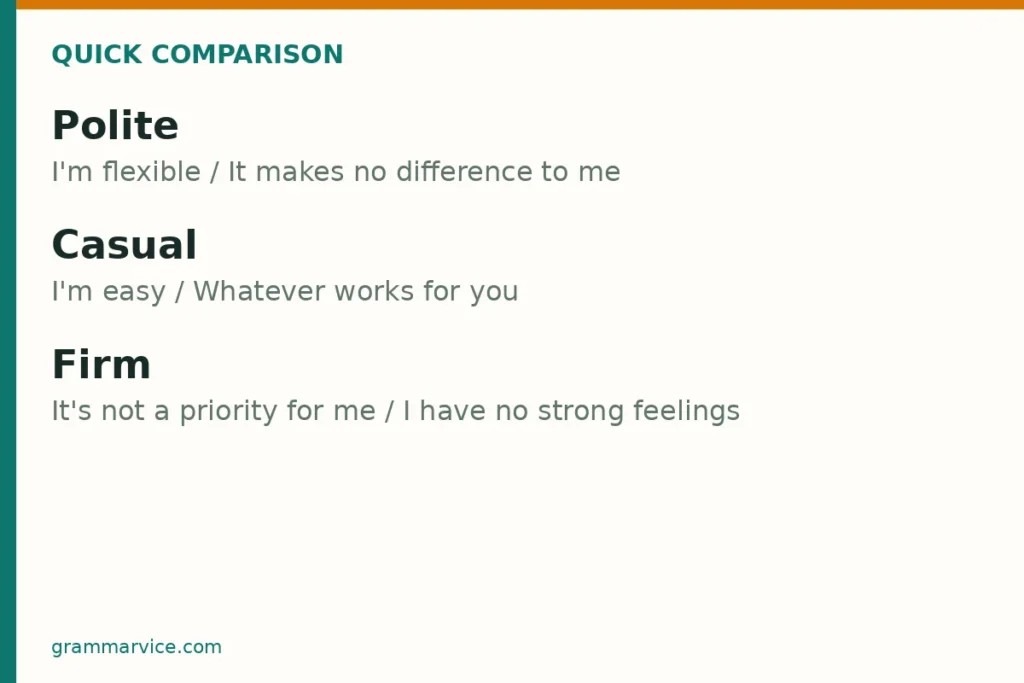
Use this quick guide to select the most appropriate expression:
- For workplace emails: Choose “I have no particular preference,” “Either option would be suitable,” or “I can accommodate either choice.” These expressions sound professional without being overly formal.
- For meetings and group decisions: Use “I’m happy to defer to the team” or “Please use your best judgment.” These phrases encourage collaboration and make decision-making easier.
- For formal conversations: Choose “I have no objection to either approach” or “This isn’t a deciding factor for me.” Both communicate neutrality clearly.
- For friends and family: Try “I’m good either way,” “Pick whichever you like,” or “I’m just here for the company.” These alternatives sound natural and friendly.
- For funny conversations: Use “My interest has left the chat” or “I’ve officially retired from having an opinion on this.” Save these for people who appreciate humor.
- For personal boundaries: Choose “I’m not going to engage with this” or “This is not something I want to discuss.” These expressions communicate your position directly.
- For strong indifference: “I couldn’t care less” communicates a much stronger lack of interest, but use it cautiously because it can sound harsh.
Before choosing an expression, ask yourself one question: Am I saying that I have no preference, that I am not interested, or that I do not want to participate? Answering this will help you select a phrase that communicates your actual intention.
Phrases to Avoid: The Rude Versions
Some expressions communicate indifference but can easily hurt someone’s feelings or create unnecessary tension. Even when you genuinely do not care about an issue, your choice of words can influence how other people respond.
Here are a few expressions to avoid in professional conversations and sensitive situations:
- “Whatever.” This one-word response can sound impatient or dismissive, particularly when someone is asking for your opinion.
- “Who cares?” It can make the other person feel that their concerns or interests are unimportant.
- “Not my problem.” This sounds defensive and may suggest that you are unwilling to help, even when the issue falls within your responsibilities.
- “I don’t give a damn.” This expression is intentionally blunt and contains profanity. It is rarely appropriate in professional or respectful conversations.
- “I couldn’t care less about you.” This is much more personal and hurtful than expressing indifference toward a situation or decision.
- “Do whatever you want.” Depending on your tone, this can sound annoyed, passive-aggressive, or dismissive rather than genuinely flexible.
These expressions are not necessarily inappropriate in every conversation. Close friends may understand your humor or blunt communication style. However, if you want to maintain a positive relationship, choosing a more considerate alternative is usually the better option.

Frequently Asked Questions
What is the most polite way to say “I don’t care”?
The most polite way to say “I don’t care” is “I have no particular preference” or “I’m comfortable with either option.” Both expressions communicate that you are happy with different outcomes without making the other person feel dismissed. For everyday conversations, “I don’t mind” is another friendly and natural alternative.
How do you say “I don’t care” professionally at work?
At work, you can say “I have no objection to either approach,” “Please use your best judgment,” or “I’m happy to defer to the team.” These expressions communicate flexibility and respect for other people’s decisions. Avoid blunt responses such as “Whatever” or “Not my problem,” especially in workplace emails and meetings.
Is “I don’t mind” the same as “I don’t care”?
No. “I don’t mind” generally means that you are comfortable with a particular choice or situation. “I don’t care” can communicate a stronger lack of interest, concern, or emotional investment. For example, saying “I don’t mind where we eat” means you are happy with different restaurants, not that you have no interest in spending time together.
What is a funny way to say “I don’t care”?
A funny way to say “I don’t care” is “My give-a-darn meter is at zero” or “My interest has left the chat.” You can also say “I’ve officially retired from having an opinion on this.” These playful expressions work best with friends and people who understand your humor.
How can I say “I don’t care” without sounding rude?
To say “I don’t care” without sounding rude, focus on expressing acceptance instead of indifference. Phrases such as “I’m good either way,” “Whatever works best for you,” and “I have no particular preference” sound more considerate. Your tone also matters. A calm, friendly delivery can make even a short response sound more respectful.
What’s the difference between “I couldn’t care less” and “I could care less”?
“I couldn’t care less” is the logically precise expression. It means your level of interest is already at its lowest possible point, so you cannot care any less. “I could care less” literally suggests that you still have some capacity to care less. However, the second expression is commonly used in American English, often sarcastically, to communicate the same intended meaning.
Conclusion
There are plenty of other ways to say “I don’t care” without sounding rude or dismissive. The best expression depends on whether you want to communicate flexibility, a lack of preference, genuine disinterest, humor, or a personal boundary.
For professional situations, phrases such as “I have no particular preference” and “I’m happy to defer to the team” are excellent choices. With friends, “I’m good either way” or “I’ll roll with whatever” sounds more natural. When you need to be firm, choose an expression that communicates your boundaries without unnecessarily disrespecting someone else.
Ultimately, choosing the right words helps you communicate honestly while maintaining positive relationships. Whether you’re looking for polite, funny, professional, or direct alternatives, these 36 expressions give you plenty of other ways to say I don’t care in almost any situation.