25 Other Ways to Say “As a Result” (With Examples)
Learning other ways to say as a result can make your writing sound more precise, varied, and polished. The phrase works well in essays and reports, but repeating it in every paragraph quickly makes your work feel repetitive. This guide gives you stronger alternatives for academic writing, professional emails, and everyday conversation, with clear examples for each one.
Below, you will find 32 unique alternatives grouped by formality, plus punctuation rules, a rewritten essay paragraph, and answers to common questions. Whether you need a formal as a result synonym for research or a lighter option for casual writing, you will find a natural replacement here.
What Does “As a Result” Mean?
The phrase as a result is a transition that shows a consequence or outcome. It connects a cause in one sentence or clause to its effect in the next. For example, “The team practiced daily. As a result, their performance improved.”
It is most often used to introduce a result that follows logically from what came before. It does not introduce a cause itself; it introduces what happened because of that cause. Understanding this distinction helps you choose the right alternative.
If you want to explore other ways to say cause and effect in writing, the same principle applies: focus on whether you are naming the cause, the effect, or the link between them.
Is “As a Result” Professional or Polite?
Yes. “As a result” is professional, polite, and widely accepted in academic and business writing. It is neither too formal nor too casual, which is why it appears so often in essays, reports, and emails.
The problem is not the phrase itself but overuse. When every paragraph ends with “as a result,” the writing sounds mechanical. A formal as a result synonym such as “consequently” or “therefore” can add variety, while a neutral option such as “so” or “thus” can keep the tone lighter.
In very formal academic writing, “consequently” and “hence” often sound more precise. In professional emails, “as a result” and “therefore” are safe choices. In casual writing, “so” or “that’s why” may feel more natural.
Quick Top Picks: The 8 Best Alternatives at a Glance
If you need a fast replacement, start with these eight:
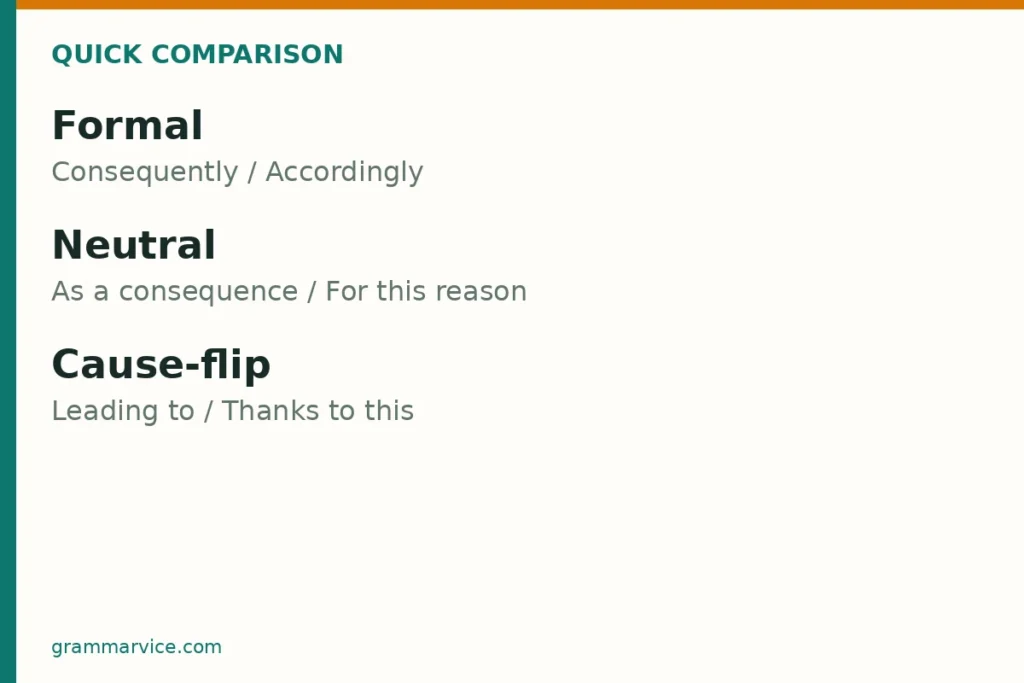
- Consequently — best for formal and academic writing
- Therefore — best for essays and logical arguments
- Thus — best for concise academic conclusions
- Hence — best for formal, old-fashioned academic tone
- As a consequence — best for formal cause-and-effect statements
- For this reason — best for clear, reader-friendly explanations
- So — best for casual and conversational writing
- That’s why — best for spoken style and informal writing
The full list below expands on these choices with 32 detailed alternatives.
Formal and Academic Alternatives to “As a Result”
These options work well in essays, research papers, reports, and formal presentations. They are ideal when you need an as a result synonym academic writing marker or an as a result synonym in research.
1. Consequently
Tone: Formal and academic. Example: “The study lacked funding; consequently, the sample size was small.”
2. Therefore
Tone: Formal and logical. Example: “The data support the hypothesis; therefore, the theory should be revised.”
3. Thus
Tone: Formal and concise. Example: “The experiment was repeated three times. Thus, the findings are reliable.”
4. Hence
Tone: Formal and traditional. Example: “The costs rose sharply. Hence, the project was delayed.”
5. Accordingly
Tone: Formal and businesslike. Example: “Sales fell in the second quarter. Accordingly, the company reduced spending.”
6. As a consequence
Tone: Formal and precise. Example: “As a consequence, the policy was changed to protect workers.”
7. In consequence
Tone: Formal, slightly old-fashioned. Example: “In consequence, the committee revised its recommendations.”
8. It follows that
Tone: Academic and logical. Example: “All participants improved. It follows that the method was effective.”
9. This led to
Tone: Formal but clear. Example: “The new law led to fewer complaints from customers.”
10. This resulted in
Tone: Formal and direct. Example: “The drought resulted in lower crop yields across the region.”
11. The outcome was
Tone: Formal and report-like. Example: “The outcome was a 20% increase in student attendance.”
12. The net effect was
Tone: Analytical and formal. Example: “The net effect was a stronger, more competitive market.”
Neutral All-Purpose Alternatives to “As a Result”
These alternatives work in almost any context, from essays to emails to general writing. They are excellent choices when you want alternative ways to say as a result without changing the tone too much.
13. For this reason
Tone: Neutral and clear. Example: “For this reason, we recommend starting the project early.”
14. Because of this
Tone: Neutral and straightforward. Example: “Because of this, the team adjusted its schedule.”
15. On account of this
Tone: Neutral to formal. Example: “On account of this, the meeting was moved to Friday.”
16. In turn
Tone: Neutral and connected. Example: “Better training improved skills, which in turn raised productivity.”
17. This means
Tone: Neutral and explanatory. Example: “This means students can access the material at any time.”
18. This caused
Tone: Neutral and direct. Example: “The storm caused widespread power outages.”
19. This brought about
Tone: Neutral and descriptive. Example: “The reform brought about major changes in education.”
20. This gave rise to
Tone: Neutral to formal. Example: “The discovery gave rise to new research in the field.”
Conversational and Light Alternatives to “As a Result”
Use these options in blogs, personal writing, casual emails, and spoken-style content. They keep the meaning but sound more relaxed.
21. So
Tone: Casual and simple. Example: “It rained all day, so we stayed inside.”
22. That’s why
Tone: Conversational. Example: “She studied hard. That’s why she passed the exam.”
23. In the end
Tone: Conversational and reflective. Example: “In the end, we decided to move to a smaller office.”
24. In the long run
Tone: Conversational and forward-looking. Example: “In the long run, the changes saved the company money.”
25. The upshot was
Tone: Informal and idiomatic. Example: “The upshot was that we finished a week early.”
26. The result was
Tone: Light and clear. Example: “The result was a much happier team.”
Cause-Flip Forms: Restructure the Sentence Instead
Sometimes the best way to avoid repeating “as a result” is to restructure the sentence. These forms put the cause first and the effect second, or use a verb to show the link directly. They are useful for other ways to say as a consequence without using a connector at all.
27. This led the team to
Tone: Active and clear. Example: “The feedback led the team to redesign the website.”
28. This prompted
Tone: Neutral and active. Example: “The delay prompted a review of the entire process.”
29. This triggered
Tone: Strong and direct. Example: “The announcement triggered a sharp rise in sales.”
30. This contributed to
Tone: Neutral and academic. Example: “Better sleep contributed to improved focus.”
31. The effect of this was
Tone: Formal and analytical. Example: “The effect of this was a calmer, more focused classroom.”
32. Owing to this
Tone: Formal and slightly old-fashioned. Example: “Owing to this, the deadline was extended by two weeks.”
When you restructure, you also improve flow. Instead of writing “The policy changed. As a result, complaints fell,” try “The policy change reduced complaints.” This version is shorter and more direct.
Punctuation Rules for Result Connectors
Many writers struggle with punctuation when using result connectors. The rules depend on whether the word is a conjunctive adverb or a phrase.
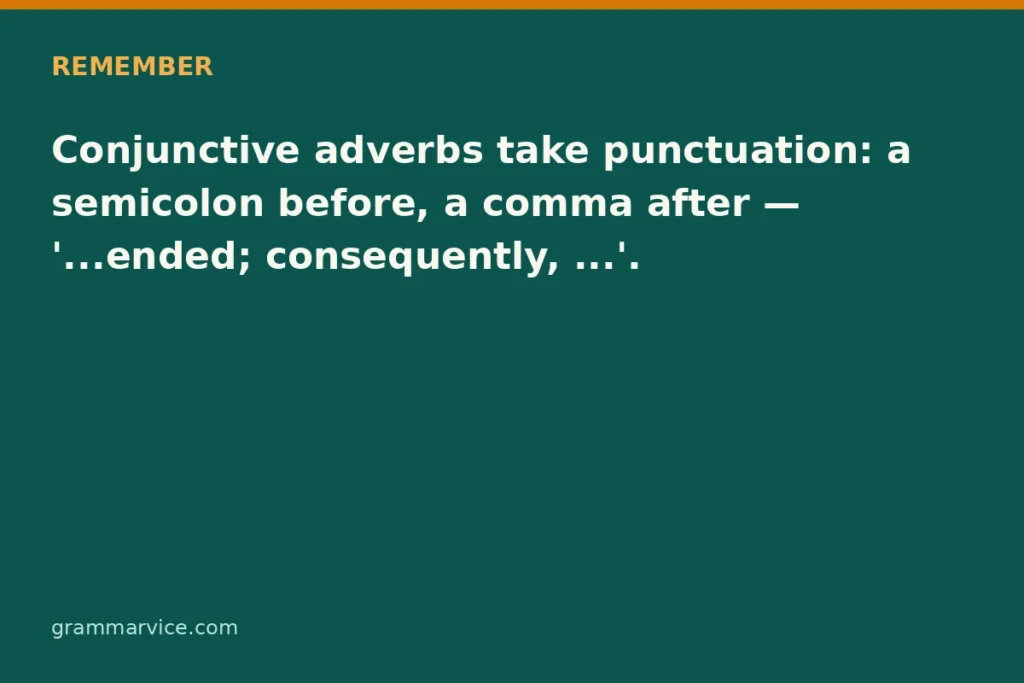
Rule 1: Conjunctive adverbs such as “consequently,” “therefore,” and “thus” need a semicolon before them when joining two independent clauses, and a comma after them.
Correct: “The rain stopped; consequently, the game resumed.”
Incorrect: “The rain stopped, consequently, the game resumed.”
Rule 2: Sentence starters such as “As a result,” “For this reason,” and “Because of this” need a comma after the phrase when they start a sentence.
Correct: “As a result, sales increased.”
Incorrect: “As a result sales increased.”
Rule 3: “So” as a conjunction does not need a semicolon. Use a comma before “so” when it joins two independent clauses.
Correct: “It was late, so we left.”
Incorrect: “It was late; so we left.”
For more guidance on related transitions, see the Cambridge Dictionary entry for “consequently”.
Before and After: An Essay Paragraph Rewritten
Before (repetitive):
“The school introduced a new reading program. As a result, test scores rose. As a result, students read more at home. As a result, parents reported higher satisfaction.”
After (varied):
“The school introduced a new reading program. Consequently, test scores rose. This also encouraged students to read more at home. For this reason, parents reported higher satisfaction.”
Notice how the rewrite keeps the meaning but sounds more natural. It also uses different sentence structures instead of repeating the same connector. Learning other ways to say “this shows” and other ways to say “in other words” can help you vary your academic writing in the same way.
Mistakes to Avoid
- Overusing one alternative: Replacing every “as a result” with “consequently” creates the same problem.
- Using a connector that does not fit: “Hence” sounds odd in a casual text message.
- Confusing cause and effect: “Because of this” should follow the cause, not introduce it.
- Forgetting punctuation: Conjunctive adverbs need a semicolon before and a comma after when joining clauses.
- Adding “and” before a result connector: “And as a result” is often redundant.
If you specifically need an as a result synonym, formal writing usually points you to “consequently,” “therefore,” or “accordingly,” while neutral writing can safely use “for this reason.” Pick the connector that matches your audience, and your sentences will sound deliberate instead of repetitive.
Frequently Asked Questions
Is “as a result” formal or informal?
“As a result” is neutral and formal enough for academic writing, business reports, and professional emails. It is not slang or informal, but it is also not overly stiff. For a more formal tone, use “consequently” or “therefore.” For a casual tone, use “so” or “that’s why.”
What is the best synonym for “as a result” in academic writing?
“Consequently” is often the best as a result synonym academic writing choice because it is precise and formal. “Therefore” and “thus” are also excellent options. If you need to know how to say as a result academically, choose the word that fits your sentence structure: “therefore” for logical conclusions, “consequently” for outcomes, and “thus” for concise summaries.
Can I start a sentence with “as a result”?
Yes. “As a result” is a common as a result synonym sentence starter in essays and reports. Start the sentence with “As a result,” followed by a comma, then the effect. For example: “As a result, the project finished on time.” This structure is clear and widely accepted.
What’s the difference between “as a result” and “as a result of”?
“As a result” introduces an effect: “As a result, we won.” “As a result of” introduces a cause: “As a result of hard work, we won.” The first phrase stands alone at the start of a sentence or clause. The second phrase must be followed by the cause, such as a noun or noun phrase.
How do I avoid overusing “as a result” in an essay?
To find another way to say as a result in an essay, rotate through different connectors and sentence structures. Use “consequently” for formal points, “for this reason” for clarity, and cause-flip verbs such as “led to” or “resulted in” to vary your style. Also, try combining sentences or using verbs to show the link directly. If you are looking for other ways to say as a result in an essay, this guide’s 32 alternatives give you plenty of options.
Which alternatives to “as a result” work best in professional emails?
In professional emails, “therefore,” “as a result,” and “for this reason” are safe and clear. “Accordingly” also works well in business contexts. Avoid overly casual options such as “so” or “that’s why” in formal emails, and avoid very formal options such as “hence” unless the tone calls for it. If you need what to say instead of as a result in an email, “for this reason” is often the most reader-friendly choice.
Conclusion
Mastering other ways to say as a result gives you more control over tone, clarity, and style. From formal options such as “consequently” and “therefore” to casual choices such as “so” and “that’s why,” each alternative has a place. The key is to match the word to your audience and vary your connectors so your writing stays fresh.
Next time you reach for “as a result,” pause and ask: Is this formal, neutral, or casual? Do I need a sentence starter or a clause connector? Choosing the right alternative will make your argument stronger and your writing more polished.