
30 Other Ways to Say “This Shows” (With Examples)
Quick Answer: Some of the best alternatives to “this shows” include “this demonstrates,” “this indicates,” “this suggests,” “this reveals,” and “this illustrates.” In academic writing, choose an expression that matches the strength of your evidence. Use “demonstrates” for strong support, “indicates” for findings, and “suggests” for interpretations that are not fully proven.
Using the phrase “this shows” repeatedly can make an essay sound repetitive, especially when you’re explaining quotations, analyzing research, or supporting an argument. Although the expression is grammatically correct, choosing more precise alternatives can make your writing clearer, more analytical, and more professional.
Fortunately, there are many other ways to say this shows in an essay without changing the meaning of your argument. Depending on your evidence, you can use expressions such as “this demonstrates,” “the findings indicate,” “the evidence reveals,” or “this highlights.”
However, these alternatives aren’t interchangeable. Some communicate strong evidence, while others introduce a possible interpretation or draw attention to an important detail. This guide covers 32 useful alternatives, explains when to use each one, and provides natural examples to help you improve your academic writing.
What Does “This Shows” Mean?
“This shows” is a transitional expression used to explain what a fact, example, quotation, statistic, or piece of evidence demonstrates. It connects information you’ve presented with the point you’re trying to make.
In an essay, the phrase usually helps explain why a particular piece of evidence matters and how it supports your argument.
For example:
Original: “The character refuses to follow the rules. This shows that he values independence more than approval.”
In this example, “this shows” connects the character’s behavior with an interpretation of his personality.
Depending on the context, the expression can communicate several different meanings:
- Demonstrating: Providing evidence that supports a particular conclusion.
- Indicating: Pointing toward a possible finding or explanation.
- Revealing: Uncovering information that wasn’t immediately obvious.
- Illustrating: Making an idea easier to understand through an example.
- Highlighting: Drawing attention to an important detail or argument.
- Suggesting: Presenting an interpretation that may be supported by the available evidence.
Understanding these differences helps you choose the right this shows synonym for your particular sentence.
If you’re looking for other ways to say this shows in an essay, remember that the goal isn’t simply to replace one phrase with a more complicated expression. The goal is to explain the relationship between your evidence and your argument more accurately.
Is “This Shows” Professional or Formal Enough?
Yes, “this shows” is grammatically correct, professional, and acceptable in academic writing. However, it can sound repetitive or overly basic when used several times in the same essay.
For example, consider this paragraph:
“The survey shows that students prefer online learning. This shows that technology is becoming more important. This shows that schools should invest in digital resources.”
Although the meaning is understandable, repeating the same expression makes the paragraph less engaging and limits the depth of the analysis.
A more polished version would be:
“The survey indicates that students prefer online learning. This finding highlights the growing importance of technology in education and reinforces the need for schools to invest in digital resources.”
The revised version uses different expressions to communicate distinct relationships between the evidence and the argument.
Here is a quick comparison:
| Expression | Formality | Best Use |
|---|---|---|
| This shows | Neutral | General explanations |
| This demonstrates | Formal | Strong supporting evidence |
| This indicates | Formal | Research findings and data |
| This suggests | Formal | Careful interpretations |
| This reveals | Formal | Uncovering deeper meaning |
| This illustrates | Formal | Examples and explanations |
| This highlights | Formal | Important points and findings |
For academic writing, choose a phrase that accurately describes what your evidence does. A sophisticated-sounding word won’t improve your essay if it exaggerates your conclusion.
Quick Top Picks: The 8 Best Alternatives at a Glance
If you need a quick replacement, these eight expressions are among the most useful alternatives to “this shows.” Each one serves a slightly different purpose.
- This demonstrates: Best when your evidence provides strong support for an argument.
- This indicates: Best when research findings or statistics point toward a conclusion.
- This suggests: Best when presenting a reasonable interpretation without claiming certainty.
- This reveals: Best when analyzing hidden meanings, motives, or important discoveries.
- This highlights: Best when drawing attention to a significant point.
- This establishes: Best when evidence provides a strong foundation for an argument.
- This illustrates: Best when an example makes an idea easier to understand.
- This reinforces: Best when additional evidence strengthens an existing argument.
For most academic essays, “this demonstrates,” “this indicates,” and “this suggests” are versatile choices. However, the strength of your evidence should determine which expression you use.
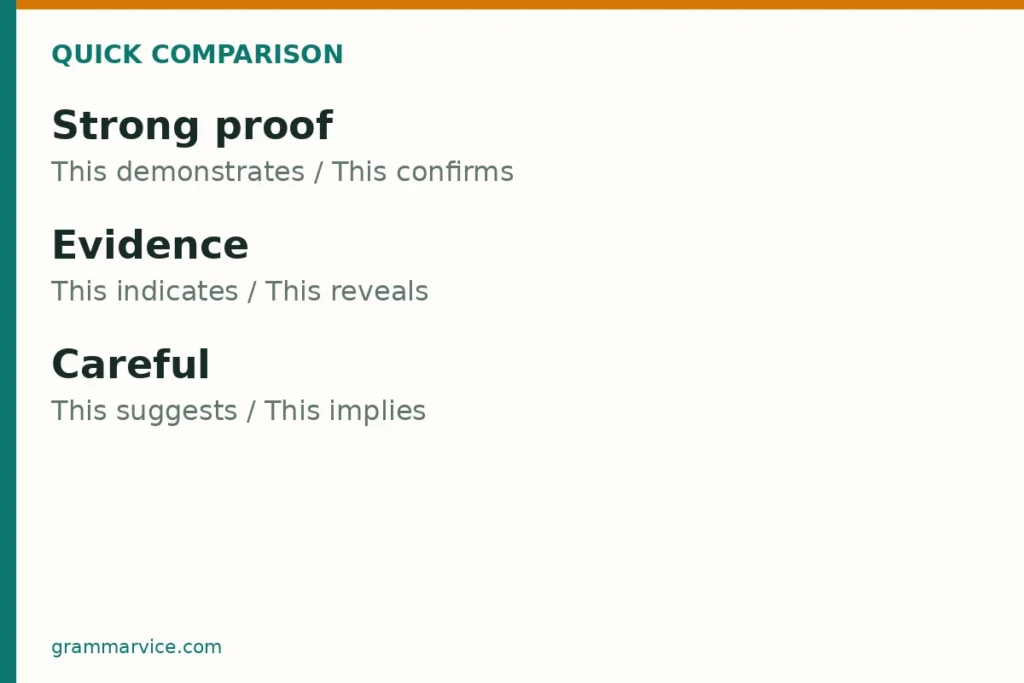
Strong Proof: Alternatives That Confirm and Establish
When your evidence provides substantial support for an argument, choose expressions that communicate confidence and authority. These alternatives are particularly useful in argumentative essays, research papers, analytical reports, and evidence-based discussions.
Be careful with words such as “proves” and “confirms.” They suggest a high level of certainty and shouldn’t be used when the evidence only points toward a possibility.
1. This Demonstrates
Tone: Formal, confident, and analytical.
“This demonstrates” is one of the strongest general alternatives to “this shows.” Use it when a quotation, example, experiment, or finding provides clear support for your argument. It works particularly well in academic and professional writing.
Example: “The consistent improvement in student performance demonstrates the effectiveness of personalized learning strategies.”
2. The Evidence Establishes
Tone: Authoritative, formal, and persuasive.
This expression is appropriate when evidence provides a strong foundation for a particular conclusion. It is especially useful in research papers and argumentative essays where you need to connect supporting information with a central claim.
Example: “The historical records establish a clear connection between industrial expansion and urban population growth.”
3. The Findings Confirm
Tone: Scientific, precise, and confident.
Use this expression when research results support or verify an earlier observation, hypothesis, or conclusion. It works particularly well in academic studies, scientific reports, and data-driven discussions.
Example: “The findings confirm that regular feedback can improve students’ understanding of complex subjects.”
4. This Substantiates
Tone: Highly formal, evidence-based, and persuasive.
“This substantiates” means that something provides supporting evidence for a claim or explanation. It is useful when you want to emphasize that your argument is backed by relevant information rather than personal opinion.
Example: “The additional survey responses substantiate the argument that public transportation accessibility influences commuting decisions.”
5. The Results Verify
Tone: Formal, factual, and research-oriented.
Choose this alternative when the results establish that a particular detail, measurement, or expectation is accurate. It is particularly suitable for experiments, technical reports, and research involving measurable outcomes.
Example: “The second round of testing verifies that the revised system operates within the required performance limits.”
6. This Provides Compelling Evidence That
Tone: Strong, persuasive, and academic.
This expression emphasizes that the available evidence strongly supports a particular interpretation or conclusion. It is useful when several relevant observations contribute to your argument.
Example: “The repeated decline in attendance provides compelling evidence that the current scheduling system needs improvement.”
7. The Evidence Supports the Conclusion That
Tone: Objective, analytical, and formal.
This is a useful alternative when you want to explain exactly how evidence connects with your conclusion. Unlike “this proves,” it communicates support without necessarily claiming that no other interpretation is possible.
Example: “The interviews and statistical findings support the conclusion that access to educational resources affects academic performance.”
8. Taken Together, These Findings Establish
Tone: Comprehensive, authoritative, and analytical.
Use this phrase when multiple pieces of evidence contribute to one broader conclusion. It is particularly effective when summarizing several studies, observations, quotations, or research results.
Example: “Taken together, these findings establish the importance of consistent communication in successful organizational change.”
Pointing to Evidence: Alternatives That Indicate and Reveal
Sometimes evidence doesn’t conclusively prove an argument but provides useful information about a pattern, relationship, or underlying issue. In these situations, expressions such as “indicates,” “reveals,” and “points toward” are more appropriate.
These alternatives work well when explaining statistics, interpreting quotations, discussing historical events, and analyzing research findings.
9. This Indicates
Tone: Professional, analytical, and precise.
“This indicates” is a useful this shows synonym for academic writing when the available information points toward a particular finding. It is especially common in research papers and discussions involving data.
Example: “The increase in customer complaints indicates that the company needs to improve its service standards.”
10. The Data Point To
Tone: Objective, research-focused, and analytical.
This expression is appropriate when numerical information suggests a particular trend or relationship. It helps you discuss statistical findings without making stronger claims than the data support.
Example: “The survey results point to a growing preference for flexible working arrangements among younger employees.”
11. The Findings Reveal
Tone: Insightful, formal, and investigative.
Use this expression when research uncovers something meaningful that wasn’t immediately obvious. It is particularly useful when discussing discoveries, hidden patterns, or unexpected results.
Example: “The findings reveal significant differences in how students from different backgrounds access educational opportunities.”
12. The Pattern Is Evident In
Tone: Formal, descriptive, and analytical.
This expression helps you direct readers toward a visible trend or repeated observation. It works particularly well when discussing charts, historical records, research findings, and recurring behaviors.
Example: “The pattern is evident in the steadily increasing number of households adopting renewable energy systems.”
13. The Results Are Consistent With
Tone: Scientific, cautious, and evidence-based.
Choose this phrase when your findings align with an existing theory, previous research, or an expected pattern. It is useful because it communicates agreement without suggesting that the results independently prove the entire theory.
Example: “The results are consistent with previous research suggesting that sleep quality influences memory retention.”
14. The Evidence Points Toward
Tone: Analytical, balanced, and professional.
This alternative communicates that available information supports a particular direction or explanation. It is especially helpful when the evidence is persuasive but doesn’t establish a definitive conclusion.
Example: “The evidence points toward a relationship between regular exercise and improved academic concentration.”
15. The Figures Reflect
Tone: Formal, statistical, and objective.
Use this expression when numerical information represents a particular condition, trend, or change. It is a natural choice for financial reports, research papers, business analysis, and statistical discussions.
Example: “The figures reflect a gradual improvement in employee retention over the past three years.”
16. The Record Documents
Tone: Formal, factual, and authoritative.
This phrase is useful when referring to information officially recorded in documents, reports, historical accounts, or institutional records. It emphasizes documented information rather than personal interpretation.
Example: “The historical record documents several changes in the region’s agricultural practices during the nineteenth century.”
Careful Interpretation: Alternatives That Suggest and Imply
Academic writing often involves interpreting information rather than presenting facts that prove a conclusion. When evidence allows for multiple explanations, cautious language helps you avoid overstating your argument.
These alternatives are particularly useful when analyzing literature, interpreting quotations, discussing human behavior, and evaluating incomplete research findings.
17. This Suggests
Tone: Thoughtful, analytical, and appropriately cautious.
“This suggests” is one of the most useful alternatives when evidence supports a possible interpretation but doesn’t establish it conclusively. It works well in essays involving literary analysis, research, and argumentative discussion.
Example: “The character’s repeated silence suggests that he is struggling to express his feelings.”
18. This May Imply
Tone: Formal, interpretive, and cautious.
Use this expression when information indirectly communicates an idea or meaning. It is particularly helpful when interpreting a quotation, a character’s actions, or an author’s underlying message.
Example: “The repeated references to darkness may imply the character’s growing sense of uncertainty.”
19. One Possible Interpretation Is That
Tone: Balanced, reflective, and academic.
This expression introduces an interpretation while acknowledging that other explanations may also be reasonable. It is especially useful in literature, history, philosophy, and social science essays.
Example: “One possible interpretation is that the author’s description of the abandoned house represents the family’s emotional isolation.”
20. This Appears to Indicate
Tone: Professional, measured, and analytical.
This phrase is useful when your evidence points toward a conclusion, but you want to acknowledge some uncertainty. It is appropriate for preliminary research findings, observations, and developing situations.
Example: “The recent changes in consumer behavior appear to indicate a growing interest in environmentally responsible products.”
21. This Could Mean
Tone: Clear, accessible, and interpretive.
Choose this expression when explaining a possible meaning in straightforward language. It is less formal than some academic alternatives but works well when you want your analysis to remain easy to understand.
Example: “The character avoids discussing his childhood, and this could mean that the experience remains painful for him.”
22. This May Be Understood As
Tone: Formal, interpretive, and thoughtful.
This expression is particularly useful when explaining how a particular event, quotation, symbol, or action can be interpreted. It allows you to present an interpretation without suggesting that it is the only possible meaning.
Example: “The final scene may be understood as a symbolic representation of the protagonist’s personal transformation.”
23. This Raises the Possibility That
Tone: Cautious, analytical, and research-oriented.
Use this expression when your evidence introduces a potential explanation that deserves further consideration. It is especially suitable for discussing research limitations, unexpected findings, and complex arguments.
Example: “The difference in test performance raises the possibility that classroom resources influence student achievement.”
24. A Plausible Reading Is That
Tone: Academic, interpretive, and sophisticated.
This expression works particularly well in literary and critical analysis. It introduces a reasonable explanation of a passage, character, theme, or argument while recognizing that alternative interpretations may exist.
Example: “A plausible reading is that the recurring image of the storm represents the conflict between personal freedom and social expectations.”
Emphasis and Explanation: Alternatives That Highlight and Illustrate
Not every alternative to “this shows” needs to communicate proof or certainty. Sometimes your purpose is to emphasize an important idea, explain a complicated concept, or demonstrate how a particular example relates to a broader argument.
The following expressions are especially useful when writing analytical paragraphs, explaining quotations, and connecting examples with your thesis statement.
25. This Highlights
Tone: Clear, formal, and emphasis-focused.
Use this expression when you want to draw attention to an important detail, issue, or finding. It is a versatile this shows synonym formal writers can use in essays, reports, and presentations.
Example: “The difference in graduation rates highlights the importance of equal access to educational resources.”
26. This Underscores
Tone: Strong, authoritative, and academic.
“This underscores” emphasizes the significance or importance of an idea. It works particularly well when you want to reinforce a central argument or explain why a particular finding matters.
Example: “The repeated delays underscore the need for better communication between project departments.”
27. This Illustrates
Tone: Explanatory, formal, and accessible.
Use this expression when a specific example, event, or quotation makes a broader concept easier to understand. It is particularly effective in literature essays and explanatory academic writing.
Example: “The protagonist’s decision to leave his hometown illustrates the conflict between personal ambition and family responsibility.”
28. This Exemplifies
Tone: Formal, academic, and precise.
This phrase introduces something that serves as a clear example of a particular quality, principle, or broader concept. It is useful when analyzing specific cases that represent a larger idea.
Example: “The community’s response to the natural disaster exemplifies the importance of cooperation during difficult circumstances.”
29. This Clarifies
Tone: Explanatory, professional, and direct.
Choose this alternative when a piece of evidence or an example makes an earlier point easier to understand. It works particularly well when explaining complicated arguments or resolving uncertainty in an essay.
Example: “The additional historical context clarifies why the government introduced these reforms.”
30. This Helps Explain
Tone: Natural, analytical, and reader-friendly.
This expression connects supporting information with the reasoning behind a particular outcome. It is a useful alternative when you want to explain why something happened rather than simply state that it happened.
Example: “The decline in household income helps explain why consumer spending decreased during the same period.”
31. This Brings Into Focus
Tone: Thoughtful, analytical, and emphasis-driven.
Use this expression when evidence makes an important issue, relationship, or underlying theme more noticeable. It works especially well in interpretive essays and discussions involving complex ideas.
Example: “The author’s description of the workers’ living conditions brings into focus the social inequalities of the industrial era.”
32. This Draws Attention To
Tone: Formal, descriptive, and direct.
This phrase is appropriate when a particular example or finding directs the reader toward an important detail. It is useful in academic essays, research discussions, and analytical reports.
Example: “The final paragraph draws attention to the long-term consequences of environmental neglect.”
The Certainty Scale: How Strong Is Each Alternative?
One of the most important parts of choosing other ways to say this shows is understanding how strongly each expression communicates your conclusion.
For example, “this establishes” communicates stronger support than “this suggests.” Similarly, “this highlights” emphasizes importance but doesn’t necessarily prove that an argument is correct.
The following table compares common alternatives by evidence strength, formality, and their most appropriate uses.
| Phrase | Strength | Formality | Best Use |
|---|---|---|---|
| This establishes | Very strong | High | Building a well-supported conclusion |
| This substantiates | Very strong | High | Backing up a specific claim |
| This confirms | Very strong | High | Verifying an existing finding |
| This demonstrates | Strong | High | Explaining substantial supporting evidence |
| This provides compelling evidence | Strong | High | Supporting a persuasive argument |
| This indicates | Moderate to strong | High | Explaining data and observations |
| This reveals | Moderate to strong | High | Uncovering information or meaning |
| This illustrates | Explanatory | High | Making an idea clearer through an example |
| This highlights | Emphasis-focused | High | Drawing attention to an important point |
| This reflects | Moderate | High | Representing a condition or characteristic |
| This points toward | Moderate | High | Identifying a possible relationship |
| This suggests | Cautious | High | Presenting a reasonable interpretation |
| This may imply | Cautious | High | Explaining an indirect meaning |
| This could mean | Tentative | Neutral | Introducing a possible explanation |
Think of evidence strength as a guide rather than a strict ranking. A phrase can be formal without making a particularly strong claim. For example, “this highlights” is formal, but it primarily emphasizes importance rather than certainty.
When choosing other ways to say this evidence shows, consider whether your evidence genuinely establishes a conclusion or simply points toward a possible explanation.
Before and After: An Essay Paragraph Rewritten
Understanding individual alternatives is helpful, but seeing them in a complete academic paragraph makes it easier to understand how to use them naturally.
Consider this example about the relationship between urban development and environmental change.
Before: Repetitive Version
“Urban development has changed the natural environment in many ways. This shows that expanding cities can affect local ecosystems. The decline in green spaces also shows that construction reduces natural habitats. This shows that urban planning needs to consider environmental protection. The increase in air pollution shows that population growth can create additional environmental problems. This shows that sustainable development is important for future communities.”
The paragraph communicates a reasonable argument, but the repeated expression makes the analysis sound mechanical. It also doesn’t explain the specific relationship between each piece of evidence and the main argument.
After: Improved Academic Version
“Urban development has changed the natural environment in several significant ways. The expansion of residential and commercial areas demonstrates how population growth can place pressure on local ecosystems. Similarly, the decline in green spaces highlights the consequences of construction for natural habitats. These changes indicate that urban planning must incorporate environmental protection measures. Furthermore, increasing levels of air pollution reveal the additional environmental challenges associated with population growth. Taken together, these findings underscore the importance of sustainable development in protecting future communities.”
What Changed?
- “This shows” became “demonstrates”: Used to explain how urban expansion affects ecosystems.
- “This shows” became “highlights”: Used to emphasize the consequences of losing green spaces.
- “This shows” became “indicate”: Used to connect environmental changes with the need for better planning.
- “This shows” became “reveal”: Used to explain an important environmental consequence.
- “This shows” became “underscore”: Used to emphasize the overall importance of sustainable development.
Notice that the revised paragraph doesn’t simply replace every occurrence with a different synonym. Each expression performs a specific job, making the reasoning easier to follow.
This is the best approach when deciding what to say instead of this shows in an essay: select a phrase based on the relationship between the evidence and the conclusion.
Mistakes to Avoid When Replacing “This Shows”
Using different expressions can improve your writing, but replacing a simple phrase with an inappropriate synonym can create new problems. Avoid these common mistakes when choosing alternatives.
1. Using “This Proves” When Your Evidence Is Not Conclusive
“This proves” is a strong expression that suggests a conclusion has been established. It may be inappropriate when you’re discussing limited research, individual observations, or possible interpretations.
Instead of: “The survey results prove that online learning is better for every student.”
Try: “The survey results suggest that many students benefit from online learning.”
2. Replacing Every Occurrence With “This Demonstrates”
Although “this demonstrates” is an excellent academic alternative, using it in every paragraph creates the same repetition problem as “this shows.”
Combine expressions such as “indicates,” “reveals,” “illustrates,” and “suggests” according to what your evidence actually communicates.
3. Choosing Complicated Words Just to Sound Academic
Academic writing should be precise, not unnecessarily complicated. Using unfamiliar expressions without understanding their meanings can make your argument less clear.
For example, “this exemplifies” is appropriate when something serves as an example of a broader idea. It isn’t a universal replacement for “this shows.”
4. Forgetting What “This” Refers To
One of the biggest problems with this shows that alternatives is the possibility of creating unclear references. If readers cannot identify what “this” refers to, they may struggle to understand your argument.
Unclear: “The company reduced its prices and introduced a new delivery system. This demonstrates improved customer satisfaction.”
Clearer: “The company’s new delivery system and reduced prices demonstrate its efforts to improve customer satisfaction.”
Replacing “this” with a specific noun, such as “the findings,” “the quotation,” “the results,” or “the example,” can make your writing more precise.
5. Confusing Emphasis With Evidence
Words such as “highlights” and “underscores” draw attention to important information. They don’t necessarily mean that the evidence proves an argument.
For example, a quotation might highlight a character’s feelings without conclusively establishing the author’s overall intention.
6. Ignoring the Context of a Quotation
When analyzing literature, don’t simply replace “this quote shows” with a formal expression without explaining what the quotation means.
Weak: “This quote demonstrates that the character is unhappy.”
Better: “The character’s repeated references to isolation reveal his growing dissatisfaction with his surroundings.”
The improved version connects the quotation’s meaning with a specific interpretation.
7. Using the Same Sentence Structure Throughout the Essay
Even when you use different synonyms, beginning every analytical sentence with “This…” can make your writing predictable.
Try restructuring your sentences by making the evidence itself the subject:
- “The findings indicate a significant change in public attitudes.”
- “The quotation reveals the character’s internal conflict.”
- “The historical records establish a connection between the two events.”
- “The results suggest that further investigation is necessary.”
This approach provides more variety and often makes your writing sound more natural.
One last note on finding the right phrase. If you searched for a this shows synonym, academic writing guidance usually starts with matching the verb to your evidence. Students also look for different ways to say this shows in an essay, other ways to say this quote shows when analyzing a passage, other ways to say this proves in an essay when the evidence feels conclusive, and other ways to say this is shown in an essay when the original sentence is passive. Each search points to the same habit: choose the expression whose strength matches what your evidence actually does.
Frequently Asked Questions
Is “this shows” formal enough for academic writing?
Yes, “this shows” is acceptable in academic writing because it is grammatically correct and communicates meaning clearly. However, repeating it frequently can make an essay sound less polished. Alternatives such as “this demonstrates,” “this indicates,” and “this suggests” can provide greater precision when they accurately describe the evidence being discussed.
What is the best alternative to “this shows” in an essay?
“This demonstrates” is one of the best general alternatives to “this shows” in an essay, particularly when your evidence strongly supports your argument. However, “this indicates” works better for research findings, while “this suggests” is more appropriate for interpretations that aren’t fully established. Choose the expression that matches your evidence.
What can I say instead of “this shows” at the start of a sentence?
You can begin a sentence with “This demonstrates,” “This suggests,” “The evidence indicates,” “The findings reveal,” or “The results confirm.” You can also avoid starting with “this” by making the evidence itself the subject. For example, write “The quotation illustrates the character’s frustration” instead of “This shows that the character is frustrated.”
Is “this demonstrates” stronger than “this shows”?
Generally, yes. “This demonstrates” often communicates a more analytical and confident relationship between evidence and a conclusion. However, the difference depends on context. Both expressions can introduce supporting information, and neither automatically proves an argument. Use “demonstrates” when the evidence provides clear and substantial support.
How do I avoid repeating “this shows” in an essay?
Use different expressions according to the purpose of each sentence. Try “this demonstrates” for strong evidence, “this indicates” for research findings, “this reveals” for deeper meaning, and “this suggests” for careful interpretations. You can also restructure sentences by making the evidence, quotation, data, or findings the subject of the sentence.
Can I use “this shows” in a professional email or report?
Yes, “this shows” is acceptable in professional emails and reports, particularly when communicating straightforward information. However, more specific alternatives can make formal communication clearer. For example, use “the results indicate” when discussing data, “the findings demonstrate” when explaining strong evidence, or “the report highlights” when drawing attention to an important issue.
Conclusion
Choosing the right alternative to “this shows” can make your essays, research papers, and professional reports more precise and engaging. The best expression depends on the type of evidence you’re discussing and how confidently you can support your conclusion.
Use “this demonstrates” or “the evidence establishes” when presenting strong support, “this indicates” when discussing findings, and “this suggests” when offering a careful interpretation. Expressions such as “this highlights” and “this illustrates” are useful when emphasizing important details or explaining examples.
Ultimately, the best other ways to say this shows are the ones that accurately communicate your argument. Focus on clarity, vary your sentence structures, and choose expressions based on the strength of your evidence rather than simply trying to sound more academic.
For more writing alternatives, explore our guides on other ways to say “as a result” and other ways to say “in other words.” You can also review the Cambridge Dictionary definition of “demonstrate” to understand how the word is used.