25 Other Ways to Say “Same Here” (With Examples)
Quick Answer: The best other ways to say same here include “Me too,” “Likewise,” “I feel the same way,” “I can relate,” “I’m with you on that,” and “I share your perspective.” For casual conversations, choose a short and friendly response. For professional emails or meetings, use a more polished expression that clearly communicates agreement or shared experience.
Looking for other ways to say same here without repeating the same phrase in every conversation? Whether you’re replying to a friend’s text, agreeing with a coworker, or showing someone that you understand their feelings, there are plenty of natural alternatives to choose from.
“Same here” is convenient, but it can sometimes sound repetitive or too casual, especially in professional conversations. A different expression can make your response sound warmer, more thoughtful, funnier, or more confident. The right choice depends on what you’re agreeing with and how well you know the other person.
In this guide, you’ll find 32 genuinely different alternatives, including friendly expressions, empathetic responses, professional phrases, and funny ways to say same here. Each option includes a tone explanation and a natural example so you can choose the right words for texts, emails, meetings, and everyday conversations.
What Does “Same Here” Mean?
“Same here” is an informal expression used to communicate that you share another person’s feelings, opinions, experiences, preferences, or circumstances. It essentially means “I feel the same way,” “That applies to me, too,” or “I have the same experience.”
For example:
- Person A: “I’m really looking forward to the weekend.”
- Person B: “Same here!”
In this exchange, the second person communicates that they also look forward to the weekend. The expression works because the meaning is already clear from the previous statement.
You can use “same here” in several situations:
- Shared feelings: “I’m exhausted today.” — “Same here.”
- Shared opinions: “I think this is a great idea.” — “Same here.”
- Shared experiences: “I’ve had a difficult week.” — “Same here.”
- Shared preferences: “I love Italian food.” — “Same here.”
- Shared plans: “I’m excited about the trip.” — “Same here.”
Although the expression is perfectly natural in everyday English, using more specific alternatives can make your response more meaningful. For example, “I can relate” communicates understanding, while “I completely agree” emphasizes agreement with an opinion.
Is “Same Here” Professional or Polite?
Yes, “same here” is polite and generally acceptable, but it has a casual tone. It’s perfectly fine when chatting with coworkers you know well, participating in informal team discussions, or exchanging friendly messages.
However, it may sound too conversational in formal business emails, client communications, job applications, or discussions with senior management.
Consider these examples:
- Casual workplace chat: “I’m ready for a vacation.” — “Same here!”
- Professional meeting: “I believe we should prioritize customer satisfaction.” — “I share your perspective.”
- Business email: “We should review the proposal before Friday.” — “I agree with that approach.”
If you’re wondering how to say same here professionally, choose a phrase that explains exactly what you agree with. Expressions such as “I share your perspective,” “I concur,” and “That aligns with my thinking” sound more polished.
For personal conversations, however, there’s no reason to avoid “same here.” It’s friendly, clear, and natural. The important thing is matching your language to the relationship and situation.
Quick Top Picks: The 8 Best Alternatives at a Glance
Before exploring all 32 alternatives, here are eight particularly useful choices. Each works in a different situation, so you can quickly find an expression that matches your intended tone.
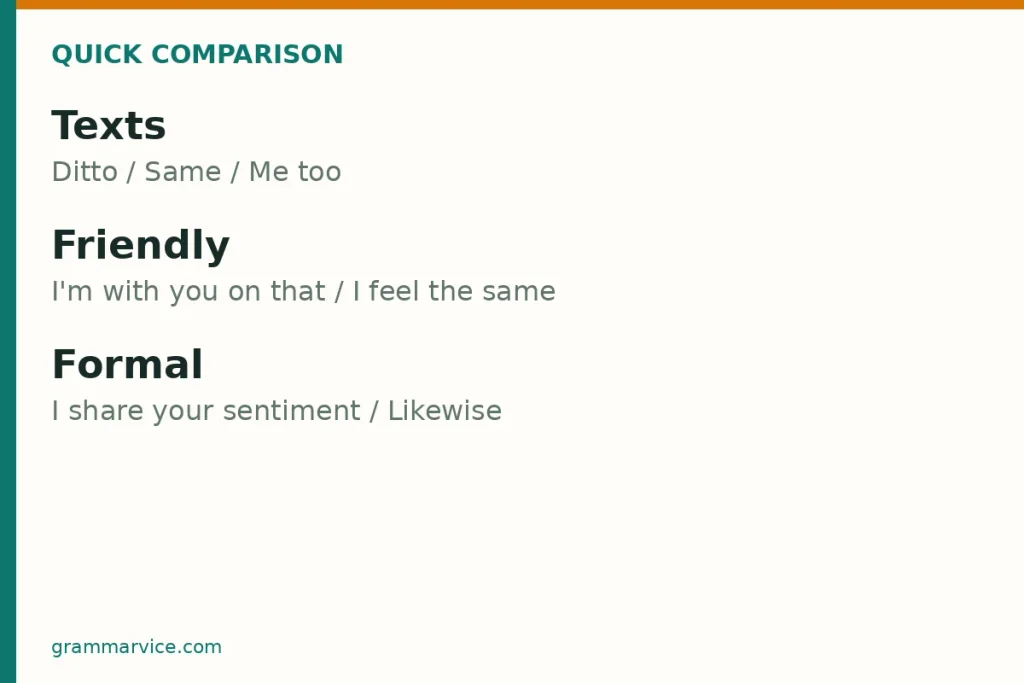
- Me too: Best for quick, everyday conversations and text messages.
- Likewise: Best for polite responses and professional interactions.
- I feel the same way: Best for expressing shared emotions or opinions.
- I can relate: Best for connecting with someone’s personal experience.
- I’m with you on that: Best for friendly agreement and showing support.
- I’ve been there, too: Best for responding empathetically to someone’s struggles.
- I share your perspective: Best for professional discussions and emails.
- Ditto: Best for short, playful responses between friends.
These expressions cover most situations where you’d normally say “same here.” However, some conversations call for a more specific response, particularly when someone shares something personal or discusses an important decision.
Quick Replies for Texts and Chats
When texting friends, family members, or people you know well, you usually don’t need a long response. Short expressions can communicate agreement without making the conversation feel forced.
These alternatives are especially useful when someone shares an opinion, feeling, or preference that you also have.
1. Me Too
Tone: Casual, friendly, and straightforward.
“Me too” is one of the most natural alternatives to “same here.” It’s short, familiar, and works particularly well when someone shares a feeling, preference, or experience that applies to you as well.
Example:
- Friend: “I can’t wait to see the new movie!”
- You: “Me too! I’ve been waiting for it all month.”
It’s an excellent choice for everyday conversations, although it may feel too informal for certain professional situations.
2. Ditto
Tone: Playful, brief, and informal.
“Ditto” means that you feel, think, or want the same thing as the person who spoke before you. It’s a convenient one-word response that adds a little personality to casual conversations.
Example:
- Friend: “I’m completely exhausted after today.”
- You: “Ditto. I need a full day of rest.”
Use it with friends or familiar coworkers. Although it’s generally understandable, it can sound too relaxed in formal business writing.
3. Same!
Tone: Very casual, enthusiastic, and conversational.
Sometimes the simplest response is the most natural. Saying “Same!” expresses agreement immediately without requiring a complete sentence. It works especially well in text messages and social media conversations.
Example:
- Friend: “Chocolate ice cream is the best!”
- You: “Same! Nothing beats it.”
The exclamation mark can make the response sound enthusiastic. Without it, “Same” can communicate quieter agreement.
4. Likewise
Tone: Polite, friendly, and slightly more polished.
“Likewise” communicates that something applies to you in the same way. It’s particularly useful when responding to compliments, greetings, expressions of appreciation, or shared sentiments.
Example:
- Colleague: “It was great working with you.”
- You: “Likewise! I really enjoyed collaborating with you.”
It’s more versatile than some casual alternatives, but context still matters. For example, “likewise” may sound unnatural when someone describes a complicated personal experience. You can explore its definition and usage in the Cambridge Dictionary’s entry for likewise.
Friendly and Casual Ways to Say “Same Here”
When talking with friends, relatives, or familiar colleagues, you can choose expressions that sound relaxed and personal. These different ways to say same here help you communicate shared interests, opinions, and experiences without sounding repetitive.
5. I Can Relate
Tone: Understanding, friendly, and empathetic.
“I can relate” is useful when someone describes an experience that you’ve also encountered. It communicates that you understand their situation because you have something similar to compare it with.
Example:
- Friend: “Balancing work and family responsibilities is exhausting.”
- You: “I can relate. Some days, it feels impossible to manage everything.”
Unlike a simple agreement, this expression establishes a personal connection with the other person.
6. I’m With You on That
Tone: Supportive, relaxed, and confident.
This expression shows that you agree with someone’s opinion, suggestion, or position. It can also communicate that you’re willing to support their decision or approach.
Example:
- Friend: “We should spend more time outdoors this summer.”
- You: “I’m with you on that. We definitely need more fresh air.”
It’s a natural choice when you want to show agreement while keeping the conversation friendly.
7. That’s True for Me, Too
Tone: Conversational, thoughtful, and agreeable.
Use this phrase when someone describes a situation, preference, or observation that also applies to you. It makes the shared connection clear without sounding overly formal.
Example:
- Friend: “I always feel more productive in the morning.”
- You: “That’s true for me, too. I get most of my work done before lunch.”
It’s particularly useful when you want to expand on your agreement with a little personal information.
8. I’m in the Same Boat
Tone: Friendly, relatable, and reassuring.
“I’m in the same boat” means you’re dealing with a similar situation or difficulty. It is especially appropriate when someone discusses a challenge, inconvenience, or shared responsibility.
Example:
- Coworker: “I’m struggling to finish all these assignments before the deadline.”
- You: “I’m in the same boat. This week has been incredibly busy.”
This expression works best when discussing circumstances rather than simply agreeing with someone’s opinion.
9. I Know What You Mean
Tone: Natural, friendly, and understanding.
This phrase tells someone that their statement makes sense to you and that you understand the point they’re making. It works in conversations about everyday experiences, preferences, frustrations, and observations.
Example:
- Friend: “Sometimes, I just want to turn off my phone and enjoy some peace.”
- You: “I know what you mean. A little quiet time makes such a difference.”
It’s a good choice when you want to acknowledge someone’s thoughts rather than simply repeat their words.
10. Count Me In
Tone: Enthusiastic, friendly, and positive.
“Count me in” is a great alternative when someone suggests an activity, makes a plan, or expresses interest in doing something you also want to do. It communicates participation rather than just sharing an opinion.
Example:
- Friend: “I’m thinking about going hiking this Saturday.”
- You: “Count me in! I’ve been wanting to get outside.”
Remember that this phrase isn’t suitable for every use of “same here.” It specifically indicates that you’re joining or accepting an invitation.
11. I Was Thinking the Same Thing
Tone: Friendly, natural, and collaborative.
Use this expression when someone says something that you had already considered. It communicates that your thoughts independently reached the same point, making it particularly useful during brainstorming or casual discussions.
Example:
- Friend: “Maybe we should try a different restaurant tonight.”
- You: “I was thinking the same thing. We always go to the same place.”
It’s more specific than “same here” because it emphasizes that you had a similar thought before hearing the other person’s suggestion.
Empathetic and Warm Ways to Say “Same Here”
Sometimes, someone isn’t simply expressing an opinion. They may be sharing disappointment, stress, sadness, or a difficult personal experience. In these situations, an empathetic response can make them feel understood and supported.
These alternatives are especially useful when you want to communicate emotional understanding rather than just agreement.
12. I’ve Been There, Too
Tone: Compassionate, reassuring, and personal.
This expression works when you’ve experienced something similar to what another person is going through. It shows that you understand their situation from personal experience and can relate to their feelings.
Example:
- Friend: “Starting a new job is exciting, but I’m also nervous.”
- You: “I’ve been there, too. The first few weeks can feel overwhelming.”
Use it when you genuinely have a similar experience. Avoid implying that you understand a situation firsthand if you haven’t experienced it.
13. I Understand Where You’re Coming From
Tone: Respectful, thoughtful, and empathetic.
This phrase acknowledges someone’s feelings or reasoning without necessarily claiming that you’ve experienced exactly the same thing. It is useful when discussing sensitive subjects, disagreements, or personal concerns.
Example:
- Friend: “I’m hesitant about moving because I don’t want to leave my family behind.”
- You: “I understand where you’re coming from. That’s a difficult decision.”
It can also work in professional conversations when you want to acknowledge another person’s concerns before explaining your own position.
14. That Hits Close to Home
Tone: Personal, sincere, and emotionally expressive.
“That hits close to home” means that something someone has said feels particularly relevant to your own life or experiences. It’s a stronger emotional response than simply saying “same here.”
Example:
- Friend: “Sometimes, people don’t realize how much pressure they’re putting on themselves.”
- You: “That hits close to home. I’ve been putting too much pressure on myself lately.”
Use it when a statement connects with something personal. It’s less suitable for ordinary preferences or routine opinions.
15. You’re Not Alone in That
Tone: Warm, comforting, and reassuring.
This expression communicates that someone isn’t the only person experiencing a particular feeling or challenge. It can be especially helpful when a friend feels isolated, discouraged, or misunderstood.
Example:
- Friend: “I feel like everyone else has their life figured out except me.”
- You: “You’re not alone in that. A lot of people feel uncertain about their next steps.”
It offers reassurance rather than simply agreeing. Be sincere, and avoid minimizing the person’s individual experience.
16. I Share Your Frustration
Tone: Understanding, supportive, and emotionally direct.
Use this expression when someone describes a frustrating situation that affects you as well. It makes your shared feelings clear and can help establish a sense of solidarity.
Example:
- Coworker: “It’s frustrating that the project keeps getting delayed.”
- You: “I share your frustration. We’ve been waiting for an update for weeks.”
This phrase is particularly effective when discussing shared problems, workplace difficulties, or disappointing circumstances.
17. I Know That Feeling
Tone: Warm, sympathetic, and conversational.
“I know that feeling” is a simple way to show that someone’s emotional experience is familiar to you. It’s particularly natural when discussing stress, excitement, disappointment, nervousness, or exhaustion.
Example:
- Friend: “I get so nervous before important presentations.”
- You: “I know that feeling. Even after practicing, I still get butterflies.”
It’s a more personal alternative than “me too” because it acknowledges the emotion behind the other person’s statement.
Professional and Formal Ways to Say “Same Here”
When communicating with managers, clients, business partners, or colleagues, it’s often better to choose precise and professional language. These same here synonyms formal alternatives can help you communicate agreement without sounding overly casual.
If you’re learning how to say same here formally, consider the context first. Are you agreeing with an opinion, sharing a concern, supporting a decision, or describing a similar experience? The most effective expression will communicate your exact intention.
18. I Agree With That Assessment
Tone: Professional, confident, and respectful.
This phrase is useful when someone evaluates a situation, reviews a proposal, or shares an informed opinion. It communicates that you agree with their analysis rather than simply sharing a general feeling.
Example:
- Manager: “The current workflow needs improvement before the next quarter.”
- You: “I agree with that assessment. We should review the process and identify the main delays.”
It’s particularly appropriate in meetings, project discussions, and professional emails.
19. I Share Your Perspective
Tone: Formal, thoughtful, and collaborative.
Use this expression when you have a similar viewpoint or understanding of a particular issue. It sounds more polished than “same here” and is especially useful when discussing strategies, business decisions, or workplace policies.
Example:
- Colleague: “I believe employee training should be a priority this year.”
- You: “I share your perspective. Investing in training can strengthen the entire team.”
It’s a strong choice when you want to show agreement while keeping your response professional.
20. My Experience Has Been Similar
Tone: Professional, measured, and informative.
This phrase is ideal when discussing work experiences, professional challenges, or previous projects. Instead of offering a vague agreement, you explain that your own experience supports what the other person has described.
Example:
- Colleague: “The onboarding process took longer than I expected.”
- You: “My experience has been similar. Getting familiar with the system required some additional time.”
It’s especially useful in workplace conversations where personal experience adds value to the discussion.
21. I Reached the Same Conclusion
Tone: Analytical, confident, and professional.
Use this expression when you have independently reviewed information and arrived at the same decision or understanding as another person. It emphasizes agreement based on reasoning rather than simply sharing an emotion.
Example:
- Team member: “After reviewing the numbers, I think we should adjust our budget.”
- You: “I reached the same conclusion after examining the latest figures.”
This is particularly effective in meetings, reports, planning sessions, and business discussions.
22. I Have the Same Concern
Tone: Professional, direct, and constructive.
When someone raises a potential problem, this phrase communicates that you’ve identified the same issue. It is more precise than “same here” because it identifies the shared concern directly.
Example:
- Manager: “I’m concerned that we may not have enough time to complete testing.”
- You: “I have the same concern. We may need to revise the project timeline.”
Use it in discussions about risks, deadlines, quality control, and project management.
23. That Aligns With My Thinking
Tone: Polished, collaborative, and professional.
This expression indicates that another person’s suggestion or viewpoint matches your own reasoning. It’s a useful option when discussing plans, strategies, priorities, or potential solutions.
Example:
- Director: “I think we should focus on improving customer retention.”
- You: “That aligns with my thinking. Retaining existing customers should be one of our priorities.”
It communicates agreement without sounding overly enthusiastic or informal.
24. I Support That Approach
Tone: Professional, positive, and cooperative.
Use this phrase when you agree with a proposed method, strategy, or course of action. It goes beyond sharing an opinion by communicating that you are comfortable with the suggested direction.
Example:
- Colleague: “Let’s divide the project into smaller phases to make progress easier to track.”
- You: “I support that approach. It should make the workload more manageable.”
It’s especially useful in team meetings, planning discussions, and professional email exchanges.
25. I Concur
Tone: Formal, concise, and authoritative.
“I concur” is a direct way to say that you agree with someone. It is a more formal alternative to “I agree” and can work well in professional discussions, written correspondence, and situations requiring a measured tone.
Example:
- Department head: “We should complete the internal review before approving the proposal.”
- You: “I concur. A review will help us identify any outstanding issues.”
Although correct and professional, it can sound stiff in everyday conversations. Use it when the formality suits the setting.
26. I Have a Similar Observation
Tone: Professional, thoughtful, and analytical.
This expression is appropriate when someone notices a trend, behavior, or pattern that you’ve also identified. It shows that your observations are consistent without simply repeating the other person’s statement.
Example:
- Colleague: “Customer inquiries seem to increase after we publish our weekly newsletter.”
- You: “I have a similar observation. We’ve noticed a comparable pattern in our recent reports.”
It’s particularly useful in research discussions, workplace reviews, and data-related conversations.
Funny and Playful Ways to Say “Same Here”
Want to make your response more entertaining? Funny ways to say same here can add humor and personality to conversations with close friends, family members, or people who appreciate playful communication.
These cool ways to say same here are best used when the conversation is relaxed. Avoid them in serious discussions, sensitive situations, or formal professional correspondence.
27. Twins!
Tone: Cute, cheerful, and playful.
“Twins!” is a fun response when someone shares the same preference, feeling, or opinion as you. It humorously suggests that the two of you are alike.
Example:
- Friend: “I could eat pizza every single day.”
- You: “Twins! It’s definitely my favorite comfort food.”
It’s particularly natural in casual text messages and friendly social conversations.
28. Get Out of My Head!
Tone: Funny, dramatic, and energetic.
This playful expression suggests that someone has said exactly what you were thinking. It’s a humorous way to communicate that your thoughts are surprisingly similar.
Example:
- Friend: “We should order burgers tonight.”
- You: “Get out of my head! I was just thinking about burgers.”
It’s a great option when someone expresses an idea that matches your thoughts perfectly.
29. Are We Sharing a Brain?
Tone: Silly, humorous, and friendly.
Use this phrase when someone repeatedly has the same thoughts or ideas as you. It exaggerates your similarity for comedic effect and works especially well between close friends.
Example:
- Friend: “I think we should cancel our plans and watch movies instead.”
- You: “Are we sharing a brain? That’s exactly what I wanted to do.”
This expression is more playful than a typical synonym and adds humor to an ordinary agreement.
30. Welcome to the Club
Tone: Lighthearted, humorous, and relatable.
“Welcome to the club” works when someone shares a familiar habit, experience, preference, or struggle. It playfully suggests that both of you belong to the same unofficial group.
Example:
- Friend: “I keep hitting snooze even when I promise myself I won’t.”
- You: “Welcome to the club! My alarm has been fighting a losing battle for years.”
It’s a natural choice for everyday frustrations and shared habits.
31. We Must Be on the Same Frequency
Tone: Witty, friendly, and slightly clever.
This phrase suggests that two people are thinking similarly or naturally understanding each other’s ideas. It adds a humorous twist to the idea of being mentally in sync.
Example:
- Friend: “I think we should take a spontaneous road trip.”
- You: “We must be on the same frequency. I’ve been planning one in my head all week.”
It’s suitable for conversations about shared ideas, plans, interests, and preferences.
32. Great Minds Think Alike
Tone: Clever, playful, and confident.
“Great minds think alike” is a familiar expression used when two people independently come up with the same idea. It’s a slightly humorous way to compliment both people’s thinking while expressing agreement.
Example:
- Friend: “I think we should get coffee before heading home.”
- You: “Great minds think alike! I was about to suggest the same thing.”
It’s particularly useful when someone suggests something you were already considering. It sounds more playful than a straightforward “I agree.”
Which One Should You Use? A Quick Guide
Choosing among different ways to say me too or same here becomes easier when you consider your relationship with the other person and the purpose of your response.
For example, a short expression works well in a text message, while a more specific sentence may be better in a business email. Similarly, an empathetic phrase is more appropriate when someone shares a difficult experience than a funny expression.
Use this table to find the best phrase for common situations:
| Setting or Situation | Best Phrase | Why It Works |
|---|---|---|
| Texting a friend | Me too | Short, natural, and familiar. |
| Casual group chat | Ditto | Quick and playful. |
| Sharing excitement | I was thinking the same thing | Shows enthusiasm and shared thoughts. |
| Agreeing with an opinion | I couldn’t agree more | Expresses strong agreement. |
| Comforting a friend | I’ve been there, too | Shows personal understanding. |
| Discussing a difficult situation | I can relate | Creates an emotional connection. |
| Responding to a greeting | Likewise | Polite and natural. |
| Professional email | I share your perspective | Sounds polished and respectful. |
| Business meeting | I concur | Clearly communicates agreement. |
| Discussing a concern | I have the same concern | Identifies a shared issue. |
| Supporting a proposal | I support that approach | Shows agreement with a suggested action. |
| Joking with friends | Are we sharing a brain? | Adds humor and personality. |
| Sharing a similar habit | Welcome to the club | Creates a playful sense of connection. |
One useful rule is to be specific whenever the conversation involves an important decision or personal feeling. Instead of responding with a generic “same here,” explain whether you agree, share the experience, or support the suggestion.
What to Reply When Someone Says “Same Here” to You
If someone responds with “same here,” you don’t always need to find another way to agree. You can acknowledge the shared feeling, continue the conversation, or ask a question that encourages the other person to share more.
Your response should depend on what the original conversation was about.
- If someone shares your excitement: “Looks like we’re both looking forward to it!”
- If someone agrees with your opinion: “Glad we’re on the same page.”
- If someone shares your frustration: “Hopefully, things get better for both of us.”
- If someone shares your preference: “Then we definitely have good taste!”
- If someone responds to your plans: “Great! We should make it happen.”
- If someone shares a personal experience: “It’s nice knowing someone understands.”
You can also ask a follow-up question to keep things moving. For instance, if someone says “same here” after you mention feeling stressed, you could reply, “What’s been keeping you busy lately?” This creates a more meaningful exchange instead of ending the conversation with another short agreement.
Mistakes to Avoid When Using Alternatives to “Same Here”
Although there are many other words to say same here, not every expression works in every situation. Choosing an alternative that doesn’t match the context can make your response sound awkward, overly formal, or even insensitive.
Here are some common mistakes to avoid:
- Using overly casual language in formal emails: “Ditto” and “Twins!” may be fine with friends, but they aren’t ideal for important business correspondence. Choose “I agree with that assessment” or “I share your perspective” instead.
- Confusing empathy with agreement: “I can relate” suggests that you understand someone’s experience. It doesn’t necessarily mean you agree with their opinion.
- Using a funny response during a serious conversation: Expressions such as “Are we sharing a brain?” can seem insensitive when someone is discussing a personal problem.
- Claiming an experience you haven’t had: Don’t say “I’ve been there, too” unless you’ve genuinely experienced something similar.
- Using “count me in” incorrectly: This phrase communicates that you want to participate in an activity. It isn’t a general replacement for every use of “same here.”
- Repeating the same alternative too often: Replacing “same here” with “me too” in every conversation doesn’t necessarily make your communication more interesting. Choose expressions that match the meaning.
- Overcomplicating a simple response: A casual conversation doesn’t need a formal sentence such as “I am in complete agreement with your perspective.” Sometimes, “Me too!” is all you need.
Also, remember that agreement and understanding aren’t always identical. If someone says something you understand but don’t necessarily agree with, a phrase such as “I see where you’re coming from” may be more accurate. If you’re looking for additional expressions for acknowledging someone’s point, explore these guides on other ways to say “that makes sense” and other ways to say “I understand.”
One last tip: most searches for other ways to say me too are really about variety, not grammar — people simply want a reply that doesn’t sound copied. And if you’re unsure what to reply to same here in a given moment, match the other person’s energy first: a short “Me too” for a light comment, an empathetic phrase for something personal, and a polished one for anything work-related.
Frequently Asked Questions
Is “same here” professional enough for work emails?
“Same here” is polite, but it is generally considered casual rather than formal. You can use it in friendly messages with familiar coworkers, but more polished alternatives are preferable when communicating with clients, managers, or business partners. Try “I share your perspective,” “I agree with that assessment,” or “My experience has been similar” to make your response sound more professional.
What is a formal way to say “same here”?
Some formal alternatives include “I concur,” “I share your perspective,” “I am in agreement,” and “That aligns with my thinking.” The best choice depends on the situation. For example, use “I concur” when agreeing with a decision, or “My experience has been similar” when discussing a shared professional experience.
What can I say instead of “same here” in a text or chat?
For texts and casual chats, you can say “Me too,” “Ditto,” “Same!”, “Twins!”, “I can relate,” or “I was thinking the same thing.” These expressions are short, natural, and easy to understand. Choose a playful response when chatting with close friends and a straightforward one when you simply want to acknowledge someone’s feelings or opinion.
What’s the difference between “same here” and “me too”?
“Same here” and “me too” communicate nearly the same meaning: you share another person’s feeling, opinion, or experience. However, “me too” is often a shorter and more direct response, while “same here” emphasizes that the other person’s statement also applies to your situation. Both are informal and commonly used in everyday English.
How do you reply when someone says “same here” to you?
You can acknowledge the shared feeling or use it as an opportunity to continue the conversation. For example, say “Glad we’re on the same page,” “Looks like we’re thinking alike,” or “Hopefully, we both get a chance to relax soon.” If the conversation involves a personal experience, asking a thoughtful follow-up question can make the exchange more meaningful.
Is “ditto” a polite alternative to “same here”?
Yes, “ditto” is generally acceptable in friendly, informal conversations. It means that you feel or think the same way as someone else and works well in texts, casual chats, and conversations with familiar coworkers. However, it can sound too casual or abrupt in formal emails, client communications, and serious discussions. In those situations, choose “I agree” or “likewise.”
Conclusion
Knowing different ways to say same here helps you communicate more naturally in everyday conversations, personal messages, and professional settings. From quick responses like “Me too” and “Ditto” to empathetic expressions like “I’ve been there, too” and formal alternatives like “I share your perspective,” there’s an option for almost every situation.
The key is to choose words that match your intention. Use casual expressions with friends, thoughtful phrases when showing empathy, and professional alternatives when discussing workplace ideas or decisions. With these 32 alternatives, you can move beyond repetitive replies and make your conversations sound more genuine, expressive, and engaging.