25 Other Ways to Say “As You Can See” (With Examples)
Quick answer: The best other ways to say as you can see include “the evidence indicates,” “the findings support the conclusion that,” and “this clearly demonstrates” — the best choice depends on whether you are writing an essay, a report, a presentation, or an email.
“As you can see” is a familiar expression, but using it repeatedly can make your writing sound predictable or unintentionally condescending. A more specific alternative can make your point clearer and your tone more professional.
Whether you are writing an academic essay, preparing a business report, explaining a graph, or communicating with a colleague, the right replacement depends on context. This guide explains what “as you can see” means, why it can sound bossy, and offers alternatives with examples for essays, reports, presentations, and emails.
What Does “As You Can See” Mean?
“As you can see” is an expression used to draw someone’s attention to information, evidence, an observation, or a detail that is already available to them.
For example:
“As you can see, customer satisfaction increased significantly during the final quarter.”
In this sentence, the speaker directs the reader’s attention to a noticeable improvement. The expression works as an introduction to evidence that follows.
People commonly use this phrase in:
- Academic writing: Explaining research findings, examples, and supporting evidence.
- Business reports: Highlighting performance figures, progress, and important results.
- Presentations: Directing an audience toward charts, graphs, slides, and images.
- Professional emails: Referring recipients to information in an attachment or document.
- Everyday conversations: Pointing out something noticeable or explaining an observation.
Although the expression is grammatically correct, its usefulness depends on context. Sometimes, a more specific sentence describes the evidence better than a general instruction to look at it.
Is “As You Can See” Professional or Polite?
Yes. “As you can see” can be professional and polite when used appropriately. It is common in workplace presentations, reports, and everyday professional communication.
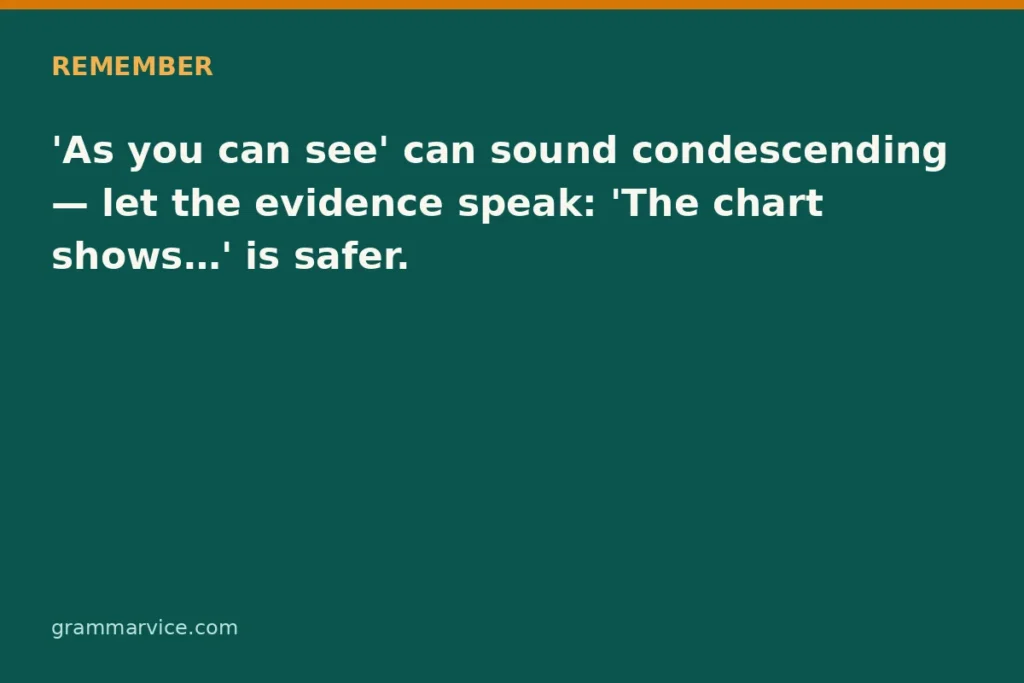
The expression can sound slightly presumptuous because it assumes the audience has already noticed or understood the information being presented.
Consider these two examples:
Less considerate:
“As you can see, I have already corrected the mistakes in your document.”
More professional:
“The revised document includes the requested corrections.”
The second version communicates the same information without suggesting that the recipient should have noticed the changes already.
If you are wondering how to say as you can see professionally, focus on the evidence or information rather than the reader. For formal writing, an appropriate as you can see synonym should describe what the evidence establishes instead of simply directing attention to it.
Why “As You Can See” Can Sound Condescending
Although the phrase is not inherently rude, it can create an unintended impression depending on your tone, audience, and context.
Here are three reasons it can sound condescending or bossy.
1. It suggests that the information is obvious.
When you say “as you can see,” you may unintentionally imply that the reader has missed something straightforward. This can feel dismissive, especially if the information is complex.
2. It can sound like an instruction.
Repeatedly directing people to look at something can make your communication feel demanding. In a presentation, for example, constantly telling the audience what they should see can sound bossy rather than helpful.
3. It assumes everyone has access to the same information.
Your reader might not be able to view an attachment, understand a graph immediately, or recognize the connection between the evidence and your conclusion.
When should you choose a softer option?
- When explaining something to a new employee or student.
- When correcting someone’s misunderstanding.
- When writing to a customer, client, or senior colleague.
- When discussing complicated findings that require interpretation.
- When the reader may not have access to the visual information you are referencing.
Instead of emphasizing what someone should already understand, describe the observation itself. This small adjustment makes your writing more considerate and more persuasive.
Quick Top Picks: The 8 Best Alternatives at a Glance
If you need a quick replacement, these eight expressions are useful starting points. Each one also appears in the detailed sections below.
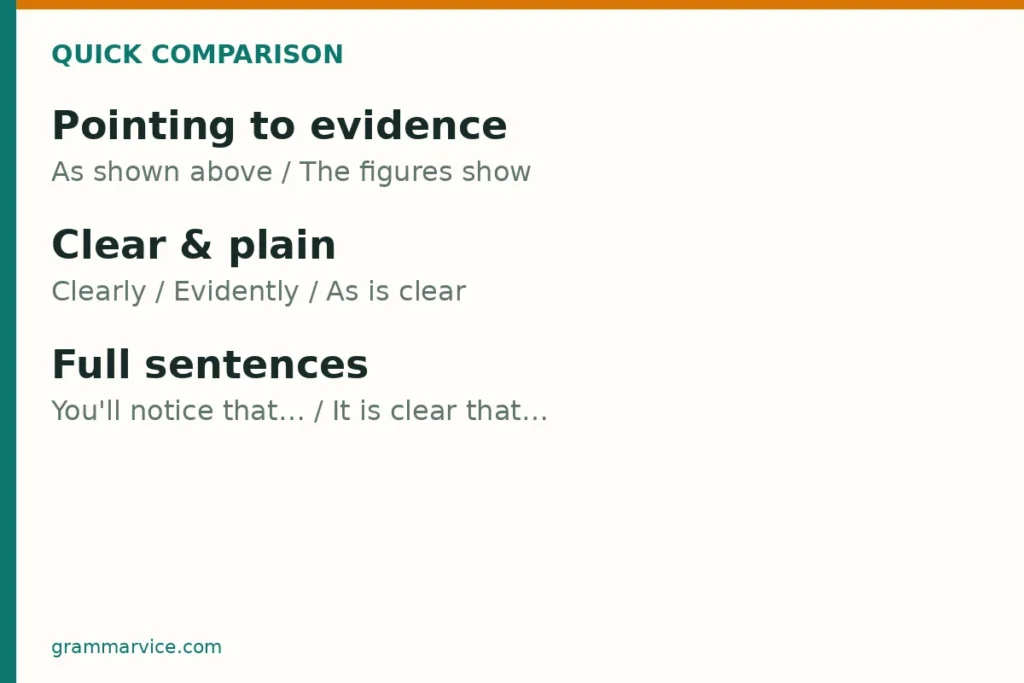
- For essays: “The findings support the conclusion that…” and “It is clear from the results that…” Both work well when you are presenting a conclusion supported by evidence.
- For reports: “As the evidence indicates…” and “As is evident from the results…” These expressions introduce findings in a formal, objective way.
- For presentations: “You’ll notice that…” and “Here’s what the results tell us.” Both help guide an audience through information without sounding demanding.
- For professional emails: “The updated report indicates that…” and “You may notice that…” These options communicate information politely and clearly.
The best choice depends on your purpose. A research paper benefits from evidence-focused wording, while a presentation benefits from conversational guidance.
Formal “As” Phrases: Other Ways to Say As You Can See
When you need an as you can see synonym formal enough for academic writing, business reports, or professional explanations, these phrases work well.
1. As the Evidence Indicates
This is a strong choice for academic papers, research summaries, and professional reports. It directs attention toward what the evidence shows, rather than toward the reader.
Example: As the evidence indicates, consistent customer communication contributes to higher satisfaction levels.
2. As Is Evident from the Results
Use this expression when findings make a particular observation reasonably clear. It is suitable for formal reports, essays, and research summaries.
Example: As is evident from the results, the revised teaching method improved student performance.
3. As Can Be Observed in Figure 2
This construction is useful in research papers and technical documents containing numbered charts, figures, or illustrations.
Example: As can be observed in Figure 2, the percentage of returning customers increased throughout the study period.
4. As the Findings Suggest
Choose this phrase when research or observations support a conclusion without establishing it beyond doubt. It is particularly useful when you want to remain cautious and accurate.
Example: As the findings suggest, regular feedback may improve employee engagement and overall productivity.
5. As the Comparison Illustrates
This expression works when you want to explain differences or similarities between two or more subjects. It is especially useful in analytical writing.
Example: As the comparison illustrates, the updated software requires fewer steps to complete the same task.
6. As a Closer Reading Reveals
Use this expression when an important detail becomes apparent through careful examination rather than an immediate observation.
Example: As a closer reading reveals, the author’s choice of language communicates a deeper conflict between the characters.
7. As the Data Make Clear
This phrase is appropriate for quantitative research, performance reviews, financial reports, and business presentations.
Example: As the data make clear, online sales accounted for the largest share of total revenue.
8. As the Pattern Becomes Apparent
This expression is useful when discussing trends, repeated behaviors, or developments that become easier to recognize over time.
Example: As the pattern becomes apparent, younger customers consistently prefer shorter product demonstrations.
Full-Sentence Alternatives
Sometimes, replacing a short introductory expression with a complete sentence makes your writing more confident and more varied.
They also help you avoid repeating the same introductory structure throughout several paragraphs. Rather than starting every sentence with “as,” you can state the conclusion directly.
9. It Is Clear from the Results That
This is a direct, complete-sentence construction that works well when the findings strongly support a conclusion.
Example: It is clear from the results that the new training program improved employee performance.
10. This Clearly Demonstrates That
Use this expression when a specific example, result, or piece of evidence provides strong support for a conclusion.
Example: This clearly demonstrates that consistent practice plays an important role in developing effective communication skills.
11. The Evidence Points To
This is a useful alternative when you want to present a conclusion without claiming absolute certainty.
Example: The evidence points to a steady improvement in customer retention following the introduction of the new service.
12. One Can Observe That
This is a formal alternative to “one can see” that works in academic explanations and objective discussions.
Example: One can observe that the two groups responded differently to the same experimental conditions.
13. The Findings Support the Conclusion That
This is one of the strongest choices for academic writing because it connects a conclusion directly to the evidence behind it.
Example: The findings support the conclusion that access to additional learning resources can improve academic performance.
14. A Closer Examination Reveals
Use this expression when you want to introduce an insight that requires more than a quick glance. It signals careful analysis.
Example: A closer examination reveals that the company’s expenses increased mainly because of higher transportation costs.
15. The Updated Report Indicates That
This is particularly useful in workplace communication and professional emails. It identifies the source of the information clearly.
Example: The updated report indicates that all outstanding tasks have been completed ahead of schedule.
Pointing at Data and Visuals
When discussing charts, graphs, tables, photographs, or other visual materials, the best alternative names the visual source directly.
For example, the expression “as you can see by this graph” is understandable, but “the graph shows” is clearer and more direct.
Here are six useful alternatives for data-focused communication.
16. The Chart Shows
This is one of the clearest expressions for presentations, reports, and academic documents. It identifies the visual source immediately.
Example: The chart shows that monthly website traffic increased by 18 percent between January and March.
17. The Figures Speak for Themselves
This expression is more conversational and confident than a traditional report-writing phrase. It suggests the numbers need little explanation.
Example: The figures speak for themselves: our customer retention rate improved from 72 percent to 89 percent.
18. The Graph Makes the Trend Easy to Identify
This is a useful explanatory sentence when you want to discuss a visual representation of changing information over time.
Example: The graph makes the trend easy to identify, showing a gradual increase in renewable energy consumption.
19. A Comparison of the Two Columns Highlights
Use this expression when discussing information presented in a table or chart with two columns. It explains exactly what the comparison shows.
Example: A comparison of the two columns highlights the difference in operating expenses before and after the policy change.
20. The Table Provides a Breakdown Of
This phrase works when a table organizes detailed information into categories, figures, or individual items.
Example: The table provides a breakdown of annual expenses across all five departments.
21. The Data Tell a More Nuanced Story
This is a useful expression when numerical information reveals a complicated situation that cannot be explained by a single observation. It works well in research discussions, business reports, and analytical presentations. Rather than simply directing attention toward figures, it signals that the information deserves a closer interpretation.
Example: The data tell a more nuanced story, revealing that customer satisfaction improved even though overall sales remained relatively stable.
22. The Numbers Highlight a Difference
Use this expression when comparing statistics, measurements, or performance figures. It is particularly effective in business presentations, financial reports, and research papers. It identifies the significance of numerical information without assuming that readers have already noticed the difference.
Example: The numbers highlight a difference in spending habits between first-time customers and returning buyers.
23. Taken Together, These Figures Reveal a Pattern
This is a strong alternative when several statistics contribute to a broader observation. It works well in academic writing and detailed reports because it shows that your conclusion comes from considering multiple pieces of evidence together.
Example: Taken together, these figures reveal a pattern of steady growth in online purchases throughout the year.
Presentation and Speaking Phrases
When speaking to an audience, you want expressions that sound natural and keep people interested. Repeatedly saying “as you can see” can sound mechanical.
A better approach is to guide listeners toward important information, explain what the findings mean, and move naturally to the next point.
24. You’ll Notice That
This is a friendly and conversational alternative that gently directs the audience’s attention toward an important detail.
Example: You’ll notice that the latest version includes several improvements to the user interface.
25. Here’s What the Results Tell Us
This expression is ideal for transitioning from presenting information to explaining its meaning. It helps the audience understand why the results matter.
Example: Here’s what the results tell us: customers are more likely to purchase products when they receive personalized recommendations.
26. Let’s Turn to What This Means
Use this phrase when moving from facts or observations to their practical implications. It is conversational and useful for presentations and meetings.
Example: Let’s turn to what this means for our marketing strategy and the decisions we need to make next.
Softer and More Casual Options
Sometimes, you do not need a highly formal expression or a detailed reference to evidence. A softer alternative can sound more considerate, especially with colleagues or clients.
These expressions are particularly useful when communicating with colleagues, helping someone understand a point, or discussing a sensitive topic.
27. You May Notice That
This is a polite and considerate alternative that gives the reader room to make their own observation.
Example: You may notice that the updated schedule includes a few additional training sessions.
28. One Thing That Stands Out Is
Use this expression when you want to draw attention to one particularly interesting or important detail.
Example: One thing that stands out is the significant improvement in customer feedback after the new support system was introduced.
Before and After: Two Sentences Rewritten Three Ways
Understanding alternatives is easier when you see how they work in complete sentences. The following examples show the same idea rewritten in formal, neutral, and soft versions.
Example 1: An Academic Essay Paragraph
Original: As you can see, social media has changed the way people communicate. It allows individuals to share information instantly and connect across distances.
Formal version: The evidence demonstrates that social media has significantly changed the way people communicate. It allows individuals to share information instantly and connect across distances.
Neutral version: These observations highlight how social media has changed the way people communicate. It allows individuals to share information instantly and connect across distances.
Softer version: One noticeable effect of social media is the way it has changed everyday communication. It allows individuals to share information instantly and connect across distances.
Each version communicates the same central idea, but the wording changes the tone. The formal version is suitable for academic writing, the neutral version works for general reports, and the softer version sounds more conversational.
If you are looking for more expressions to introduce supporting evidence in an academic paragraph, our guide to other ways to say “this shows” offers additional options.
Example 2: A Business Presentation Line
Original: As you can see, our sales increased significantly during the last quarter.
Formal version: The quarterly figures demonstrate a significant increase in sales during the final quarter.
Neutral version: The sales figures show a substantial improvement during the last quarter.
Softer version: You’ll notice that sales picked up considerably during the last quarter.
The formal version is appropriate for executive reports and official presentations. The neutral version works for most business settings, while the softer version is ideal for live presentations.
Which One Should You Use? A Quick Guide
The best alternative depends on your audience, communication style, and the information you are explaining. Use this guide to choose an expression that matches your situation.
| Context | Best Phrase | Why It Works |
|---|---|---|
| Academic essay | The findings support the conclusion that… | Connects the argument directly to supporting evidence. |
| Research paper | As the evidence indicates… | Creates an objective and analytical tone. |
| Business report | The updated report indicates that… | Identifies the source of the information clearly. |
| Financial analysis | As the data make clear… | Directs attention toward numerical findings. |
| Presentation | You’ll notice that… | Guides the audience without sounding demanding. |
| Presenting research findings | Here’s what the results tell us. | Creates a natural transition into interpretation. |
| Professional email | You may notice that… | Sounds polite and considerate. |
| Explaining a graph | The chart shows… | Identifies the visual source directly. |
| Literary analysis | As a closer reading reveals… | Introduces a deeper interpretation of the text. |
| Everyday conversation | One thing that stands out is… | Sounds natural and approachable. |
| Comparing results | As the comparison illustrates… | Highlights similarities or differences. |
| Customer communication | The revised document includes… | Communicates information without sounding condescending. |
Quick tip: If you are unsure which expression to choose, focus on what you want your reader or listener to understand, rather than on what they should already have noticed.
Mistakes to Avoid
Replacing “as you can see” is not simply about finding a more sophisticated phrase. The goal is to communicate clearly without sounding condescending or repetitive.
Here are some common mistakes to watch for.
1. Overusing “Obviously”
Replacing “as you can see” with “obviously” does not necessarily solve the tone problem. In fact, it can make it worse, because it also assumes shared understanding.
Less considerate: Obviously, the new system is more efficient than the previous one.
Better: The performance results indicate that the new system is more efficient than the previous one.
Choose an evidence-based expression instead of assuming that everyone shares the same understanding.
2. Using “As You Can Clearly See” Instead
Adding the word “clearly” does not automatically make the original expression stronger. It can actually make the tone problem worse.
Less effective: As you can clearly see, the project is behind schedule.
Better: The project timeline shows that several milestones are behind schedule.
The improved version identifies the actual issue rather than implying that the audience should have noticed it already.
3. Pointing at Information the Reader Cannot See
Avoid using expressions such as “as shown in the chart” or “as displayed above” when the reader cannot actually see the visual you are referring to.
Less effective: As you can see in the chart, our expenses have increased.
Better: Our expenses increased by 12 percent during the reporting period.
If the visual is not available, explain the relevant information directly rather than relying on something the reader cannot view.
4. Choosing Formal Language for Every Situation
Not every conversation requires expressions such as “as the evidence indicates” or “the findings support the conclusion that.”
Less natural: As the available information indicates, we should begin the meeting shortly.
Better: It looks like we’re ready to start the meeting.
Match your wording to the audience and setting. Professional communication can still sound friendly and natural.
5. Repeating the Same Alternative Too Often
Replacing every instance of “as you can see” with “as the results show” can create another repetitive pattern.
Instead, vary your sentence structures. You can introduce evidence, explain a finding, describe a comparison, or guide the audience, using different expressions for each purpose.
If you found this page while hunting for an as you can see synonym essay writers can actually use, the full-sentence options above are the ones to bookmark. Students often search an as you can see thesaurus for a quick swap, but the stronger move is structural: the same family covers an as we can see synonym formal reports prefer (“as the evidence indicates”), an as you will see synonym for forward references (“as the next section shows”), and the one can see synonym “one can observe that” for objective academic prose. Once you know how to say as you can see in an essay — lead with the evidence, not the reader — the phrase rarely needs to appear at all.
Frequently Asked Questions
Is “as you can see” rude or condescending?
“As you can see” is not inherently rude, but it can sound condescending depending on the context and tone. It can imply that the information is obvious or that the reader should already have noticed it. Describing the evidence itself, rather than what the reader should see, usually avoids that impression.
What is the most formal way to say “as you can see” in an essay?
“The findings support the conclusion that” is an effective formal alternative for academic essays. Other formal options include “as the evidence indicates” and “it is clear from the results that.”
What can I say instead of “as you can see” in a presentation?
For presentations, try “you’ll notice that,” “here’s what the results tell us,” or “let’s turn to what this means.” These guide the audience without sounding demanding.
Is “as you can see” grammatically correct?
Yes, “as you can see” is grammatically correct. It is a dependent introductory clause commonly used to draw attention to information. Its problem is tone and overuse, not grammar.
How do I say “as you can see” in a professional email?
In a professional email, use phrases such as “the attached report indicates,” “the updated document shows,” or “you may notice that.” These are polite, clear, and identify the source of the information.
Should I avoid “as you can see” in academic writing?
You do not need to avoid “as you can see” completely, but it is usually better to use more precise, evidence-focused language in academic writing, such as “the findings support the conclusion that” or “as the evidence indicates.”
Conclusion
Choosing the right alternative to “as you can see” can make your writing more professional, natural, and persuasive.
For formal communication, choose phrases such as “the evidence indicates” or “the findings support the conclusion that.” For presentations, choose conversational guides such as “you’ll notice that.”
Ultimately, the best other ways to say as you can see are the ones that communicate your point clearly, respect your reader, and match your setting.
For another useful way to clarify an explanation, explore our guide to other ways to say “in other words”. You can also consult the Cambridge Dictionary definition of “evidently” when choosing precise language for formal explanations.