30 Other Ways to Say “That’s Not Good” (With Examples)
Quick Answer: If you want other ways to say that’s not good, try phrases such as “That’s disappointing,” “This doesn’t meet expectations,” “I have some concerns about this,” or “This could benefit from improvement.” The best alternative depends on your situation. Use empathetic expressions when responding to bad news, diplomatic language at work, and casual phrases in everyday conversations.
Saying “That’s not good” is a simple way to express disappointment, concern, or dissatisfaction. However, it can sometimes sound blunt, negative, or even insensitive, especially when you’re speaking to a coworker, responding to someone’s problem, or giving feedback on their work.
Fortunately, there are many better expressions you can use without changing your intended meaning. Whether you want to sound professional in an email, give constructive criticism, respond politely to bad news, or express disappointment in a casual conversation, choosing the right words makes a difference.
In this guide, you’ll discover 33 useful alternatives, including empathetic responses, formal expressions, diplomatic feedback phrases, and casual ways to communicate that something isn’t good. Each alternative includes a tone explanation and a natural example sentence.
What Does “That’s Not Good” Mean? Other Ways to Say That’s Not Good
“That’s not good” is an informal expression used to communicate that something is disappointing, undesirable, problematic, unacceptable, or below expectations. It can describe a situation, decision, result, behavior, experience, or piece of work.
The meaning changes slightly depending on the context and tone. For example:
- Disappointment: “That’s not good. I was hoping for a better result.”
- Concern: “That’s not good. We might miss the deadline.”
- Disapproval: “That’s not good. You shouldn’t have handled it that way.”
- Poor quality: “That’s not good. The report needs more detail.”
- Bad news: “That’s not good. I’m sorry you’re dealing with that.”
Although the expression is grammatically correct and widely understood, it doesn’t always communicate exactly what you mean. Sometimes you want to show sympathy rather than criticize. Other times, you need to explain that something doesn’t meet professional standards.
Choosing a more specific expression helps your listener understand whether you’re disappointed, concerned, sympathetic, or offering constructive feedback.
Is “That’s Not Good” Professional or Polite?
“That’s not good” is not inherently rude, but it is generally informal. In professional conversations, it may sound vague or overly critical because it identifies a problem without explaining what needs to change.
For example, telling an employee “That’s not good” after reviewing their work doesn’t provide enough information for them to improve. A more constructive response would be, “The report needs additional supporting information before we can approve it.”
Here is how the expression compares across different situations:
| Situation | Is “That’s Not Good” Appropriate? | Better Alternative |
|---|---|---|
| Casual conversation | Usually yes | That’s a bummer. |
| Professional email | Not ideal | This doesn’t meet our expectations. |
| Workplace feedback | Can sound critical | This could benefit from some revisions. |
| Responding to bad news | May sound insensitive | I’m sorry to hear that. |
| Formal discussion | Too informal | The outcome is unsatisfactory. |
| Discussing a problem | Too vague | There are some concerns we need to address. |
If you’re wondering how to say not good professionally or how to say not good politely, the key is to replace general criticism with specific, respectful language.
Professional communication doesn’t mean avoiding negative feedback. It means delivering that feedback clearly, respectfully, and constructively.
Quick Top Picks: The 8 Best Alternatives at a Glance
Not sure which expression to choose? Here are eight versatile alternatives to “That’s not good” for different situations.
- “I’m sorry to hear that.” Best for responding sympathetically to someone’s bad news.
- “That’s disappointing.” Best for expressing dissatisfaction without sounding harsh.
- “This doesn’t meet the requirements.” Best for formal workplace discussions.
- “The current result falls short of expectations.” Best for professional performance feedback.
- “There are some concerns we need to address.” Best for discussing problems diplomatically.
- “This could benefit from some revisions.” Best for giving polite feedback on someone’s work.
- “Let’s revisit this section.” Best for encouraging improvements collaboratively.
- “Not ideal.” Best for casual conversations when something isn’t going as planned.
These expressions cover most situations, but the following alternatives offer more specific ways to communicate your feelings and opinions.
Empathetic Ways to React to Bad News
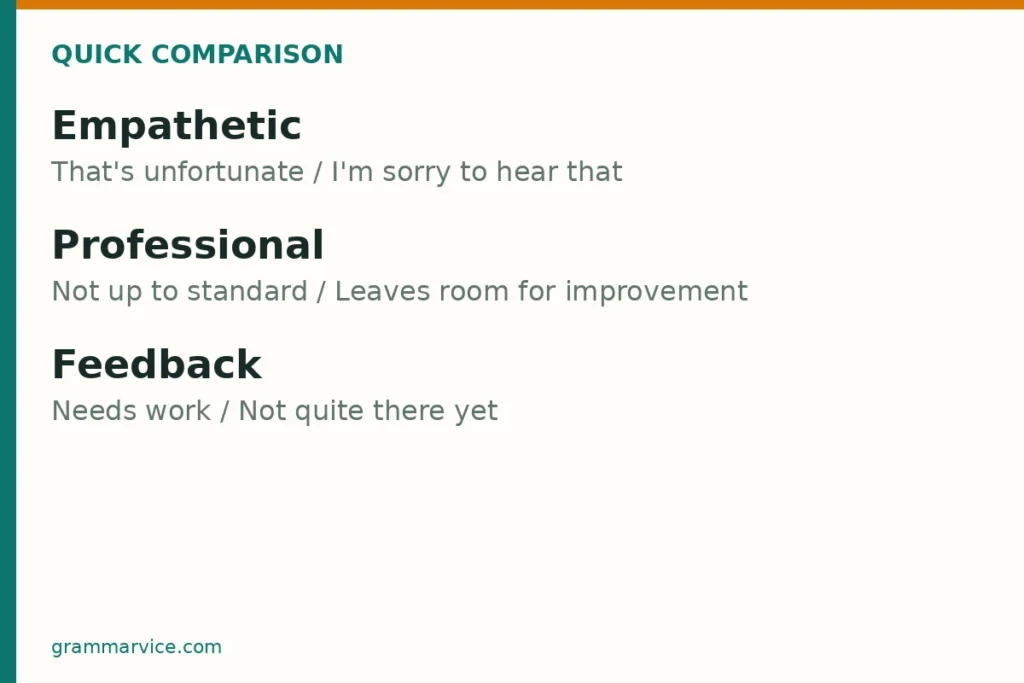
When someone shares disappointing news, your response should acknowledge their feelings rather than make the situation sound worse. Expressions such as “I’m sorry to hear that” and “That’s a tough situation” communicate understanding and concern.
These alternatives are particularly useful when talking to friends, family members, coworkers, or anyone experiencing an unexpected problem.
1. “I’m Sorry to Hear That”
Tone: Empathetic, compassionate, and polite.
This is one of the most natural alternatives when someone tells you something unfortunate has happened. It communicates sympathy without judging the situation or making assumptions about how the person feels.
Example: “I’m sorry to hear that your application wasn’t accepted. I know you were looking forward to the opportunity.”
2. “That’s Disappointing”
Tone: Understanding, honest, and moderately sympathetic.
Use this expression when an outcome doesn’t meet expectations. It acknowledges disappointment without sounding overly dramatic or suggesting that the person is responsible for what happened.
Example: “That’s disappointing. We were all hoping the project would receive approval this week.”
3. “What a Tough Situation”
Tone: Supportive and compassionate.
This phrase recognizes that someone is dealing with a difficult circumstance. It works particularly well when the situation involves personal challenges, unexpected changes, or problems that aren’t easily resolved.
Example: “What a tough situation. I hope everything works out for you and your family.”
4. “I Can See Why That’s Frustrating”
Tone: Validating and emotionally supportive.
Choose this expression when someone is upset because something hasn’t gone as expected. Instead of simply commenting on the problem, you acknowledge why the person might feel frustrated.
Example: “I can see why that’s frustrating, especially after you’ve spent so much time preparing for the presentation.”
5. “I Wish the Outcome Had Been Different”
Tone: Gentle, thoughtful, and sympathetic.
This expression is appropriate when you want to acknowledge an unfortunate result without criticizing anyone involved. It communicates that you understand the disappointment and would have preferred a better outcome.
Example: “I wish the outcome had been different, but I appreciate all the effort you put into the application.”
6. “That’s Certainly Not the News We Hoped For”
Tone: Professional, empathetic, and collaborative.
Use this expression when disappointing news affects a group or team. The word “we” creates a sense of shared understanding rather than placing the disappointment entirely on one person.
Example: “That’s certainly not the news we hoped for, but we’ll review our options and decide what to do next.”
7. “I’m Sorry Things Didn’t Work Out as Planned”
Tone: Considerate and reassuring.
This is a thoughtful way to respond when someone’s plans, expectations, or efforts haven’t produced the desired result. It is especially useful when the person has invested considerable time or energy into something.
Example: “I’m sorry things didn’t work out as planned with the new position. I hope another opportunity comes along soon.”
8. “That’s a Real Setback”
Tone: Serious, understanding, and supportive.
This phrase acknowledges that a problem could affect someone’s progress. It’s more direct than a simple expression of sympathy, making it suitable for professional and personal situations where the consequences are significant.
Example: “Losing that client is a real setback, but we can use the experience to strengthen our next proposal.”
Professional and Diplomatic Ways to Say “That’s Not Good”
In professional communication, you may need to explain that a decision, proposal, result, or situation is unsatisfactory without sounding disrespectful. The best approach is to describe the problem objectively and, when possible, suggest a practical next step.
These formal ways to say not good are useful in workplace conversations, business meetings, performance reviews, reports, and professional emails.
9. “This Doesn’t Meet the Requirements”
Tone: Formal, objective, and direct.
Use this phrase when something fails to satisfy specific guidelines, standards, or expectations. It focuses on measurable requirements rather than making a personal judgment about someone’s abilities.
Example: “The submitted proposal doesn’t meet the requirements outlined in the project brief.”
10. “The Current Result Falls Short of Expectations”
Tone: Professional and constructive.
This expression communicates that the outcome isn’t as strong as anticipated. It is appropriate for discussing performance, business results, project progress, or deliverables that need improvement.
Example: “The current result falls short of expectations, so we should review the strategy before moving forward.”
11. “There Are Some Concerns We Need to Address”
Tone: Diplomatic, measured, and solution-oriented.
This is an excellent alternative when you want to raise an issue without sounding confrontational. It invites discussion and makes it clear that certain problems require attention.
Example: “There are some concerns we need to address before we can finalize the agreement.”
12. “This Approach May Not Be Effective”
Tone: Respectful, analytical, and professional.
Use this expression when you disagree with a proposed method or strategy. It challenges the approach rather than criticizing the person who suggested it.
Example: “This approach may not be effective for our target audience, so I’d recommend considering another strategy.”
13. “The Outcome Is Not Acceptable in Its Current Form”
Tone: Firm, formal, and authoritative.
This phrase is useful when a result fails to satisfy an important standard and needs substantial changes. It communicates a clear boundary while leaving room for corrections.
Example: “The outcome is not acceptable in its current form, and we need to resolve the outstanding issues before approval.”
14. “We May Need to Reconsider This Direction”
Tone: Diplomatic, thoughtful, and strategic.
Choose this alternative when you believe the current plan isn’t producing the desired results. It suggests a change in direction without dismissing the original idea or blaming anyone.
Example: “We may need to reconsider this direction if the proposed changes continue to exceed our budget.”
15. “This Presents a Challenge”
Tone: Neutral, professional, and measured.
This expression is useful when discussing a problem that could affect progress but isn’t necessarily impossible to solve. It sounds less negative than saying something is bad or unacceptable.
Example: “The reduced project timeline presents a challenge, but we can explore ways to adjust our priorities.”
16. “The Proposal Needs Further Refinement”
Tone: Constructive, professional, and encouraging.
Use this phrase when an idea has potential but needs additional work before it can be accepted. It communicates that the proposal isn’t ready without suggesting that the entire idea is worthless.
Example: “The proposal needs further refinement before we can present it to the management team.”
17. “I Have Reservations About This Option”
Tone: Cautious, respectful, and diplomatic.
This is a useful expression when you have doubts about a suggestion, decision, or proposed solution. It allows you to disagree without sounding dismissive or unnecessarily negative.
Example: “I have reservations about this option because it could create additional costs for the department.”
Polite Ways to Give Feedback on Work and Quality
Sometimes, the problem isn’t an unfortunate situation but the quality of someone’s work. If you’re a manager, colleague, editor, or team leader, you may need to explain that a task isn’t good enough professionally while maintaining a respectful relationship.
A polite way to say something is not good is to identify the specific area that needs improvement and communicate what should happen next. This makes feedback more useful and less personal.
18. “This Could Benefit From Some Revisions”
Tone: Gentle, polite, and constructive.
This expression is ideal when reviewing writing, presentations, reports, or creative work. It suggests improvement without making the recipient feel that their entire effort has been rejected.
Example: “This could benefit from some revisions, particularly in the introduction and the final section.”
19. “A Few Areas Need More Attention”
Tone: Respectful, specific, and encouraging.
Use this phrase when most of the work is acceptable but certain details require improvement. It helps you communicate that the work has potential while highlighting the need for additional effort.
Example: “A few areas need more attention, especially the supporting data and the formatting.”
20. “The Work Isn’t Quite Where It Needs to Be Yet”
Tone: Honest, supportive, and developmental.
This expression is particularly useful when giving feedback to someone who is learning or developing a new skill. The word “yet” suggests that improvement is possible rather than implying permanent failure.
Example: “The work isn’t quite where it needs to be yet, but you’re making progress with each revision.”
21. “Let’s Revisit This Section”
Tone: Collaborative and solution-focused.
Instead of directly saying that something is wrong, this expression suggests reviewing a particular part together. It works well in team discussions, editing sessions, and project reviews.
Example: “Let’s revisit this section because the main argument could be explained more clearly.”
22. “I Think We Can Strengthen This”
Tone: Positive, encouraging, and constructive.
This is an effective way to suggest that something needs improvement without focusing on its weaknesses. The word “we” creates a collaborative atmosphere and makes the feedback feel less like personal criticism.
Example: “I think we can strengthen this presentation by adding more relevant examples and supporting evidence.”
23. “This Needs a More Thorough Review”
Tone: Professional, clear, and objective.
Use this phrase when work contains errors, inconsistencies, or missing information that require closer examination. It communicates that the current version isn’t ready for approval.
Example: “This needs a more thorough review before we send the final document to the client.”
24. “Some Details Appear to Be Missing”
Tone: Polite, factual, and specific.
This expression is useful when a report, application, presentation, or submission lacks important information. It points out a clear issue without suggesting that the entire piece of work is poor.
Example: “Some details appear to be missing from the financial summary, so could you add the supporting figures?”
25. “This May Not Be the Right Fit for the Brief”
Tone: Diplomatic, professional, and objective.
Use this expression when a piece of work doesn’t align with the original instructions, project goals, or client requirements. It’s also helpful when explaining how to say not a good fit professionally without making the discussion personal.
Example: “This design may not be the right fit for the brief because the client requested a simpler and more accessible layout.”
Casual and Honest Ways to Say “That’s Not Good”
In everyday conversations, you don’t always need formal or diplomatic language. When talking to friends, relatives, or people you’re comfortable with, casual expressions can communicate disappointment or concern naturally.
These alternatives also include other ways to say that’s bad or that’s too bad when you want to sound conversational rather than overly serious.
26. “That’s a Bummer”
Tone: Casual, friendly, and sympathetic.
This expression is common in informal American English. It works well when someone shares disappointing news or describes an unfortunate experience. It communicates sympathy without making the conversation overly serious.
Example: “That’s a bummer that your concert tickets got canceled at the last minute.”
27. “That’s Rough”
Tone: Informal, understanding, and supportive.
Use this phrase when someone describes a difficult experience or an unpleasant situation. It’s short and natural, especially in conversations with friends or close coworkers.
Example: “That’s rough. Having your flight delayed after such a long journey must be exhausting.”
28. “Not Ideal”
Tone: Casual, understated, and mildly critical.
This is a useful expression when something isn’t going according to plan but doesn’t necessarily represent a serious problem. It communicates dissatisfaction without sounding overly negative.
Example: “Having the meeting moved to 7 a.m. isn’t ideal, but I’ll make it work.”
29. “That’s a Letdown”
Tone: Honest, conversational, and disappointed.
Use this expression when something fails to meet your expectations, especially after you’ve been looking forward to it. It conveys more personal disappointment than a neutral expression such as “Not ideal.”
Example: “The restaurant’s new menu was a letdown because I expected more variety.”
30. “This Isn’t Looking Great”
Tone: Direct, informal, and concerned.
This phrase is appropriate when a situation is developing poorly or the available information suggests an unfavorable outcome. It is more direct than “Not ideal” and works best in relaxed conversations.
Example: “This isn’t looking great. The weather forecast says it might rain throughout the weekend.”
31. “That’s a Problem”
Tone: Direct, practical, and serious.
Use this expression when you want to make it clear that something needs attention. Unlike a general statement of disappointment, it identifies the situation as an issue that may require action.
Example: “That’s a problem because we need the signed documents before the end of the day.”
32. “This Could Be Better”
Tone: Casual, honest, and mildly critical.
This expression works when you want to communicate dissatisfaction without making a harsh judgment. It’s suitable for informal opinions about food, services, experiences, or creative work.
Example: “The new version of the app could be better, especially when it comes to navigation.”
33. “That’s a Tough Break”
Tone: Casual, sympathetic, and conversational.
This expression acknowledges that someone has experienced bad luck or an unfortunate setback. It’s particularly useful when the situation is outside their control and you want to show understanding.
Example: “That’s a tough break, especially after all the preparation you put into the competition.”
Which One Should You Use? A Quick Guide
The best alternative depends on what you’re responding to, who you’re speaking with, and how strongly you want to express your opinion.
Use this comparison table to find the most suitable expression for your situation.
| Situation | Best Phrase | Why It Works |
|---|---|---|
| Someone shares bad news | I’m sorry to hear that. | Communicates sympathy without judging. |
| A disappointing outcome | That’s disappointing. | Expresses dissatisfaction naturally. |
| Professional email | This doesn’t meet the requirements. | Sounds objective and specific. |
| Formal business discussion | The outcome is not acceptable in its current form. | Communicates a firm professional position. |
| Giving feedback to an employee | This could benefit from some revisions. | Encourages improvement without personal criticism. |
| Disagreeing with a suggestion | I have reservations about this option. | Expresses concern diplomatically. |
| Reviewing a presentation | Let’s revisit this section. | Encourages collaboration. |
| Explaining that work isn’t good enough | The work isn’t quite where it needs to be yet. | Communicates the need for improvement. |
| Discussing an unsuitable proposal | This may not be the right fit for the brief. | Focuses on suitability rather than personal ability. |
| A friend experiences bad luck | That’s a tough break. | Sounds natural and sympathetic. |
| A minor inconvenience | Not ideal. | Expresses mild dissatisfaction without exaggeration. |
| A serious practical issue | That’s a problem. | Makes the need for action clear. |
Remember that the same expression won’t work equally well in every situation. For example, “That’s a bummer” might be appropriate when a friend’s plans fall through, but it would sound too casual in a formal performance review.
Example: A Feedback Email, Rewritten
One of the most useful situations for learning how to say not good professionally is writing a feedback email. Your goal should be to communicate the problem clearly while maintaining a respectful and constructive tone.
Consider the following example of a blunt email that could make the recipient feel criticized.
Blunt version:
“Hi Jordan,
That’s not good. The report isn’t what I expected, and several things are missing. Please fix it and send it again.
Thanks.”
This message communicates dissatisfaction, but it doesn’t identify the specific problems or provide helpful direction. It may also sound unnecessarily harsh.
Here is a more professional and diplomatic version.
Rewritten professional version:
Subject: Feedback on the Project Report
Hi Jordan,
Thank you for putting together the project report. I’ve reviewed the current version, and I believe a few areas need further attention before we can finalize it.
In particular, the supporting data could be more detailed, and some important information appears to be missing from the conclusion. I think we can strengthen the report by addressing these points and making the recommendations more specific.
Could you please revisit these sections and send me an updated version by Thursday?
I appreciate your effort and look forward to reviewing the revised report.
Best regards,
Alex
Why the rewritten version works:
- It starts positively: Acknowledging the recipient’s effort creates a more respectful tone.
- It identifies specific problems: Instead of saying the report is bad, it explains which sections need attention.
- It provides direction: The recipient understands what needs to change.
- It maintains professionalism: The language communicates dissatisfaction without sounding insulting.
- It includes a clear next step: The deadline makes expectations easier to understand.
This approach works for many professional situations, including reviewing presentations, discussing project delays, evaluating proposals, and requesting corrections.
Mistakes to Avoid When Saying “That’s Not Good”
Even when your intention is positive, the wrong expression can make your message sound rude, dismissive, or unnecessarily negative. Avoid these common mistakes when choosing an alternative.
1. Being Too Blunt Without Explaining the Problem
Saying “That’s not good” doesn’t tell the other person what went wrong. If you’re discussing work, explain the specific issue instead.
Instead of: “That’s not good.”
Try: “The introduction needs more supporting information to make the main argument clear.”
2. Using Casual Expressions in Formal Situations
Expressions such as “That’s a bummer” and “That’s rough” are natural in everyday conversations, but they may sound unprofessional in business emails or formal meetings.
Choose more appropriate expressions, such as “This presents a challenge” or “The current result falls short of expectations.”
3. Making Feedback Personal
Avoid language that attacks someone’s abilities or character. Focus on the work, decision, or situation rather than the individual.
Instead of: “You’re not good at preparing reports.”
Try: “The report would benefit from a clearer structure and more detailed supporting information.”
4. Being Overly Negative When Someone Shares Bad News
When someone tells you about an unfortunate experience, responding with “That’s terrible” or “That’s really bad” may increase their distress.
A more empathetic response, such as “I’m sorry to hear that,” acknowledges their feelings without making the conversation more negative.
5. Using Vague Professional Language
Professional language should be clear, not unnecessarily complicated. Expressions such as “This is unsatisfactory” may communicate disapproval, but they don’t explain what needs improvement.
Whenever possible, identify the issue and suggest a practical next step.
6. Avoiding Honest Feedback Completely
Being polite doesn’t mean pretending that everything is fine. If something genuinely fails to meet expectations, communicate that clearly and respectfully.
For example, “The outcome is not acceptable in its current form” is firm but professional. You can follow it with specific recommendations to help resolve the issue.
One short note before the questions below. People often search for how to say not good in a nice way, how to say this is not good without sounding harsh, or how to say not good enough professionally — and all three searches lead to the same skill: naming the specific problem in respectful words. The same applies if you arrived here looking for other ways to say that’s too bad or other ways to say bad news; the empathetic section above covers those moments, while the professional sections cover feedback and quality.
Frequently Asked Questions
Is it rude to say “That’s not good”?
No, saying “That’s not good” isn’t automatically rude. However, it can sound blunt or insensitive depending on your tone and the situation. It’s generally acceptable in casual conversations, but in professional settings or when responding to someone’s personal problems, a more thoughtful expression can communicate your message more respectfully.
What is the most polite way to say something is not good?
“This could benefit from some improvement” is one of the most polite ways to communicate that something isn’t good enough. It sounds constructive rather than judgmental. Other options include “There are a few areas we could strengthen” and “This may need some additional attention.” Choose an expression that matches the seriousness of the issue.
How do you say “That’s not good” in a professional email?
In a professional email, replace “That’s not good” with a specific and objective statement. For example, write, “The current version doesn’t fully meet the project requirements, and a few sections need further refinement.” This communicates dissatisfaction clearly while giving the recipient a better understanding of what needs to change.
What can I say instead of “That’s not good” when giving feedback at work?
When giving workplace feedback, try expressions such as “This could benefit from some revisions,” “Let’s revisit this section,” or “A few areas need more attention.” These alternatives encourage improvement without making the recipient feel personally criticized. Whenever possible, explain the specific issue and provide an actionable recommendation.
How do you say “That’s not good” without sounding negative or weak?
Use confident, respectful language that focuses on the problem instead of criticizing the person. For example, say, “This approach isn’t producing the expected results, so I recommend considering another option.” This communicates your concerns directly without sounding aggressive or avoiding the issue.
What’s a more empathetic way to respond to bad news?
“I’m sorry to hear that” is one of the most empathetic ways to respond to bad news. You can also say, “I can see why that’s frustrating” or “That’s a tough situation.” These expressions acknowledge the other person’s feelings and show that you’re listening rather than simply judging the situation.
Conclusion
Finding the right alternative to “That’s not good” can make your communication more thoughtful, respectful, and effective. The best expression depends on whether you’re responding to disappointing news, giving workplace feedback, discussing poor-quality work, or having a casual conversation.
Use empathetic phrases such as “I’m sorry to hear that” when someone is experiencing a difficult situation. Choose professional alternatives such as “This doesn’t meet the requirements” when discussing work, and try “This could benefit from some revisions” when offering constructive feedback.
Ultimately, the best other ways to say that’s not good allow you to express your honest opinion without making the other person feel unnecessarily criticized. Be clear about the problem, choose words that match the situation, and focus on communicating your message with respect.
For more useful expressions, explore our guides on other ways to say “unfortunately” and other ways to say “I can’t believe it.”
For a clearer understanding of the word “unsatisfactory,” you can also consult the Cambridge Dictionary’s definition of “unsatisfactory.”